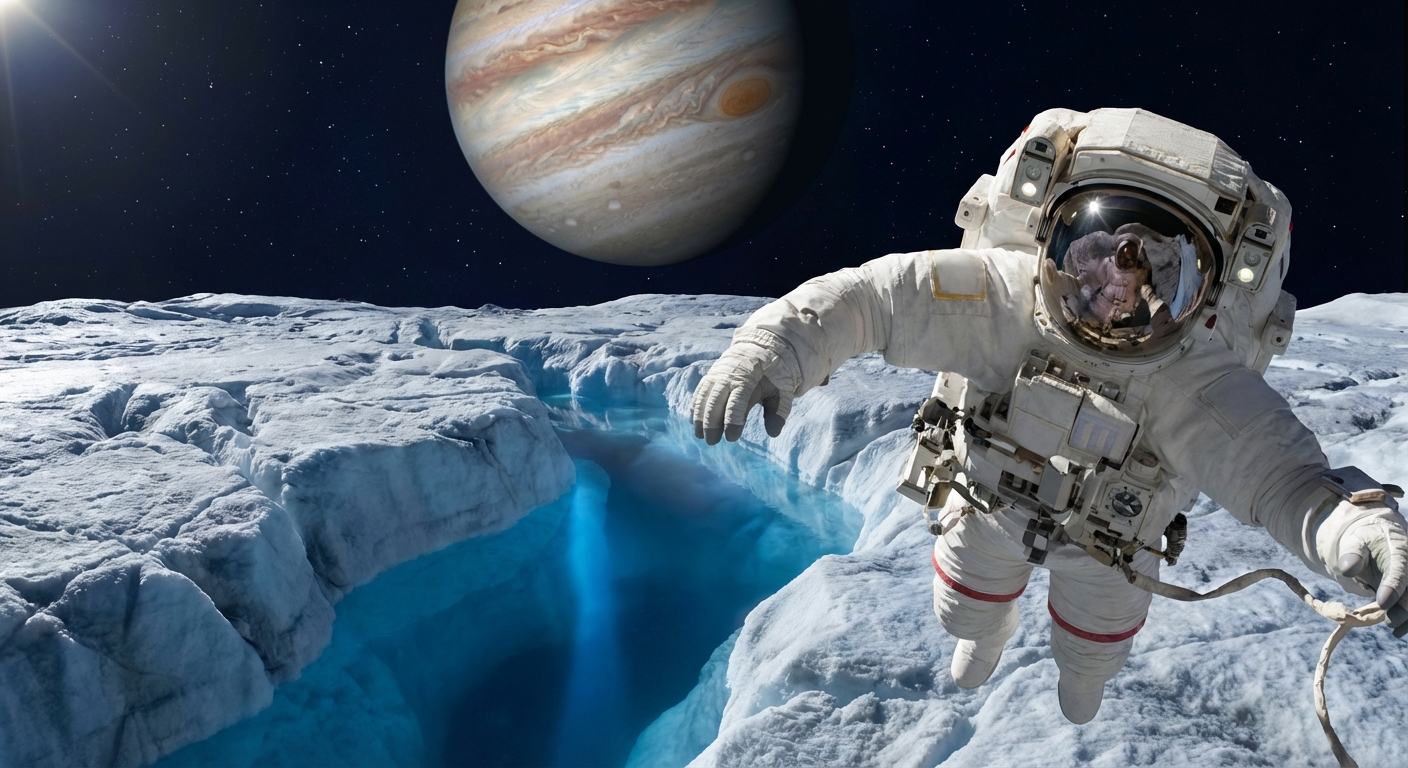
Look at the solar system with the naked eye and it seems mostly barren: rocky planets, gas giants, frozen debris. The only obvious blue marble is Earth. Yet as spacecraft data pile up, a startling pattern has emerged: our planetary neighborhood may be rich in liquid water, it’s just mostly hidden from view.
A Wet Surprise in a Seemingly Dry Neighborhood
Beneath the cracked ice of moons and dwarf planets, entire oceans may slosh in darkness—some with more water than all of Earth’s combined. For astrobiologists and planetary scientists, these ocean worlds have become prime candidates in the search for life.
What Makes an Ocean World?
An ocean world is a planetary body—planet, dwarf planet, or moon—that harbors a significant volume of liquid water. That water can be:
- Exposed on the surface (like Earth, in part), or
- Buried beneath ice shells or thick atmospheres.
In our solar system, most ocean worlds fall into the second category: internally warmed, ice-covered oceans sustained by tidal or radiogenic heating rather than direct sunlight.
Key ingredients:
- Liquid water over geological timescales
- Energy sources to drive chemistry (tidal flexing, radioactive decay, or interaction with magnetospheres)
- Access to rock or reactive materials to fuel complex chemistry
Europa: The Archetype
Jupiter’s moon Europa has become an icon of hidden oceans.
Evidence for an Ocean
Multiple lines of data converge:
- Surface geology: Europa’s surface is crisscrossed with ridges and bands of reddish-brown material suggesting a mobile, deformable substrate underneath.
- Few large craters: The surface is geologically young; something is resurfacing it—possibly upwelling ice or water.
- Magnetic field behavior: Galileo spacecraft measurements showed perturbations in Jupiter’s magnetosphere consistent with a conductive layer (saltwater) beneath the ice.
Current best estimates suggest:
- Ice shell thickness: perhaps 10–30 km
- Ocean depth: 60–100 km
- Total water volume: about 2–3 times that of Earth’s oceans
Why It’s Fascinating
Europa offers liquid water, likely contact between that ocean and a rocky seafloor, and tidal heating from Jupiter’s immense gravity. That trio—water, rock, energy—makes Europa a laboratory for potential seafloor hydrothermal ecosystems.
NASA’s Europa Clipper, launching mid-2020s and arriving in the 2030s, will fly by the moon dozens of times, mapping the ice thickness, probing the ocean with ice-penetrating radar, and sniffing any plumes that may vent ocean material into space.
Enceladus: Geysers into Space
Saturn’s small moon Enceladus was once an afterthought: just another icy chunk. Then Cassini flew by.
The Geysers
At Enceladus’s south pole, Cassini detected towering plumes of water vapor and ice grains erupting through fractures—nicknamed “tiger stripes.” The mission literally flew through these geysers and sampled them directly.
Analysis revealed:
- Water vapor, salts, and organic molecules in the plumes
- Silica nanoparticles consistent with hot water interacting with rock—evidence for hydrothermal vents on the ocean floor
- A global subsurface ocean beneath an ice shell
Astrobiological Gold Mine
Enceladus checks many boxes for potential habitability:
- Liquid water ocean
- Contact with a rocky core
- Chemical gradients and probable hydrothermal activity
What it lacks in size, it makes up in accessibility: its ocean literally sprays space, providing natural samples. Several mission concepts, such as the proposed Enceladus Orbilander, would orbit and then land to study the plumes and surface deposits in unprecedented detail.
Titan: Methane Seas and a Buried Ocean
Saturn’s largest moon Titan is a strange hybrid: a frigid world with a thick nitrogen atmosphere and surface lakes—not of water, but of liquid methane and ethane.
Two Liquids, Two Stories
- Surface seas (Ligeia Mare, Kraken Mare): Hydrocarbon lakes sculpt shorelines, dunes, and river channels reminiscent of terrestrial landscapes, but at -180 °C.
- Subsurface ocean: Gravity data from Cassini and rotational dynamics suggest a water-ammonia ocean beneath the icy crust.
Titan thus hosts two distinct liquid regimes:
- A hydrocarbon hydrological cycle at the surface (evaporation, condensation, rain, rivers, lakes).
- A potential water ocean at depth.
Why Titan Matters
Titan offers a natural experiment in organic chemistry:
- Complex organics form in its hazy atmosphere and rain down to the surface.
- The interaction between organics, water ice, and possibly a subsurface ocean may produce prebiotic chemistry unlike anything on Earth.
NASA’s Dragonfly rotorcraft mission, set to launch in 2028, will hop between Titan’s dunes and plains, sampling surface material and probing for complex organics.
Ganymede, Callisto, and Beyond
Jupiter’s moons Ganymede and Callisto are also strong ocean world candidates.
- Ganymede: The largest moon in the solar system, Ganymede has its own intrinsic magnetic field. Galileo data suggest a deep ocean sandwiched between ice layers. ESA’s JUICE mission (Jupiter Icy Moons Explorer), launched in 2023, will focus heavily on Ganymede, eventually entering orbit around it.
- Callisto: Less geologically active, but magnetic and gravity data also point to a subsurface ocean.
Even distant dwarf planets may join the club:
- Pluto: New Horizons images reveal young, possibly convecting nitrogen-ice plains and evidence for past or present internal oceans.
- Ceres: Dawn mission data suggest briny pockets and past cryovolcanism, hinting at subsurface liquid reservoirs.
How Do These Oceans Stay Liquid?
Far from the Sun, sunlight is too weak to keep water from freezing solid. Ocean worlds rely on internal heat sources:
- Tidal heating: Gravitational flexing from a parent planet (Jupiter, Saturn) kneads moons, generating heat—most dramatic for Europa and Enceladus.
- Radiogenic heating: Decay of radioactive isotopes in rocky interiors provides a long-term heat supply.
- Antifreeze chemistry: Salts or ammonia mixed with water lower its freezing point.
These processes create long-lived, stable liquid environments in places we once wrote off as inert ice balls.
Why Ocean Worlds Electrify Astrobiology
For life as we know it, three ingredients are essential:
Liquid water
Energy sources
Chemical building blocks
Ocean worlds pack all three. Furthermore, subsurface oceans are naturally shielded from radiation and asteroid impacts.
The big questions:
- Do hydrothermal vents on Europa or Enceladus host ecosystems analogous to Earth’s deep-sea vent communities?
- Can prebiotic chemistry on Titan’s surface—or at the water–rock interface deep within—take the next step toward life?
- How long have these oceans persisted, and how stable are their environments?
Future missions aim to move beyond habitability (can it support life?) toward biosignatures (is life actually there?). That requires precise measurements of organic molecules, isotopic ratios, and possibly even cells or cell-like structures, if we’re extraordinarily lucky.
Ocean Worlds as a Cosmic Template
The ocean worlds story reaches beyond our solar system. Exoplanet surveys and models suggest that water-rich planets may be common in the galaxy, in forms even more extreme than Europa or Titan.
Concepts like Hycean planets—hot, water-covered worlds with hydrogen atmospheres—or so-called water worlds with deep global oceans and high-pressure ice mantles arise naturally in formation models.
Our local ocean worlds provide the experimental baseline:
- How water behaves under immense pressures
- How ice phases change with depth (from familiar ice Ih to exotic ice VI and VII)
- How heat and chemistry circulate in deep, stratified oceans
These insights feed directly into interpretations of exoplanet spectra and climate models.
The New Blueprint for Life-Hunting Missions
For decades, Mars dominated the search for life. Ocean worlds have now forced agencies to expand their playbook. The emerging strategy:
- Mars: Look for past or present surface or subsurface life.
- Europa & Enceladus: Test the seafloor hydrothermal ecosystem hypothesis.
- Titan: Probe alternative chemistries and prebiotic processes.
- Ganymede, Callisto, Ceres, Pluto: Map the extent and diversity of subsurface oceans.
The unifying insight is profound: Earth may not be the archetypal ocean world. It’s just the only one whose ocean lies on the surface.
As we send more orbiters, landers, and maybe submarines to these hidden seas, we’re not merely cataloging exotic environments. We’re stress-testing our assumptions about what a planet needs to be alive—and learning that the universe may be far more inventive with its oceans than we ever imagined.