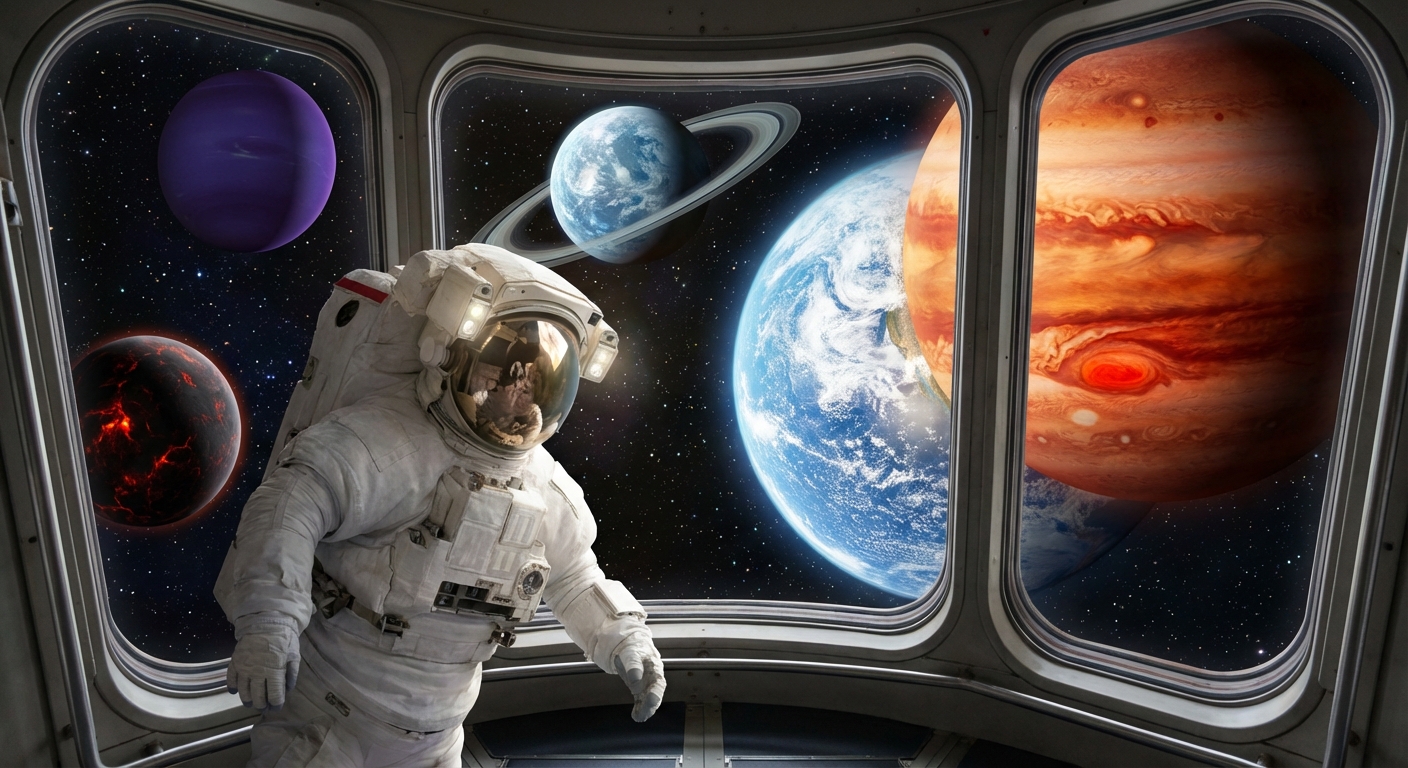
For generations, astronomy textbooks quietly assumed that our solar system offered a fairly typical template for how planetary systems look. A few rocky planets close in, gas giants farther out, an icy debris belt beyond. Then we started actually finding planets around other stars.
Our Solar System Is Weird—And That’s the Point
What we’ve seen since the mid‑1990s has turned that comfortable picture on its head. With over 5,000 confirmed exoplanets and many thousands more candidates, a clear theme has emerged: most planetary systems look nothing like ours.
For space science enthusiasts, this is both disorienting and thrilling. It means our theories of planet formation had blind spots—and that the universe is far more inventive with worlds than we’d dared to imagine.
A Census of the Strange: The Main Exoplanet Types
Exoplanets defy clean categorization, but several broad types keep surfacing.
Hot Jupiters: The First Shock
The first exoplanets found around Sun‑like stars were hot Jupiters—gas giants in orbits tighter than Mercury’s, with "years" lasting just days.
Example: 51 Pegasi b, discovered in 1995.
Key traits:
- Masses similar to or greater than Jupiter
- Orbital periods of a few days
- Temperatures well over 1,000 °C
They shouldn’t exist, according to early models that placed gas giant formation far from the star, beyond the "snow line." Their existence forced theorists to embrace planetary migration—the idea that planets can drift inward or outward after formation due to interactions with the protoplanetary disk or with other planets.
Super-Earths and Mini-Neptunes: The Missing Middle
If you plot exoplanets by radius, a striking fact jumps out: the most common sizes are ones we don’t have.
- Super-Earths: Planets with 1–10 Earth masses; often 1.2–1.7 Earth radii.
- Mini-Neptunes: Slightly larger, with significant hydrogen/helium envelopes; perhaps 1.7–3.5 Earth radii.
Kepler data even hint at a radius valley—a relative scarcity of planets between roughly 1.5 and 2 Earth radii. One interpretation: planets this size tend to evolve either into:
- Stripped, rocky super-Earths (losing their gaseous envelopes through photoevaporation or core-powered mass loss), or
- Puffy mini-Neptunes that retain thick atmospheres.
This bifurcation matters immensely for habitability. A 1.5 Earth-radius planet might be a dense rocky world; a 2.5 Earth-radius world with the same stellar flux could be an inhospitable gas dwarf.
Ultra-Short-Period Planets and Lava Worlds
Some exoplanets orbit so close to their stars that their years last mere hours.
- Orbital periods: < 1 day
- Likely tidally locked, with a permanent day and night side
- Day-side temperatures high enough to melt rock
Worlds like 55 Cancri e and K2‑141 b may host magma oceans, rock vapor atmospheres, and even "mineral rain"—a geophysical regime without parallel in our system.
Warm Neptunes, Cold Jupiters, and Everything In Between
Beyond the dramatic extremes, there’s a continuum:
- Warm Neptunes on moderate orbits, possibly with complex clouds and hazes.
- Cold Jupiters that look more like our own Jupiter and Saturn, often at several AU.
- Eccentric giants on elongated orbits that turn their climates into extreme seasons.
Each class probes different physics: atmospheric escape, cloud microphysics, tidal heating, and more.
How We Know What We Know: Methods That Bias the Picture
Our view of exoplanet diversity is strongly shaped by the methods we use to find and study them.
The Transit Method
When a planet passes in front of its star (from our vantage point), it blocks a fraction of the starlight. Missions like Kepler and TESS have leveraged this method to discover thousands of worlds.
Biases:
- Favors large planets (bigger dip in light)
- Favors close-in planets (more frequent transits)
- More sensitive around smaller stars (M dwarfs)
The Radial Velocity Method
Planets tug on their stars, causing subtle Doppler shifts in stellar spectra as the star wobbles toward and away from us. This technique pioneered exoplanet detection and continues to refine mass measurements.
Biases:
- Favors massive planets
- Favors close-in or massive, distant giants with long baselines of data
Direct Imaging and Microlensing
- Direct imaging has captured young, massive planets far from bright stars—worlds that glow in infrared as they cool.
- Microlensing events, where a foreground star and its planets magnify a background star, can reveal planets at Earth-like distances from Sun-like stars—but as one-time events.
These complementary techniques gradually fill in the census, but the current sample is far from complete. Many Earth-sized, Earth-orbit exoplanets undoubtedly remain invisible to our present instruments.
Decoding Interiors: Mass, Radius, and the Art of Inference
We can’t yet dig into exoplanets, but by combining mass (from radial velocity) and radius (from transits), we infer density—a powerful, if blunt, diagnostic.
- High density (~5–8 g/cm³): Likely rocky, possibly iron-rich super-Earths.
- Moderate density (~1–3 g/cm³): Likely substantial gas envelopes or water-rich worlds.
- Very low density (< 0.5 g/cm³): Ultra-puffy gas giants ("cotton candy" planets) with extended atmospheres.
These inferences are model-dependent. Is a 1.8 Earth-radius planet a rocky world with a thin atmosphere, or a water-rich planet with a steam envelope? The same bulk density can arise from different internal structures.
Future missions and techniques, such as measuring love numbers (tidal response) or using asteroseismology to constrain host star properties more precisely, will sharpen these interior models.
Atmospheres as Fingerprints: JWST and Beyond
The James Webb Space Telescope (JWST) is already transforming our view of exoplanet atmospheres.
By observing transits and eclipses at infrared wavelengths, JWST can:
- Detect molecular absorption features (water vapor, CO₂, methane, CO, potentially ammonia and sulfur compounds).
- Infer clouds, hazes, and thermal structures.
- Constrain metallicity (heavy element abundance) and chemistry.
Early JWST results have:
- Confirmed water and CO₂ in several hot Jupiter and warm Neptune atmospheres.
- Detected methane on some temperate mini-Neptunes and Hycean candidates like K2‑18 b.
- Revealed complex cloud structures and non-equilibrium chemistry.
For rocky, Earth-sized planets, the task is harder. Their signals are faint, and stellar activity (especially for M dwarfs) complicates interpretation. But targets like the TRAPPIST‑1 system remain focal points for pushing instrument sensitivity and analysis techniques.
Planet Formation Models Under Pressure
The classical core accretion model—small dust grains clumping into planetesimals, then planetary cores, then grabbing gas—remains a backbone of theory. But exoplanet demographics have forced several major upgrades:
- Disk migration: Planets interacting with protoplanetary disks can migrate inward or outward, producing hot Jupiters and resonant chains.
- Pebble accretion: Centimeter-scale "pebbles" may accelerate core growth, altering where and how fast giant planets form.
- Photoevaporation and core-powered mass loss: Close-in planets lose atmospheres over time, sculpting the observed radius distribution.
Statistical studies now compare large exoplanet populations to synthetic systems from formation models, using Bayesian frameworks and machine learning to tune parameters like disk mass distributions and migration efficiencies.
The TRAPPIST‑1 Laboratory
The TRAPPIST‑1 system, 40 light-years away, illustrates how exoplanets stress-test our ideas.
- Seven Earth-sized planets
- Compact architecture: all within 0.06 AU
- Multiple planets in or near the habitable zone
- Resonant chain of orbital periods
TRAPPIST‑1 likely formed farther out and migrated inward as a pack, locked into resonances. Its worlds endure intense stellar activity from their ultracool dwarf star, complicating atmospheric retention and surface habitability—but making them prime JWST targets.
Whether any are truly habitable remains uncertain, but their very existence demonstrates that compact, multi-planet systems around small stars are common—a stark contrast to our Sun’s architecture.
Are We Typical or an Outlier?
One of the most profound questions in exoplanet science is deceptively simple: Is our solar system normal?
Clues that we may be somewhat unusual:
- No hot Jupiters
- No super-Earths or mini-Neptunes
- Gas giants relatively far out, on near-circular orbits
Some models suggest that the presence and migration history of Jupiter may have sculpted our inner system, possibly limiting the mass budget available for super-Earth formation and clearing out primordial populations of inner planets.
If that’s true, systems like ours might be less common—but perhaps particularly favorable for stable, long-term habitable zones.
Current surveys are still biased toward close-in planets, so we lack a robust statistical sample of full solar system analogs. Missions like PLATO (ESA) and improved radial velocity facilities aim to fill that gap in the 2030s.
The Coming Era: From Catalogs to Character Stories
The first 30 years of exoplanet science were about detection and statistics: how many, how big, how close. The next 30 will be about characterization and context.
Key frontiers:
- Direct imaging of Earth-sized planets around nearby Sun-like stars with future missions (e.g., Habitable Worlds Observatory concepts).
- High-resolution spectroscopy to map wind patterns and 3D structures in exoplanet atmospheres.
- Long-baseline monitoring to detect seasonal changes on temperate worlds.
As we refine classifications—not just "super-Earth" or "mini-Neptune," but detailed taxonomies based on composition, climate regimes, and formation histories—we’ll be able to ask more nuanced questions:
- How does stellar type shape planetary diversity?
- Which architectures are most conducive to long-term climate stability?
- How rare are truly Earth-like planets, not just in size and insolation, but in atmospheric chemistry and geologic vigor?
Embracing the Alien
The wild diversity of exoplanets is not an obstacle to understanding—it’s the key. By confronting worlds that our initial theories couldn’t predict, we’re forced to generalize our models, broaden our sense of what’s possible, and, perhaps, recognize that Earth is one expression of planetary potential among many.
In that sense, the strangest exoplanets—the hot Jupiters hugging their stars, the lava worlds, the ultra-puffy giants—are not mere curiosities. They are signposts, reminding us that "planet" is not a synonym for "Earth-like." It is a vast category, encompassing a menagerie of environments, chemistries, and histories that we are only beginning to map.
As our instruments sharpen and our catalogs grow, it may turn out that the biggest surprise isn’t how alien most planets are, but how often, in all that strangeness, something a little bit like home appears.