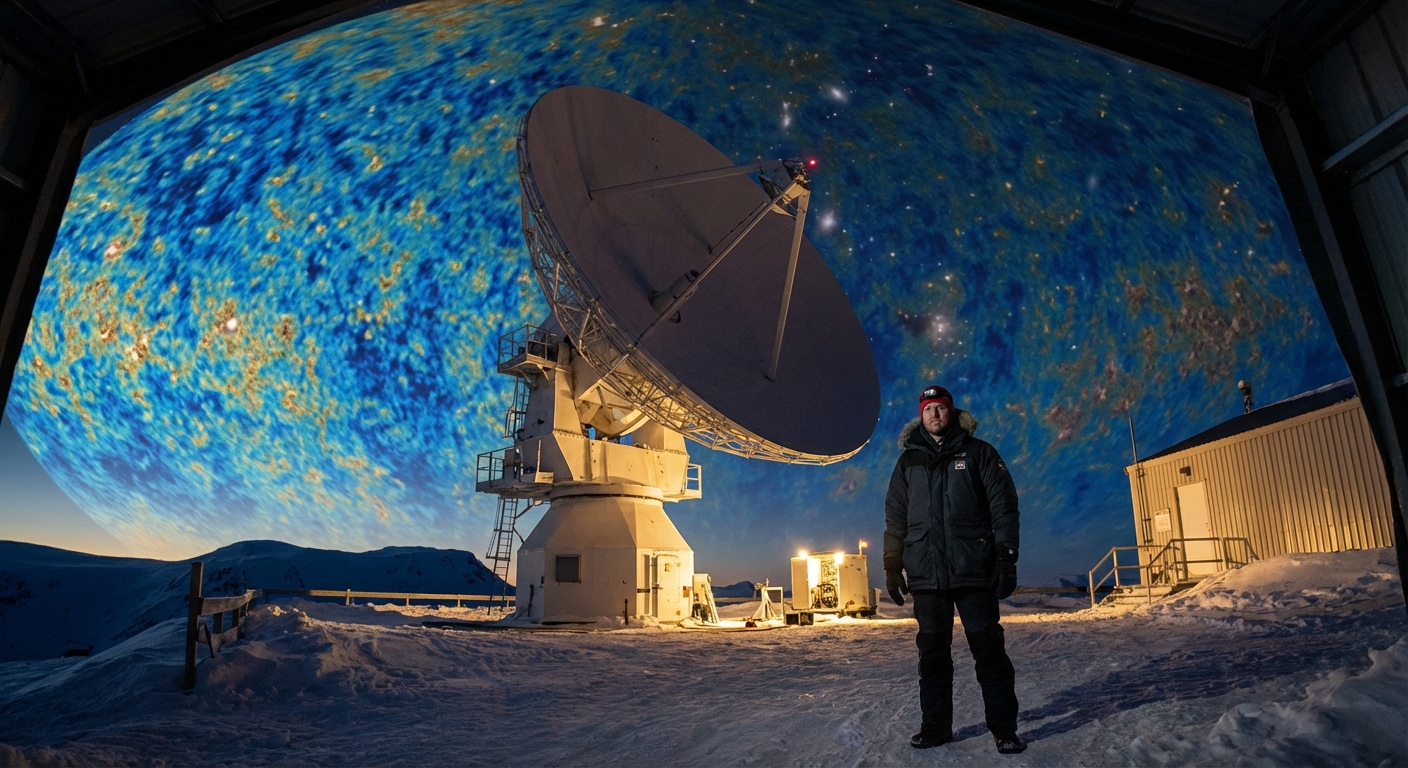
If you could tune your eyes to microwaves, the night sky would blaze with a nearly uniform glow: the cosmic microwave background (CMB). It is the oldest light we can observe directly, a fossil from when the universe was just 380,000 years old.
The Faint Glow That Changed Cosmology
Discovered accidentally in 1965 by Arno Penzias and Robert Wilson, the CMB transformed cosmology from speculation to precision science. Each tiny wrinkle in its temperature and polarization encodes information about the universe’s contents, geometry, and history.
Think of the CMB as a dense, information-rich map. This field guide explains how to read it.
Where the CMB Comes From
Recombination: From Plasma to Transparent Cosmos
For its first few hundred thousand years, the universe was a hot plasma: free electrons, protons, and photons interacting constantly. Photons could not travel far without scattering.
As the universe expanded and cooled to about 3000 K, protons and electrons combined to form neutral hydrogen in an event we call recombination (strictly, "combination"—this is the first time they united). With fewer free electrons, photons stopped scattering so frequently and began to stream freely through space.
Those photons have been traveling ever since, their wavelengths stretched by cosmic expansion from visible light into microwaves. Today we observe them as a near-perfect blackbody spectrum at a temperature of 2.725 K.
The surface from which these last-scattered photons arrive is called the surface of last scattering. It is not a physical shell but a spherical time-slice in the early universe.
The CMB Spectrum: A Smoking Gun for the Big Bang
The COBE satellite, launched in 1989, measured the CMB spectrum with extraordinary precision. The result: a blackbody curve that matches theory so well that deviations are limited to parts in 10⁵.
This is difficult to reconcile with any model other than a hot, dense early universe that once was in thermal equilibrium. Alternative ideas, like steady-state cosmologies, cannot naturally produce such a spectrum.
The CMB’s very shape is a foundational piece of evidence for the Big Bang.
Temperature Anisotropies: Tiny Wrinkles, Big Payoffs
At first glance, the CMB is uniform. But if you subtract the overall average, you see fluctuations in temperature at the level of tens of microkelvin.
These anisotropies arise from a mix of effects:
- Small primordial density fluctuations
- Variations in gravitational potential wells and hills
- Doppler shifts from moving matter
Power Spectrum: A Fingerprint of the Early Universe
We can summarize the pattern of anisotropies by decomposing the sky into spherical harmonics and plotting the power spectrum—the variance as a function of angular scale.
This spectrum features a series of acoustic peaks, produced by sound waves oscillating in the photon–baryon plasma before recombination.
The positions and heights of these peaks encode:
- Total density and curvature: The first peak’s position constrains spatial geometry; Planck data show the universe is very close to flat.
- Baryon density: The relative heights of odd and even peaks reveal how many ordinary particles there were.
- Dark matter density: Affects overall peak structure and damping tail.
- Expansion history: Influences the angular diameter distance to recombination.
From this single map of the sky, cosmologists have extracted parameters like the age of the universe (~13.8 billion years), the matter content, and the precise shape of the initial fluctuation spectrum.
Polarization: A New Dimension of Information
CMB photons were last scattered by electrons, and such scattering polarizes light. The CMB thus carries a faint polarization pattern across the sky.
We can decompose this polarization into two components:
- E-modes: Gradient-like patterns; produced by scalar (density) perturbations.
- B-modes: Curl-like patterns; can be produced by tensor (gravitational wave) perturbations or by lensing of E-modes.
Why Cosmologists Chase B-Modes
If inflation produced a background of primordial gravitational waves, they would imprint a characteristic B-mode pattern on large angular scales.
Detecting this signal would:
- Provide direct evidence for inflationary dynamics.
- Pin down the energy scale of inflation.
Several experiments—BICEP/Keck, POLARBEAR, SPTpol, ACTPol and more—are pushing toward this goal. In 2014, an apparent detection by BICEP2 turned out to be contaminated by Galactic dust, underscoring the difficulty of the measurement.
The search continues with ever greater sensitivity and sky coverage.
Secondary Anisotropies: The CMB Meets Large-Scale Structure
The CMB we see is not pristine. On its way to us, CMB light interacts with evolving large-scale structures, producing secondary anisotropies that carry further information.
Key effects include:
- Integrated Sachs–Wolfe (ISW) Effect: As dark energy accelerates expansion, gravitational potentials evolve, slightly altering photon energies.
- Sunyaev–Zel’dovich (SZ) Effect: CMB photons gain energy by scattering off hot electrons in galaxy clusters, distorting the spectrum along those sightlines.
- Weak Lensing of the CMB: Mass inhomogeneities deflect CMB photons, slightly remapping the anisotropy pattern.
By analyzing these effects, cosmologists can measure:
- The growth rate of structure (testing gravity and dark energy).
- Cluster abundance (constraining matter density and σ₈).
- The distribution of mass via CMB lensing maps.
Recent Discoveries and High-Precision Results
The Planck satellite, launched by ESA, has provided the highest-fidelity full-sky maps of the CMB temperature and polarization to date.
Key outcomes:
- Confirmation of ΛCDM with remarkable precision.
- Tight limits on spatial curvature and neutrino properties.
- Measurements of the optical depth to reionization, refining our view of when the first stars lit up.
Ground-based experiments (ACT, SPT, POLARBEAR, Simons Array) have pushed to smaller angular scales and deeper polarization sensitivity, complementing Planck and improving constraints on parameters and secondary anisotropies.
Pulsar timing arrays have also recently reported evidence for a nanohertz gravitational wave background, likely from supermassive black hole binaries. Combined with CMB observations, these multi-frequency gravitational wave windows are starting to trace gravitational radiation across cosmic history.
How the CMB Connects to Other Cosmic Probes
The CMB doesn’t stand alone; it anchors a network of observations:
- Big Bang Nucleosynthesis (BBN): Light element abundances inferred from ancient gas match baryon densities measured by the CMB.
- Baryon Acoustic Oscillations (BAO): The same sound waves imprinted in the CMB left a spatial scale in galaxy clustering, providing a standard ruler to track expansion.
- Type Ia Supernovae: Independent distance measures complement CMB-derived cosmological models.
Discrepancies between these probes—like the Hubble constant tension—are treated as potential hints of new physics.
A Practical Checklist for Reading a CMB Paper
For enthusiasts diving into the literature, here’s a quick guide to what to look for:
- Dataset: Which experiment(s)? Planck, ACT, SPT, POLARBEAR, etc.
- Observables: Temperature, E-mode polarization, B-mode polarization, lensing.
Angular Scales: Are they focusing on large scales (ℓ ≲ 30), acoustic peak regime, or damping tail?
4. Parameters: Which cosmological parameters are being constrained? (Ωₘ, Ω_Λ, H₀, nₛ, τ, Σmν, etc.) 5. Model Space: Standard ΛCDM only, or extensions (e.g., wCDM, early dark energy, extra neutrino species)?
Tensions/Anomalies: Are they addressing known tensions or reporting new anomalies?
Being systematic in this way helps distinguish incremental refinements from genuinely paradigm-challenging results.
Why This Relic Light Inspires Awe
There is something deeply arresting about the CMB. Every CMB photon you detect began its journey when the universe was still opaque, before a single star or galaxy existed. It has wandered for almost 14 billion years, deflected, redshifted, but not destroyed.
All of cosmology’s precision—our confidence in the universe’s age, composition, and geometry—rests heavily on reading this ancient light correctly.
The CMB is both a boundary and an invitation: a boundary, because beyond recombination the universe becomes opaque to light; an invitation, because it compels us to develop new probes—like neutrinos and gravitational waves—to peer even further back.
As we refine our maps and methods, we are not merely polishing numbers. We are listening ever more closely to the earliest whisper the universe left for us in the sky.