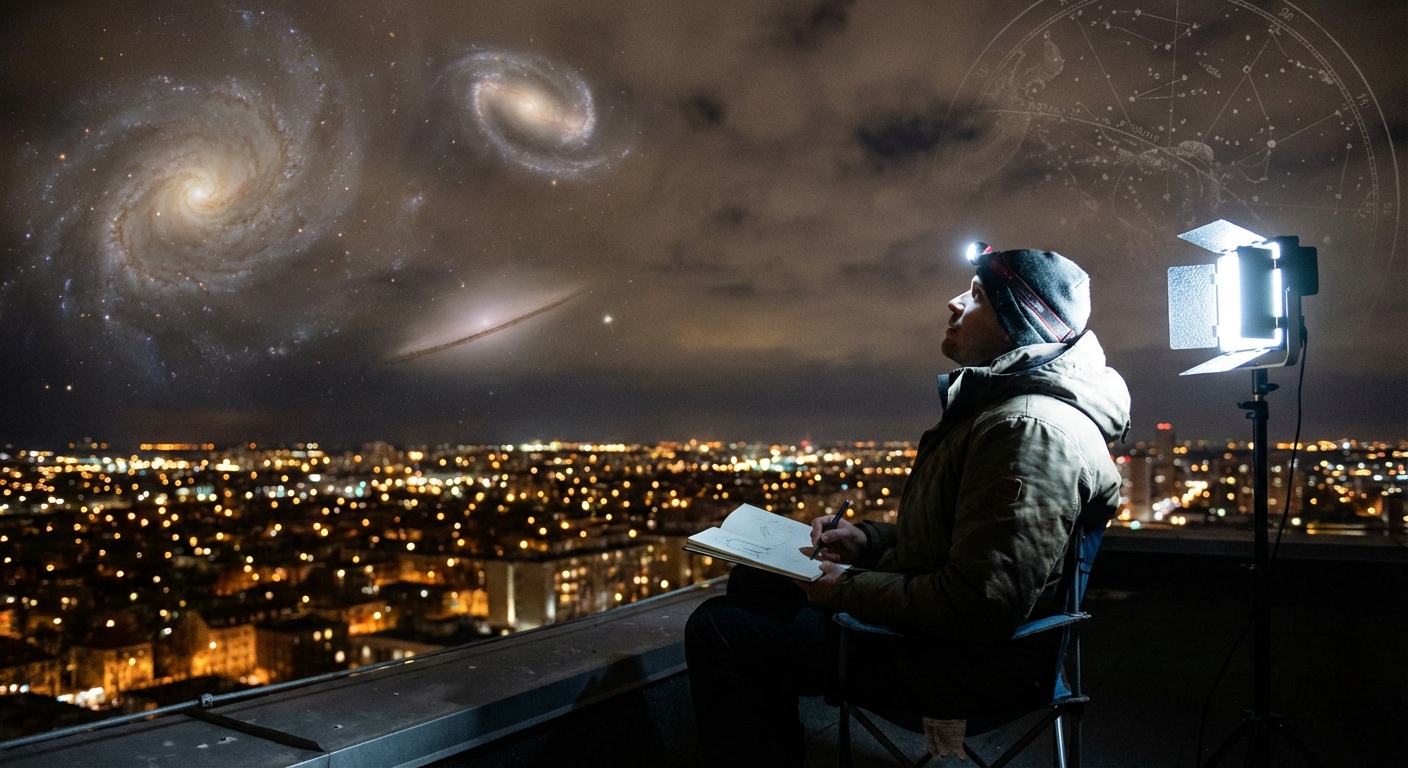
Cosmology is often presented as a catalog of facts: the universe is 13.8 billion years old; dark energy is ~68% of the energy budget; space is nearly flat. But behind these numbers lies a distinct way of reasoning about reality.
Cosmology as a Way of Thinking
To "think like a cosmologist" is to combine physics, statistics, and humility into a disciplined curiosity about the largest scales. You don’t need a PhD to adopt this mindset—only a willingness to juggle evidence, theory, and uncertainty.
This guide walks through a practical framework you can use to approach cosmological questions the way professionals do.
Step 1: Start with Symmetry, Not Detail
Cosmologists begin with sweeping assumptions, then refine.
The Cosmological Principle
The foundational assumption is that on large scales the universe is homogeneous and isotropic:
- Homogeneous: No special places.
- Isotropic: No special directions.
This is not a philosophical preference; it’s an empirical claim, supported by the near-uniformity of the cosmic microwave background (CMB) and the large-scale distribution of galaxies.
When tackling a new question, cosmologists ask: What symmetries can we justifiably assume? These simplify the equations of general relativity to the Friedmann–Lemaître–Robertson–Walker (FLRW) metric and lead directly to the concept of an expanding universe.
Adopt this habit: Before diving into complexity, ask which symmetries or approximations are reasonable. Let them guide your first-order understanding.
Step 2: Translate Stories into Parameters
In everyday language, we talk about "how fast the universe is expanding" or "how much dark matter there is." Cosmologists turn these into parameters in a model.
Key examples in the standard ΛCDM model:
- H₀: Hubble constant (expansion rate today)
- Ωₘ: Matter density fraction
- Ω_Λ: Dark energy density fraction
- nₛ: Spectral index of primordial fluctuations
- σ₈: Amplitude of matter clustering on 8 Mpc scales
Each parameter corresponds to a physical story. For instance:
- Changing Ωₘ alters how quickly structures form.
- Changing Ω_Λ changes the late-time expansion history.
Adopt this habit: When you encounter a cosmological claim, identify which parameters it’s really about. This turns vague debates into quantitative questions.
Step 3: Trust Observables, Question Inference
Cosmologists are relentlessly careful about distinguishing observables from derived quantities.
- Observable: Measured directly (e.g., redshifts, fluxes, angles, time delays).
- Derived: Inferred using a model (e.g., distances, ages, masses).
For example, Type Ia supernova surveys measure brightness and redshift. Distances and cosmological parameters come only after adopting a cosmological model.
The same is true for the CMB: we observe a sky map of temperature and polarization; cosmological parameters come from fitting model spectra to those maps.
Adopt this habit: When you read a result, ask:
What are the raw observables?
What model assumptions bridge those observables to the claimed conclusion?
This mindset is crucial when evaluating tensions like the Hubble constant discrepancy.
Step 4: Use Multiple, Independent Probes
Cosmology rarely relies on a single line of evidence. Instead, it exploits orthogonal probes:
- CMB anisotropies (early universe snapshot)
- Baryon acoustic oscillations (BAO) (standard ruler in galaxy clustering)
- Type Ia supernovae (standard candles tracking expansion)
- Weak gravitational lensing (mass distribution and growth of structure)
- Galaxy cluster counts (sensitive to matter density and σ₈)
Each probe has different systematics and parameter sensitivities. When they converge on the same parameter values, confidence soars; when they don’t, it flags possible new physics or unaccounted-for errors.
Adopt this habit: Be suspicious of conclusions resting on a single method. Look for cross-checks.
Step 5: Embrace Bayesian Thinking
Modern cosmology is steeped in Bayesian inference. Parameters are not "measured" in isolation; they are constrained given data and prior knowledge.
In practice, cosmologists:
- Specify a model (e.g., ΛCDM, or an extension with extra parameters).
- Choose priors: plausible ranges for each parameter.
- Compute the likelihood of the data under different parameter combinations.
- Use Markov Chain Monte Carlo (MCMC) or related methods to sample the posterior probability distribution.
The output is not a single best-fit number, but a probability distribution—often summarized as mean values with credible intervals.
Adopt this habit: When you see a cosmological "measurement," imagine a probability distribution, not a single truth. Ask what priors and model assumptions went into it.
Step 6: Separate Precision from Accuracy
Cosmology has entered a precision era. Planck, DES, and other surveys can measure parameters to a few percent or better. But high precision does not automatically mean high accuracy if the underlying model is incomplete.
Example:
- Planck’s CMB data yield a very precise value of H₀ within ΛCDM.
- Local distance ladder methods yield a discrepant value with similar precision.
This tension could signal:
- Underestimated systematics in one or more methods.
- The need to extend the model (e.g., early dark energy, new neutrino physics).
Adopt this habit: Treat increasingly precise numbers as sharper tests of your model, not as guarantees the model is correct.
Step 7: Keep History in View
Cosmology’s current confidence rests on a century of course corrections.
A quick historical arc:
- 1920s: Hubble discovers cosmic expansion.
- 1940s–1950s: Big Bang vs. steady-state debates.
- 1965: Discovery of the CMB tilts the balance toward a hot Big Bang.
- 1980s: Inflation proposed; cold dark matter models developed.
- 1990s: COBE, then WMAP, bring CMB into focus; supernovae reveal accelerated expansion.
- 2000s–2010s: Concordance cosmology (ΛCDM) emerges; Planck tightens the screws.
Nearly every major step came from surprises: an unexpected background, a mismatch in counts, a strange pattern in the sky.
Adopt this habit: View current models as the latest, best-fitting chapter—not the final word. Expect revisions when new data arrive.
Step 8: Use Thought Experiments, But Anchor in Data
Cosmologists often explore wild scenarios—cyclic universes, multiverses, varying constants. These are useful theoretical laboratories.
The discipline comes from insisting that credible cosmological ideas:
- Reproduce all existing data at least as well as ΛCDM.
- Make testable predictions distinguishable from ΛCDM.
Speculation is tolerated, even encouraged, but only insofar as it eventually faces observation.
Adopt this habit: Enjoy speculative cosmology, but always ask: What would we observe differently if this were true?
Step 9: Learn the Language of Scales
Cosmology spans extreme ranges:
- Length: From subatomic to gigaparsecs.
- Time: From 10⁻⁴³ seconds (Planck time) to 10¹⁷ seconds (age of the universe).
- Energy: From relic neutrino backgrounds to inflationary energy scales possibly near the grand unification scale.
Thinking like a cosmologist means being comfortable jumping between:
- Comoving vs. proper distances
- Lookback time vs. redshift
- Linear vs. nonlinear scales in structure growth
This scaling mindset helps intuit which processes dominate where: radiation early on, matter at intermediate times, dark energy late.
Adopt this habit: When you encounter a new cosmic phenomenon, immediately ask: On what length, time, and energy scales does it live?
Step 10: Preserve a Sense of Awe
For all its equations and likelihood curves, cosmology is fundamentally an exercise in wonder. We infer the physics of the first second from a microwave fog. We reconstruct the growth of a cosmic web we can never see in full. We map the composition of the universe when most of its contents are invisible.
Cultivating a cosmologist’s mindset doesn’t mean losing that awe; it means channeling it into clear, testable questions.
Thinking like a cosmologist is less about memorizing parameters and more about developing habits:
- Begin with symmetry.
- Quantify stories as parameters.
- Separate observables from inferences.
- Prefer multiple, independent probes.
- Embrace Bayesian uncertainty.
- Distinguish precision from accuracy.
- Respect history’s reversals.
- Tie speculation to observation.
- Speak the language of scales.
Do that, and you’re not just reading about the universe—you’re participating in how we come to understand it.