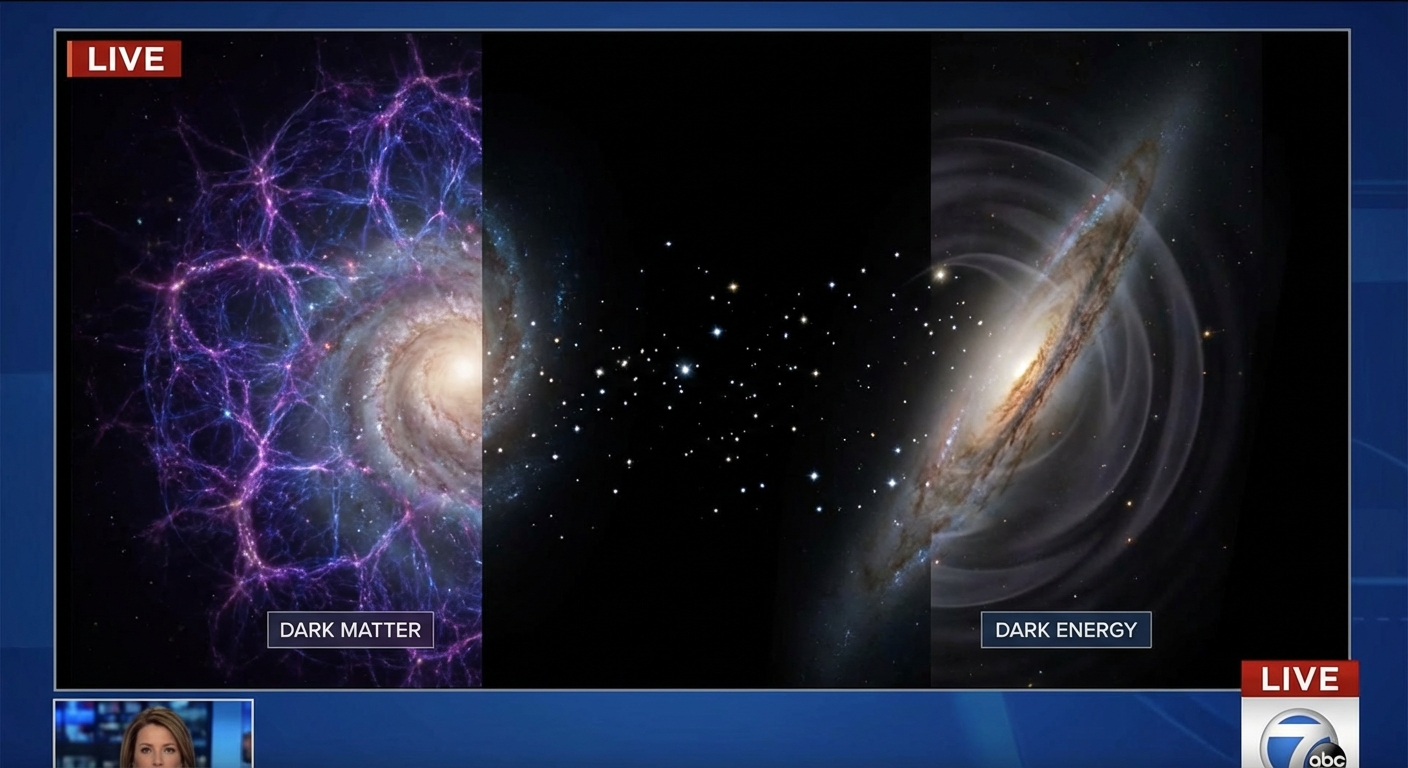
Look up at the night sky and you’re seeing a rounding error. Stars, gas, dust, planets—everything luminous—constitutes less than 5% of the universe’s energy budget. The rest is invisible yet overwhelmingly influential: dark matter and dark energy.
Two Shadows, One Universe
They are often mentioned together, yet they are fundamentally different. One clumps; the other stretches. One acts like an invisible scaffolding; the other like a hidden engine driving space itself apart.
Understanding their contrast is central to modern cosmology, and recent observations have made the distinction sharper—and more intriguing—than ever.
What Is Dark Matter?
The Case from Galactic Scales
Dark matter first emerged as an accounting problem. In the 1970s, Vera Rubin and colleagues measured the rotation curves of spiral galaxies. Instead of falling off with radius—as expected if most mass were in the visible disk—the rotation speeds stayed flat.
This implied that galaxies are embedded in massive, extended dark halos. Similar discrepancies showed up in:
- Galaxy clusters (via galaxy velocities and X-ray emitting gas)
- Gravitational lensing (more bending of light than visible mass can explain)
- Cosmic structure formation (simulations need extra mass to grow realistic galaxies)
Today, dark matter is modeled as a cold, collisionless component: cold dark matter (CDM).
What Dark Matter Is Not
Dark matter is not simply:
- Faint stars or planets (surveys have ruled out most such candidates)
- Known neutrinos (they are too light and too fast—"hot"—to form observed structures)
It appears to be non-baryonic, made of particles beyond the Standard Model.
Leading Candidates
WIMPs (Weakly Interacting Massive Particles)
Once the dominant paradigm, WIMPs would have been thermally produced in the early universe. Decades of sensitive detectors deep underground (like Xenon, LUX-ZEPLIN, PandaX) have yet to find convincing signals, pushing models into more exotic parameter space.
Axions and Axion-like Particles
Originally proposed to solve the strong-CP problem in QCD, axions are ultra-light, weakly interacting particles. They could form a condensate behaving like cold dark matter. Experiments like ADMX and new cavity and haloscope designs target their detection.
Sterile Neutrinos, Dark Photons, and More
A zoo of models now exist—many tested indirectly by their effects on structure formation and cosmic microwave background (CMB) anisotropies.
How We Map Dark Matter
Even if we can’t see dark matter directly, we can infer its distribution. Key methods include:
- Weak gravitational lensing: Tiny distortions in galaxy shapes reveal the intervening mass. Surveys like the Dark Energy Survey (DES) and the Hyper Suprime-Cam have produced large-scale dark matter maps.
- Strong lensing: Multiple images and arcs around massive galaxies and clusters provide detailed local mass maps.
- Galaxy redshift surveys: The clustering pattern of galaxies traces the underlying dark matter field.
The emerging picture: a cosmic web where dark matter forms filaments, nodes, and voids, with luminous galaxies nestled in the densest knots.
What Is Dark Energy?
If dark matter explains how structures grow, dark energy explains how space expands.
The 1998 Shock
In the late 1990s, two independent teams tracking distant Type Ia supernovae—standardizable candles—made a startling discovery: the universe’s expansion is accelerating.
Under gravity alone, expansion should decelerate. To accelerate, something must act like a repulsive component of energy. This is dark energy.
The Simplest Model: A Cosmological Constant
Einstein once introduced a term, the cosmological constant (Λ), into his equations to achieve a static universe. After Hubble discovered expansion, Einstein discarded Λ as his "biggest blunder."
Cosmology brought Λ back. In the standard ΛCDM model, dark energy is just a constant energy density per unit volume of space. As the universe expands, matter thins out, but Λ remains fixed, eventually dominating.
In this picture:
- Dark energy doesn’t clump or form structures.
- It exerts negative pressure, causing accelerated expansion.
- Its equation of state parameter is w = -1 exactly.
Or Something More Exotic?
Observations are now precise enough to test whether dark energy is truly constant or something dynamic:
- Quintessence: A slowly rolling scalar field, like a cousin of the inflaton.
- Modified Gravity: Perhaps general relativity itself changes on cosmic scales.
- Early Dark Energy: A component that was briefly important before recombination, potentially easing the Hubble tension.
Projects like DESI, Euclid, the Nancy Grace Roman Space Telescope, and the Vera C. Rubin Observatory aim to map the expansion history and growth of structure with enough precision to discriminate between these possibilities.
Dark Matter vs. Dark Energy: Key Differences
| Feature | Dark Matter | Dark Energy |
|---|---|---|
| Behavior | Clumps under gravity | Smooth, uniform (on large scales) |
| Effect | Enhances gravity, builds structure | Drives accelerated expansion |
| Scale | Dominant on galaxy & cluster scales | Dominant on cosmic expansion scales |
| Fraction of cosmic budget | ~27% | ~68% |
| Evidence | Galaxy rotation curves, lensing, CMB, large-scale structure | Supernovae, CMB, BAO, growth of structure |
| Nature | Likely particles beyond the Standard Model | Possibly vacuum energy or new field/gravity |
They are not two sides of one coin; they occupy separate roles in the cosmic drama. Yet they interact gravitationally and jointly determine the universe’s fate.
Recent Puzzles: Cracks in ΛCDM or Statistical Flukes?
The standard ΛCDM model fits a remarkable range of data, but tension points have emerged.
The Hubble Tension
- CMB inference (Planck) suggests H₀ ≈ 67–68 km/s/Mpc.
- Local measurements (SH0ES, strong lensing, masers) favor H₀ ≈ 73–74 km/s/Mpc.
This persistent discrepancy may hint at new dark energy physics, early dark energy components, or other beyond-ΛCDM ingredients.
Growth of Structure Tension
Some surveys find slightly slower growth of structure than ΛCDM predicts. This could reflect:
- Subtle systematics in weak lensing and galaxy clustering measurements.
- New physics affecting dark matter interactions or dark energy properties.
Cosmology is now entering a precision era where such discrepancies are treated as potential clues rather than mere nuisances.
How Upcoming Experiments Will Clarify the Picture
A global network of observatories is targeting dark components from multiple angles:
- Particle Detectors: Underground and collider experiments probing WIMPs, axions, and other dark matter candidates.
- CMB Stage-4: Next-generation microwave background experiments to refine dark matter and dark energy constraints.
- Lensing and Redshift Surveys: Euclid, Rubin (LSST), DESI, and Roman will map billions of galaxies, providing exquisite measurements of expansion and structure growth.
- Gravitational Waves: Future detectors like LISA may detect dark matter imprints in binary systems or signatures from early-universe phase transitions.
The synergy between these diverse probes is critical. Dark matter and dark energy leave intertwined signatures; peeling them apart demands cross-checks from very different physical regimes.
Why These Invisible Components Matter
Strip away dark matter, and galaxies barely form. Remove dark energy, and the universe decelerates, perhaps recollapsing in a "Big Crunch" depending on the total density. Change either by even modest amounts, and the timeline for star formation, chemistry, and potentially life itself shifts dramatically.
We are, in a literal sense, products of two unseen actors:
- Dark matter gave us structure to live in.
- Dark energy gave us time to evolve.
Their nature remains one of the deepest open questions in science—sitting at the nexus of astrophysics, particle physics, and gravity.
Living with the Unknowns
It’s tempting to treat "dark" as a synonym for "mysterious" and stop there. Cosmology demands more. We have detailed, quantitative models of how dark matter and dark energy behave. We’ve mapped their effects across billions of light-years and billions of years of cosmic history.
What we lack is the microphysical story—the "what are they really?" answer.
If the last few decades are any guide, that answer will likely reshape fundamental physics. It might introduce new particles, new fields, or new principles of spacetime. For now, we stand in an odd position: the universe’s dominant ingredients are invisible, yet their fingerprints are everywhere.
Dark matter and dark energy are not placeholders for ignorance; they are well-characterized unknowns. And in cosmology, that’s often where the breakthroughs begin.