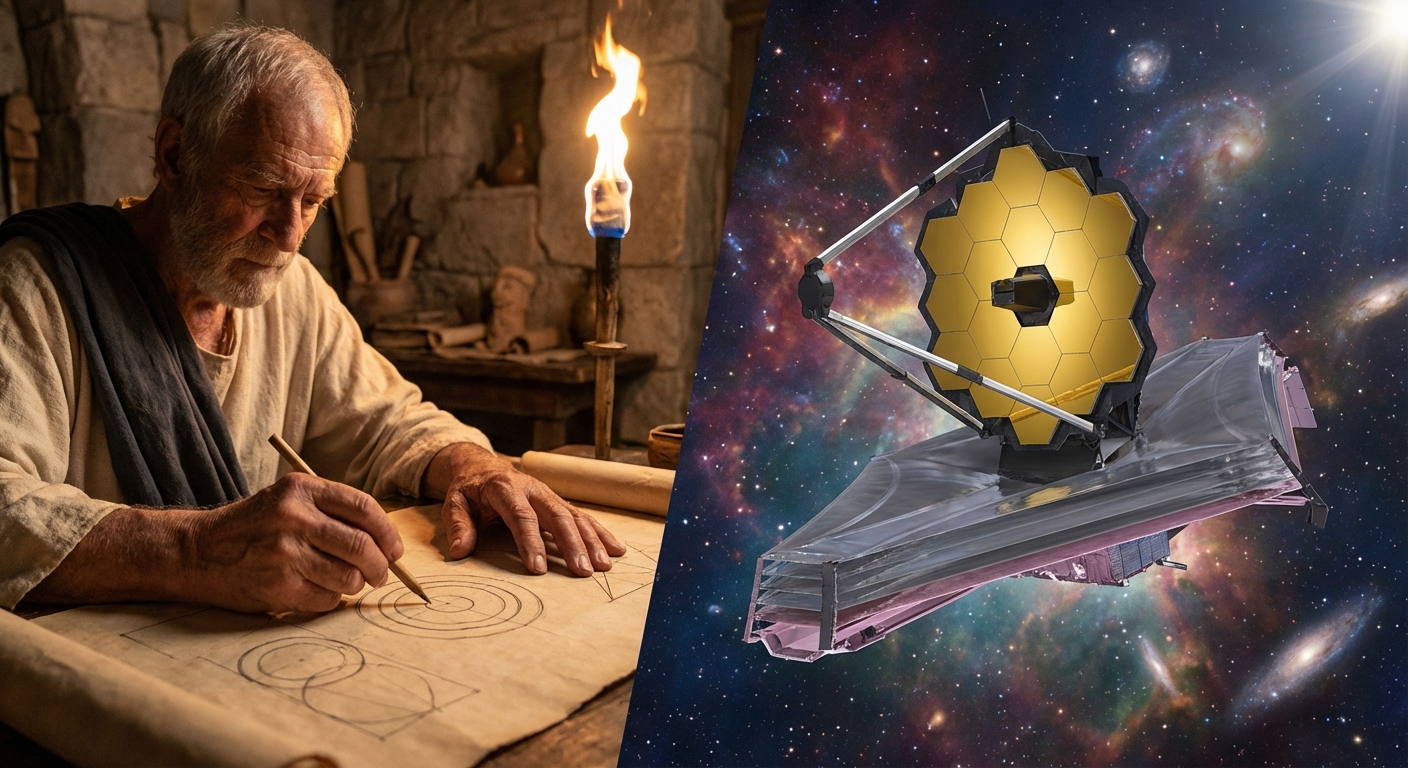
Our picture of the cosmos has changed more in the last 100 years than in the previous 2,000. Yet each era’s cosmology—from Aristotle’s nested spheres to today’s ΛCDM model—has been a serious attempt to answer the same questions:
Many Universes of the Human Mind
- What is the universe made of?
- How big is it, and does it change with time?
- What role do we play within it?
Comparing these cosmologies side by side reveals not only scientific progress, but also shifts in philosophy, technology, and method. It also highlights something humbling: our current model may be as provisional, in retrospect, as crystalline spheres once were.
Classical Antiquity: The Geocentric, Finite Cosmos
Aristotle’s Universe
In the 4th century BCE, Aristotle proposed a finite, spherical universe:
- Earth at the center.
- Nested crystalline spheres carrying the Moon, planets, Sun, and fixed stars.
- A clear distinction between sublunar (changeable, imperfect) and celestial (eternal, perfect circular motion) realms.
Matter was made of four elements; the heavens of a fifth, aether. There was no concept of cosmic evolution; the universe was effectively timeless.
This cosmology was not just a physical model; it resonated with prevailing metaphysics and theology. It placed humans near the center—literally and existentially.
The Copernican and Newtonian Revolutions: An Infinite, Static Stage
Copernicus and Heliocentrism
In 1543, Nicolaus Copernicus proposed a heliocentric system:
- Sun near the center.
- Earth as one of several planets in circular orbits.
Initially, heliocentrism was a geometric reorganization, not yet a new physics. But it displaced Earth from the cosmic center and opened the door to further revision.
Kepler, Galileo, and Newton
Kepler replaced circles with ellipses; Galileo’s telescopic observations exposed imperfections in the heavens: sunspots, lunar craters, the phases of Venus, Jupiter’s moons.
Isaac Newton’s universal gravitation then unified terrestrial and celestial mechanics:
- Same laws apply on Earth and in the sky.
- Gravity acts at a distance, potentially across infinite space.
The resulting cosmological image:
- Stars as distant suns.
- Space possibly infinite and static, populated by stars and nebulae.
- Time effectively eternal in both directions.
Cosmology was more philosophical than quantitative, but the stage was set for thinking of the universe as a boundless, uniform arena governed by universal laws.
Early 20th Century: General Relativity and Expanding Space
Einstein’s Static Universe
In 1917, Albert Einstein applied his new general theory of relativity to the cosmos. His first solution was a static, finite universe with positive curvature—a 3D hypersphere.
To prevent gravitational collapse, he introduced the cosmological constant (Λ), providing a repulsive effect. This elegant model fit the philosophical preference for an unchanging universe.
Hubble and the Discovery of Expansion
Edwin Hubble’s observations in the 1920s revealed two key facts:
- Many "nebulae" are actually galaxies outside the Milky Way.
- Their light is redshifted, with redshift roughly proportional to distance.
This suggested that space itself is expanding. Einstein reportedly called his static model and the introduction of Λ his biggest blunder, though Λ would later be resurrected as dark energy.
Competing Cosmologies: Big Bang vs. Steady State
By mid-century, two main families of cosmological models emerged:
- Big Bang: A hot, dense early universe that expands and cools.
- Steady State: Proposed by Bondi, Gold, and Hoyle; the universe expands but maintains constant density via continuous matter creation.
Both sought to explain the observed expansion; they differed on whether the universe had a finite age and evolving properties.
The Hot Big Bang and the Rise of Precision Cosmology
The Cosmic Microwave Background as Arbiter
In 1965, Penzias and Wilson detected the cosmic microwave background (CMB) by accident. A relic radiation with a nearly perfect blackbody spectrum was exactly what hot Big Bang models predicted, and difficult for steady-state models to accommodate.
The CMB, later mapped by COBE, WMAP, and Planck, cemented the hot Big Bang as the baseline cosmology.
Inflation and the Flat, Structured Universe
In the 1980s, inflationary cosmology was introduced to solve the horizon and flatness problems and explain the origin of cosmic structure.
Inflation recast the early universe as:
- Undergoing a brief period of exponential expansion.
- Seeding quantum fluctuations that later grow into galaxies.
By the 1990s and early 2000s, measurements of:
- CMB anisotropies,
- Large-scale structure,
- Type Ia supernovae,
converged on a universe that is:
- Spatially flat (or very close to it).
- Composed primarily of dark matter and dark energy.
- 13.8 billion years old.
This ΛCDM model became the standard cosmology.
Today’s Standard Model: ΛCDM Under the Microscope
Core Ingredients
The ΛCDM cosmology includes:
- Λ (Lambda): Dark energy, often modeled as a cosmological constant.
- CDM: Cold dark matter, a non-baryonic component that drives structure formation.
- Baryonic matter: Ordinary atoms, about 5% of the cosmic energy budget.
- Radiation and neutrinos: Subdominant today but crucial early on.
It describes a universe that:
- Began hot and dense.
- Inflated in its earliest fraction of a second.
- Transitioned from radiation to matter to dark energy domination.
- Is currently accelerating in its expansion.
Precision and Tensions
Space- and ground-based observatories have refined ΛCDM’s parameters. But precision has also exposed cracks:
- The Hubble tension between early- and late-time measurements of the expansion rate.
- Mild discrepancies in the growth of structure.
These may signal new physics—perhaps involving dark energy’s behavior, neutrino properties, or modifications to gravity—or unresolved systematics.
In this sense, ΛCDM resembles earlier cosmologies near their turning points: powerful, broadly successful, yet facing anomalies that may herald a shift.
JWST and the High-Redshift Frontier
The James Webb Space Telescope (JWST) extends our view deep into cosmic history, observing galaxies at redshifts z > 10, when the universe was a few hundred million years old.
Early JWST results have sparked lively discussion:
- Detection of seemingly massive, surprisingly mature galaxies at high redshifts.
- Implications for the efficiency of early star formation and feedback.
Do these findings challenge ΛCDM? So far, most cosmologists think they stress astrophysical modeling (how quickly and efficiently galaxies form) more than the underlying cosmology.
But as JWST continues to populate the early universe with data, it may uncover patterns that force deeper revisions.
Comparing Cosmologies: A Snapshot Table
| Era | Geometry & Extent | Time | Contents | Dynamics |
|---|---|---|---|---|
| Aristotle | Finite, nested spheres; geocentric | Eternal | Four elements + aether | Essentially static |
| Newtonian | Possibly infinite, Euclidean; heliocentric | Eternal | Matter governed by gravity | Static or quasi-static |
| Einstein (1917) | Finite, positively curved | Eternal (static) | Matter + Λ | Static by construction |
| Mid-20th c. Big Bang | Expanding, possibly curved | Finite age | Radiation + matter | Expansion from hot state |
| Steady State | Infinite, expanding | Eternal (no beginning) | Matter, constantly created | Density constant despite expansion |
| ΛCDM (today) | Nearly flat, vast | ~13.8 Gyr age | Baryons, CDM, Λ, radiation | Expanding, accelerating |
Each cosmology reflects not only new data but also shifts in what counts as a satisfying explanation—symmetry, simplicity, or empirical fit.
What Stays the Same as Cosmologies Change
Despite dramatic revisions, several themes persist:
- Universality of Laws: From Newton onward, there’s a growing belief that the same physical laws apply everywhere.
- Mathematical Structure: Geometry and equations become central, from Ptolemaic epicycles to Einstein’s field equations.
- Interplay of Philosophy and Observation: Preferences for simplicity, elegance, or steadiness repeatedly meet (and are sometimes overturned by) new data.
Our current model is the most empirically grounded yet, but its dark components and early inflationary phase show that deep conceptual questions remain.
The Next Cosmology?
It’s impossible to predict the next major shift, but active research areas hint at possible directions:
- Modified gravity theories challenging general relativity on cosmic scales.
- Dynamic dark energy or interactions within the dark sector.
- Quantum gravity insights about the Big Bang, perhaps replacing singularities with bounces or emergent spacetime.
- Multiverse scenarios, where our observed cosmology is one realization among many.
Future surveys (Euclid, Rubin, Roman, CMB-S4), gravitational-wave observatories (LISA, third-generation ground-based detectors), and particle experiments will jointly test these ideas.
Cosmology as an Evolving Conversation
Seeing cosmologies across time side by side is both humbling and empowering. Humbling, because even our best models may be provisional. Empowering, because each revision has brought us closer to a universe that is mathematically coherent and empirically tested.
Aristotle’s spheres gave way to Newton’s infinite space; Newton’s static cosmos yielded to Einstein’s curved spacetime; Einstein’s static solution fell to Hubble’s expansion; steady-state ceded to the hot Big Bang; now ΛCDM stands, precise yet incomplete.
Cosmology is not a march toward a final picture so much as an evolving conversation between mind and sky. With every new telescope, detector, and theory, we redraw the universe—and our place within it—once again.