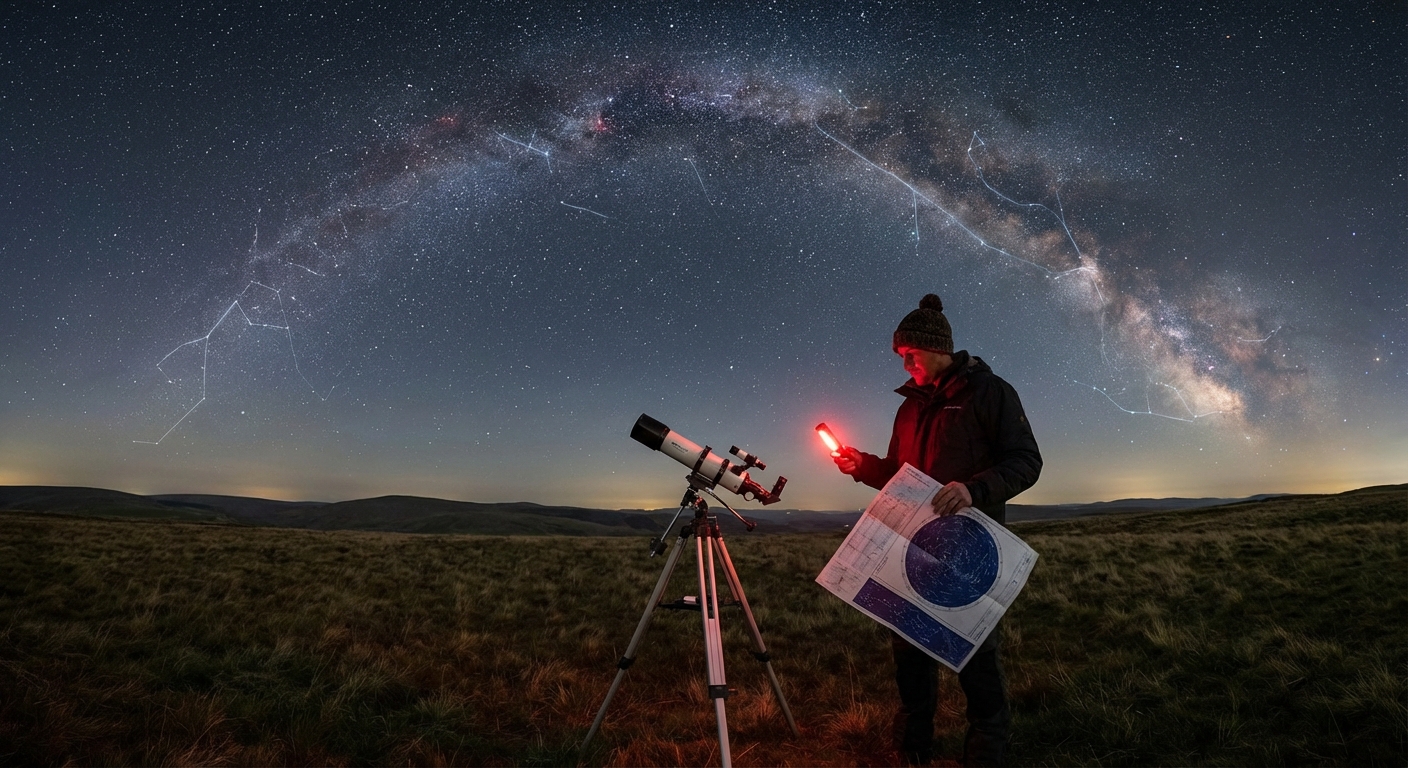
Stargazing can be more than spotting bright dots and recognizing a few constellations. With a bit of method and context, you can approach the night sky the way a professional astronomer does: as a dynamic, three-dimensional laboratory filled with objects at different distances, ages, and physical states.
Why Learn to “Read” the Sky?
This guide isn’t about buying the biggest telescope. It’s about training your eyes and mind so every glance upward connects to the deeper science—cosmic distances, stellar evolution, planetary motion—behind what you see.
Step 1: Turn the Dome into a Map
Astronomers think of the sky as a celestial sphere: an imaginary dome surrounding Earth. Two coordinates—right ascension (RA) and declination (Dec)—play roles similar to longitude and latitude.
You don’t need to memorize coordinates, but you should:
- Learn the cardinal directions at your observing site.
- Note where the ecliptic (the apparent path of the Sun) arcs across the sky; the planets will cluster along it.
- Recognize a few anchor constellations: Orion, Ursa Major, Cygnus, Scorpius, and Sagittarius are excellent seasonal landmarks.
Use a planisphere or an astronomy app in red-light mode to match the dome above you with a chart. Over time, your mental model of the sky will become as familiar as a neighborhood map.
Step 2: See in Layers, Not Just Lights
Every point of light sits at a different distance and represents a different phase of stellar or galactic evolution. Train yourself to think in layers:
- Near-Earth: satellites, the International Space Station, bright meteors
- Solar System: planets, the Moon, comets, main-belt asteroids
- Local stellar neighborhood: bright naked-eye stars within a few hundred light-years
- Galactic structure: the Milky Way band, open clusters, globular clusters, star-forming regions
- Extragalactic realm: faint smudges of distant galaxies and galaxy clusters
When you look at Orion, for example, you’re seeing:
- Nearby stars like Betelgeuse (about 550–700 light-years away)
- The Orion Nebula (M42), a stellar nursery 1,300 light-years distant
- Background Milky Way stars far beyond
This layered view mirrors how astronomers interpret deep images from observatories like the James Webb Space Telescope (JWST)—foreground stars superimposed on distant galaxies.
Step 3: Time-Domain Awareness—The Sky Is Moving
Astronomers now talk about time-domain astronomy, focusing on how objects change. You can practice this visually:
- Track planetary positions week by week as they drift relative to the stars.
- Watch lunar phases and the changing orientation of features like the Mare Crisium.
- Note the seasonal shift of constellations; Orion is a winter highlight in the Northern Hemisphere but vanishes behind the Sun in summer.
On longer timescales, professionals monitor supernovae, variable stars, and transient events. At the amateur level, you can join this effort through variable star observing programs and exoplanet transit monitoring.
Step 4: Using Binoculars and Small Telescopes Like a Pro
You don’t need an observatory to adopt professional habits. What matters is how you observe:
Choose the Right Tool
- Binoculars (7×50 or 10×50): wide-field views, ideal for star fields, open clusters, and comets.
- Small refractor (70–100 mm): sharp views of the Moon, planets, bright nebulae.
- Dobsonian reflector (150–250 mm): deep sky on a budget: galaxies, globular clusters, faint nebulae.
Log, Don’t Just Look
Astronomers keep observation logs. You can, too:
- Record date, time, location, instrument, and sky conditions (transparency, seeing).
- Sketch what you see; include approximate star patterns and brightness differences.
- Note subtle details—hints of color, structure in nebulae, irregular galaxy shapes.
Over months, your logs become a dataset, revealing how your skills and the sky itself change with seasons and cycles.
Step 5: Attach the Physics to the View
What elevates stargazing to expert level is understanding the physical story behind each object.
When you see:
- Jupiter’s bands and moons, connect them to atmospheric dynamics, magnetospheres, and orbital resonance.
- Saturn’s rings, recall their composition (mostly water ice), probable age (maybe younger than the dinosaurs), and ongoing studies by the Cassini mission data.
- The Andromeda Galaxy (M31), think about its 2.5 million light-year distance and the fact it’s on a collision course with the Milky Way.
Recent discoveries keep enriching these stories.
- JWST’s sharp views of star-forming regions, like the Pillars of Creation, reveal jets from newborn stars and intricate dust sculpting, confirming and refining models of how stars emerge from cold molecular clouds.
- Observations of protoplanetary disks with ALMA and JWST show ringed, gapped structures, real-time evidence of planets carving paths in their birth disks.
Each patch of sky can be mentally annotated with cutting-edge science.
Step 6: Connect to Current Research and Citizen Science
Professional astronomers increasingly rely on public participation to sift through massive datasets.
Projects you can join:
- Galaxy Zoo: help classify galaxy morphologies in survey images.
- Planet Hunters: search for exoplanet transits in light curves.
- Supernova and variable star networks: contribute photometric observations.
These efforts are part of a broader trend: observatories like Rubin Observatory will produce so many transient alerts that automated pipelines and human pattern recognition must work together.
As a dedicated observer, you can:
- Provide rapid follow-up on new supernova discoveries.
- Track near-Earth objects for orbit refinement.
- Capture pre- and post-outburst imagery of variable stars.
In doing so, you shift from consumer of astronomy to contributor.
Step 7: Think in Cosmic Time
Perhaps the most profound mindset shift is temporal. When you observe the sky:
- The Andromeda light hitting your eye left before modern humans existed.
- The photons from a distant quasar may predate the formation of our solar system.
Astronomers routinely work with lookback time—how far into the past each observation peers. JWST’s deepest fields reveal galaxies as they were a few hundred million years after the Big Bang, challenging models of how quickly the first stars and galaxies assembled.
Even your backyard observations are embedded in this framework. That red giant you admire may be nearing its final act; a star cluster may be dispersing into the galactic field.
Step 8: Preserve Your Dark Adaptation and Your Wonder
A few practical tips that professionals take seriously:
- Use red lights to protect night vision.
- Give your eyes 20–30 minutes to fully dark-adapt.
- Shield yourself from stray light; even turning off a nearby porch light can unlock magnitudes of faint stars.
Yet beyond technique, maintain curiosity. Ask:
- Why does this object look the way it does?
- What would it look like in other wavelengths: radio, infrared, X-ray?
- What unanswered questions are researchers actively debating about it?
Astronomy thrives on questions that lead to better instruments, deeper surveys, and new physics.
From Enthusiast to Informed Observer
Learning to read the night sky like an astronomer is not about memorizing catalogs. It’s about cultivating a three-dimensional, physical, and temporal understanding of what you’re seeing.
Each time you step outside and look up, you’re engaging with a universe that modern astronomy is mapping in unprecedented detail—from exoplanet atmospheres to the cosmic web of dark matter.
With a bit of practice, your stargazing sessions become more than aesthetic experiences; they become fieldwork in the grandest science of all: the study of the universe itself.