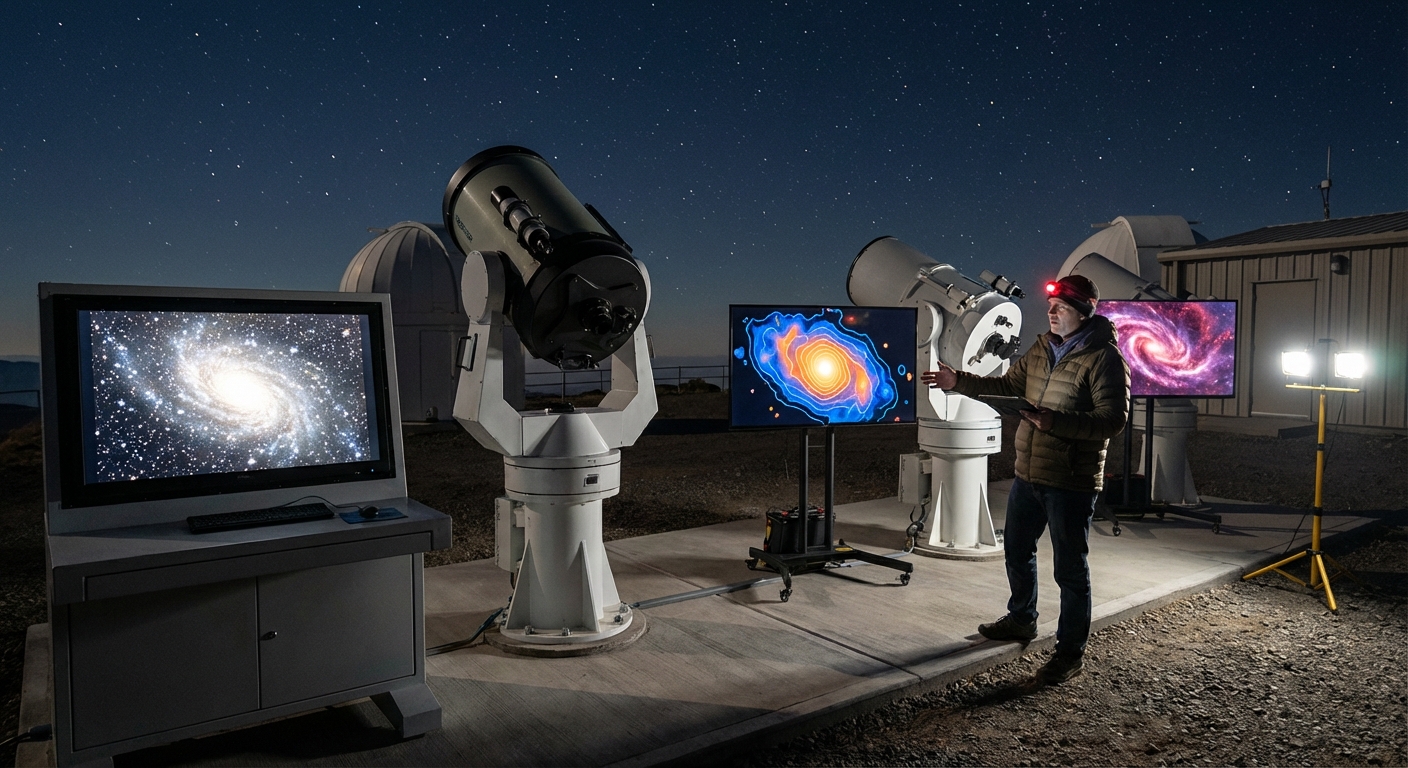
To the naked eye, the universe is a tapestry of visible light. But astronomy has long outgrown that narrow window. Modern observatories operate across the electromagnetic spectrum—from radio waves kilometers long to gamma rays shorter than an atom.
One Sky, Many Invisible Universes
Each band reveals a different universe: cold gas, hot plasma, hidden stars, violent jets. Comparing them is not just a matter of colors; it is a way of dissecting physical processes.
This explainer compares three foundational windows—optical, radio, and infrared—showing what each does best, how they complement each other, and how recent discoveries hinge on this multiwavelength approach.
Optical Astronomy: The Classic View
What It Sees
Optical light (roughly 400–700 nm) is the range our eyes evolved to detect, coinciding with the Sun’s peak emission. Optical telescopes excel at:
- Stellar populations: star clusters, galaxy disks, and halos
- Reflection and emission nebulae: gas clouds lit by nearby stars
- Precise positional measurements: astrometry and proper motions
Modern optical surveys—like those from the Hubble Space Telescope and ground-based instruments—have mapped billions of galaxies and countless stars.
Strengths
- High angular resolution, especially from space or with adaptive optics
- Accessible from the ground with relatively mature technology
- Rich in spectral lines (e.g., hydrogen, metals) for chemical and kinematic diagnostics
Optical spectroscopy underpins much of astrophysics: measuring redshifts, stellar metallicities, rotation curves, and more.
Limitations
- Dust absorption and scattering obscure star-forming regions and galactic centers.
- Optical light from very distant galaxies is redshifted into the infrared.
To see through dust and to higher redshifts, astronomers turn to infrared.
Infrared Astronomy: The Hidden and the Distant
Infrared (IR) spans wavelengths from about 0.7 micrometers to hundreds of micrometers, divided into near-, mid-, and far-infrared.
What It Sees
Infrared is ideal for:
- Cool objects: brown dwarfs, giant planets, dust-enshrouded stars
- Star formation regions: protostars embedded in molecular clouds
- Galactic centers: including the Milky Way’s, normally obscured by dust
- High-redshift galaxies: whose optical/UV light has been shifted into IR
The James Webb Space Telescope (JWST) is a flagship IR observatory, with instruments that excel from the near- to mid-infrared.
Strengths
- Dust penetration: longer wavelengths scatter less, revealing structures hidden in optical.
- Thermal emission: dust warmed by young stars or active galactic nuclei glows brightly in IR.
- Access to molecular features: water, CO, CO₂, PAHs (polycyclic aromatic hydrocarbons).
JWST has used these strengths to:
- Image proto-planetary disks and identify gaps carved by forming planets.
- Detect water vapor and other molecules in exoplanet atmospheres.
- Observe galaxies in the first few hundred million years after the Big Bang.
Limitations
- Earth’s atmosphere emits and absorbs strongly in many IR bands, requiring space-based or high-altitude observatories and careful background subtraction.
- Thermal emission from the telescope itself must be minimized; hence the need for cryogenic cooling.
Infrared excels at the warm and hidden, but for the coldest and largest-scale structures, astronomers turn to radio.
Radio Astronomy: The Cold, the Coherent, and the Colossal
Radio wavelengths range from millimeters to meters and beyond. This regime revolutionized astronomy in the 20th century.
What It Sees
- Cold gas: notably neutral hydrogen via the 21-cm line
- Synchrotron emission: relativistic electrons spiraling in magnetic fields (supernova remnants, jets)
- Masers: naturally occurring cosmic lasers (e.g., water or methanol masers in star-forming regions)
- Pulsars: rotating neutron stars emitting beams of radio waves
Radio observations map large-scale structure, galactic magnetic fields, and the interstellar medium in ways impossible at other wavelengths.
Strengths
- Penetrates dust and gas, revealing galactic centers and star-forming regions.
- Huge baselines via very long baseline interferometry (VLBI) achieve micro-arcsecond resolution—crucial for projects like the Event Horizon Telescope.
- Sensitive to coherent emission (like pulsars) and extended structures (jets, lobes) invisible in optical.
Recent high-impact results powered by radio include:
- The Event Horizon Telescope’s imaging of black hole shadows in M87 and the Milky Way.
- Fast radio bursts (FRBs), millisecond radio flashes from extragalactic distances, whose origins are still under study.
Limitations
- Coarse resolution from single dishes due to long wavelengths; interferometry mitigates this but at technological cost.
- Vulnerable to radio frequency interference (RFI) from human technology.
Case Study 1: A Galaxy in Three Lights
Consider a star-forming spiral galaxy like M51 (the Whirlpool Galaxy):
- Optical: shows grand-design spiral arms lined with bright, young star clusters and H II regions (ionized hydrogen).
- Infrared: reveals warm dust lanes, embedded star formation, and the obscured central region.
- Radio: maps cold hydrogen gas reservoirs, cosmic-ray electrons in magnetic fields, and sometimes jets from a central black hole.
Layering these images builds a more complete picture:
- Radio shows fuel (cold gas) and energetic processes.
- Infrared shows ongoing star formation and dust heating.
- Optical shows luminous stellar populations and ionized gas.
The galaxy becomes not just a photogenic spiral, but a system with tracked inputs (gas), processing (star formation), and outputs (winds, radiation, metals).
Case Study 2: The Galactic Center
The center of the Milky Way is heavily obscured in optical; dust blocks our view.
- Infrared observations revealed the orbits of stars orbing an unseen mass—leading to the discovery of the 4-million-solar-mass black hole Sagittarius A.
- Radio observations image the accretion flow and jets, and were key in the Event Horizon Telescope’s image of Sgr A’s shadow.
Without IR and radio, our galaxy’s central engine would remain almost entirely hidden.
Case Study 3: Exoplanet Atmospheres
- Optical: transit photometry detects planetary sizes via dimming; optical spectroscopy can probe some atmospheres, especially for hot, large exoplanets.
- Infrared: transit and eclipse spectroscopy are particularly powerful, as many atmospheric features (H₂O, CO, CO₂, CH₄) have strong IR signatures.
JWST’s IR instruments have already:
- Measured detailed emission and transmission spectra of hot Jupiters.
- Detected carbon dioxide in exoplanet atmospheres, refining composition and temperature profiles.
As we approach smaller, cooler worlds, infrared observations will be critical for searching for biosignature gases.
Complementarity, Not Competition
Optical, IR, and radio astronomy are sometimes framed as competing approaches, but in practice they are deeply complementary:
- Optical pinpoints stellar light and dynamics.
- Infrared exposes dusty environments and high-redshift objects.
- Radio maps cold gas, magnetic fields, and large-scale structures.
Many key questions in modern astronomy—how galaxies form, how black holes grow, how planets assemble—demand multiwavelength campaigns:
- Surveys like ALMA (mm/sub-mm) plus JWST (IR) plus Hubble (optical) and Chandra/XMM (X-ray) yield “panchromatic” portraits.
- Time-domain facilities coordinate to catch transients: a supernova or gamma-ray burst may be observed from radio to gamma rays in hours.
The Future: Sharper, Deeper, and More Synergistic
Upcoming and current facilities are pushing each window further:
- Optical: Vera C. Rubin Observatory’s LSST will perform an ultra-deep, time-domain survey of the southern sky.
- Infrared: JWST is in full operation, while concepts for future IR missions emphasize even higher contrast for exoplanet imaging.
- Radio: SKA and next-generation VLA will deliver unprecedented sensitivity and mapping speed.
As data volumes explode, astronomy is moving into the era of virtual observatories and multiwavelength archives, where a single object’s complete spectral fingerprint can be explored from a laptop.
For space science enthusiasts, understanding what each band reveals is like learning multiple languages of the cosmos. The more windows you appreciate, the more fully the universe speaks.