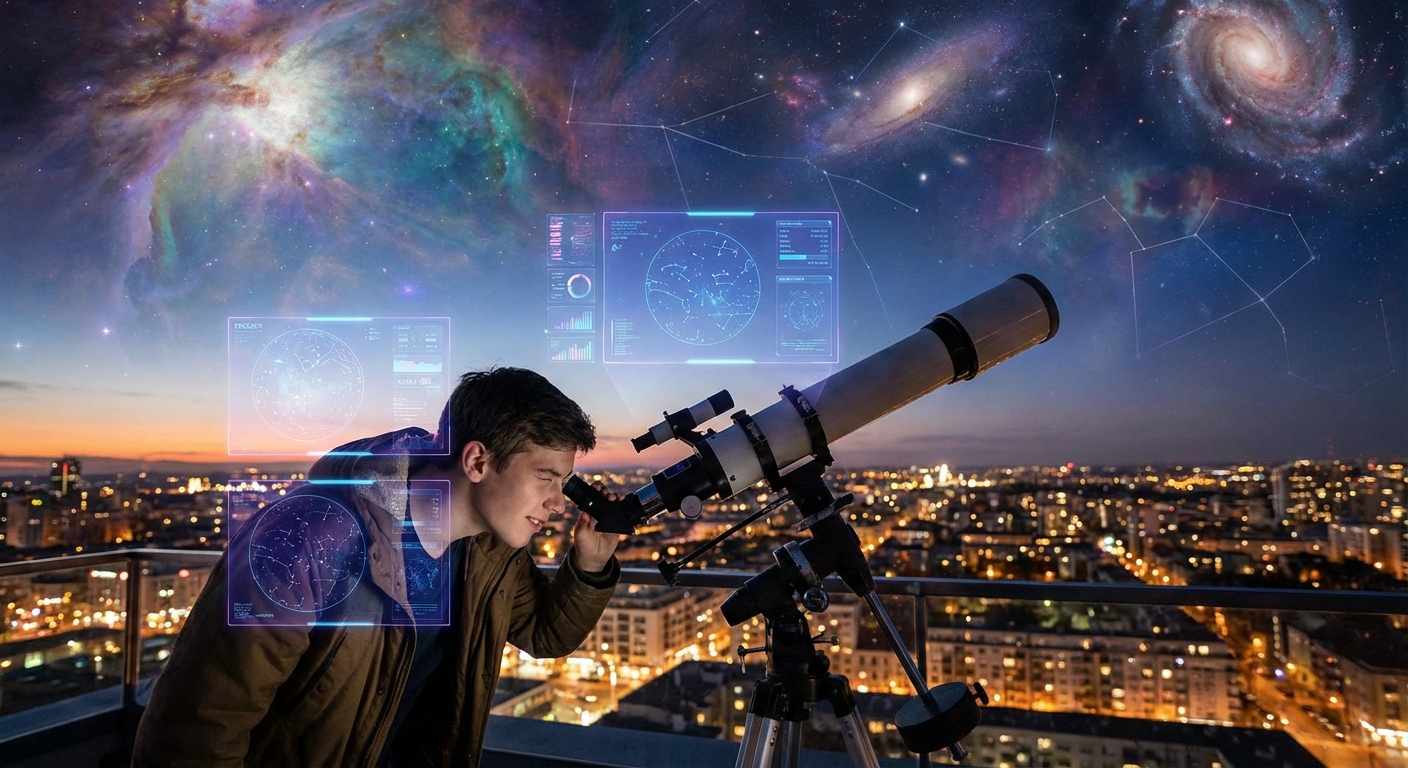
Over the past decade, astronomy has shifted from a largely observational science to a data-driven, high-precision discipline capable of testing ideas once considered unprovable. From the first image of a black hole’s shadow to the flood of exoplanet discoveries, we are living through a golden age in which the universe is not just observed, but measured and modeled with stunning accuracy.
The New Golden Age of Looking Up
This revolution is being powered by a fleet of next-generation observatories on the ground and in space—and by a quiet revolution in computing and statistics that lets astronomers extract subtle signals from oceans of noisy data.
From Galileo to Gigapixels: A Brief Historical Arc
When Galileo first turned his primitive telescope toward Jupiter in 1610, he discovered four moons and shattered the notion of a perfect, unchanging heavens. That small instrument kicked off centuries of telescopic innovation:
- 17th–19th centuries: Larger refractors and reflectors expanded our reach, revealing nebulae and star clusters and helping map the Milky Way.
- Early 20th century: Spectroscopy and photography turned astronomy into astrophysics, letting scientists measure stars’ compositions, velocities, and temperatures.
- Mid–late 20th century: Radio, infrared, ultraviolet, X-ray, and gamma-ray astronomy opened new windows on the cosmos, exposing black holes, quasars, and the cosmic microwave background.
Today’s instruments dwarf their predecessors. A modern wide-field survey camera can capture more sky in a single exposure than entire observatory careers once documented on glass plates.
The Data Deluge: Surveys That See Everything, All the Time
A defining feature of modern astronomy is the rise of large sky surveys: systematic, repeated imaging and spectroscopy covering huge fractions of the sky.
Observatories like the Sloan Digital Sky Survey (SDSS) pioneered this approach, mapping millions of galaxies and creating three-dimensional charts of the cosmos. The next leap is the Vera C. Rubin Observatory in Chile, whose Legacy Survey of Space and Time (LSST) will image the entire visible sky every few nights using a 3.2-gigapixel camera.
This shift has two crucial implications:
- Time-domain astronomy: Instead of single snapshots, we get movies—tracking supernovae, variable stars, asteroid flybys, and mysterious transients.
- Big-data science: Astronomers now handle petabytes of data, using machine learning to flag anomalies and rare phenomena that might previously have gone unnoticed.
For enthusiasts, this means more public data, better sky maps, and easier access to professional-grade observations.
Black Holes in Sharp Focus
Black holes went from theoretical curiosities to observational targets within a human lifetime. The Event Horizon Telescope (EHT)—a global network of radio antennas acting as an Earth‑sized virtual telescope—delivered a landmark in 2019: the first image of a black hole’s shadow in galaxy M87.
That fuzzy ring of emission encircling darkness encoded deep physics:
- The shadow size matched predictions from general relativity, bolstering Einstein’s century-old theory under extreme conditions.
- The polarization maps released later traced magnetic fields twisted by the black hole’s gravity, hinting at how relativistic jets are launched.
In 2022, EHT repeated the feat closer to home, imaging the supermassive black hole at the center of the Milky Way, Sagittarius A. Its mass—about 4 million Suns packed into a region smaller than Mercury’s orbit—has been inferred for decades from stellar orbits; now we’ve seen its silhouette against a glowing plasma backdrop.
Exoplanets: From Oddities to a Galactic Census
In 1995, the first planet around a Sun-like star was announced. Today, the number of confirmed exoplanets exceeds 5,000, with thousands more candidates awaiting confirmation.
Key advances have driven this explosion:
- Transit method: Space telescopes like Kepler and TESS observe tiny dips in starlight as planets pass in front of their host stars.
- Radial-velocity method: Spectrographs measure minute wobbles in a star’s motion due to the gravitational tug of orbiting planets.
We’ve discovered:
- Hot Jupiters: gas giants orbiting perilously close to their stars
- Super-Earths and mini-Neptunes: planet types absent from our solar system but common in the galaxy
- Potentially habitable worlds around red dwarfs like TRAPPIST-1
The James Webb Space Telescope (JWST) is now pushing exoplanet science into a new phase: atmospheric characterization. By analyzing how starlight filters through a planet’s atmosphere during transits, JWST can detect molecules like water vapor, carbon dioxide, methane, and even complex aerosols.
Recent JWST results include hints of carbon dioxide and water vapor in the atmospheres of several warm exoplanets, refining our understanding of how planetary atmospheres form and evolve. For rocky worlds, these techniques may one day reveal biosignatures—or definitively rule them out.
Mapping the Invisible: Dark Matter and Dark Energy
Despite our observational prowess, about 95% of the universe’s contents remain invisible to telescopes:
- Dark matter: An unseen mass component that shapes galaxy rotations and cosmic structure
- Dark energy: A repulsive component driving the accelerated expansion of the universe
Astronomers infer dark matter through gravitational effects, such as:
- Galaxy rotation curves that stay flat at large radii
- Gravitational lensing, where background galaxies appear stretched and magnified by foreground mass
Dark energy is probed through observations of distant Type Ia supernovae, baryon acoustic oscillations (patterns in galaxy clustering), and the cosmic microwave background.
New surveys and missions—like Euclid (ESA) and Nancy Grace Roman Space Telescope (NASA)—aim to measure cosmic expansion and structure growth with unprecedented precision, testing whether dark energy is a cosmological constant or something even stranger.
Citizen Science and the Democratization of Discovery
Modern astronomy is increasingly collaborative—not just among institutions, but between professionals and the public.
Platforms like Zooniverse enlist volunteers to classify galaxies, spot gravitational lenses, and identify exoplanet transits. Amateur astronomers with modest equipment routinely:
- Track near-Earth asteroids
- Monitor variable stars and supernovae
- Provide follow-up observations for professional surveys
Astronomy has become one of the most open sciences: many observatories release data to the public within months, enabling enthusiasts to perform real analyses and, occasionally, real discoveries.
Why the Cosmos Still Surprises Us
For all of our progress, the universe retains its talent for astonishment:
- Fast radio bursts—millisecond flashes of radio waves from distant galaxies—remain partially mysterious.
- Some stars defy expectations with unusual chemical compositions and pulsation patterns.
- Galaxy formation simulations still struggle to capture the full diversity of structures we observe.
The more detail we gain, the more subtle and complex the picture becomes. Modern astronomy excels at revealing not just answers, but better questions.
Looking Up, Armed with Context
For space science enthusiasts, this is a uniquely rewarding moment. With a small telescope or even a good pair of binoculars, you can look at Saturn’s rings or the Orion Nebula knowing that:
- Black holes at galaxy centers are being imaged, not just inferred.
- Planets around other stars are being scanned for atmospheric fingerprints.
- The large-scale structure of the universe is being mapped* in ever finer detail.
The night sky hasn’t changed—our ability to interpret it has. Astronomy today stands at the intersection of physics, computing, engineering, and human curiosity, continually reshaping our understanding of where we fit in the cosmos.
And the most profound discoveries may still be hidden in data we have already collected, waiting for someone—perhaps you—to ask the right question.