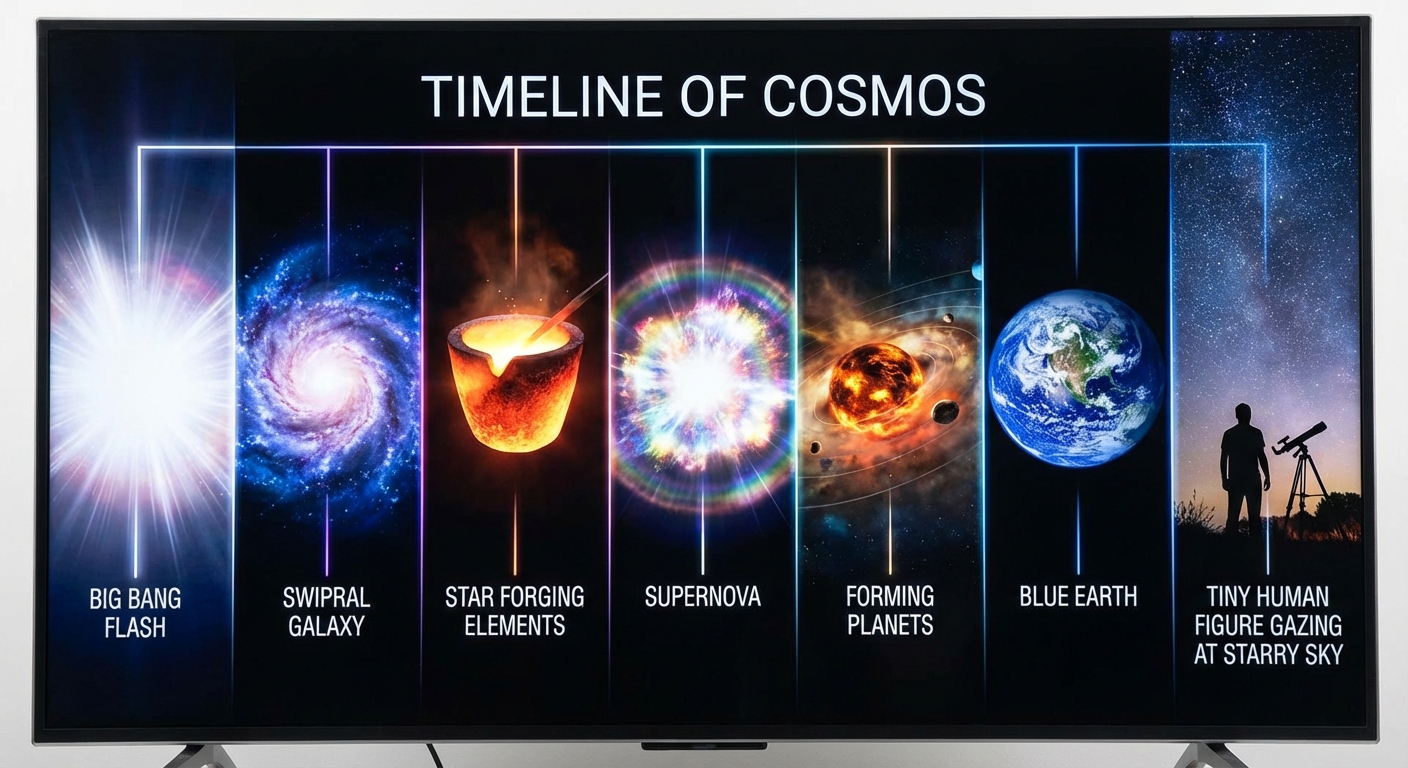
The night sky can seem timeless, but astronomy reveals a universe in motion and transformation. From a hot, nearly featureless beginning, the cosmos evolved into a complex web of galaxies, stars, planets, and—on at least one world—life.
A Universe That Changes
These 10 milestones trace that story, weaving in modern discoveries that sharpen our timeline and challenge earlier assumptions.
1. The First Fractions of a Second: Inflation and Quantum Seeds
Current cosmology suggests that a tiny fraction of a second after the Big Bang, the universe underwent inflation—a dramatic, exponential expansion. Quantum fluctuations in this early epoch were stretched to cosmic scales, seeding the density variations that later grew into galaxies.
Evidence comes from the exquisite uniformity—and tiny anisotropies—of the cosmic microwave background (CMB), mapped by missions like WMAP and Planck. These temperature ripples, at the level of one part in 100,000, trace the earliest imprints of structure.
Inflation remains a frontier: multiple models vie for supremacy, and astronomers hunt for signatures like primordial gravitational waves in the polarization pattern of the CMB.
2. Nucleosynthesis: Forging the First Elements
Within the first few minutes, as the universe cooled from its initial inferno, Big Bang nucleosynthesis fused protons and neutrons into light nuclei:
- Hydrogen
- Helium
- Traces of deuterium, helium-3, and lithium
The predicted abundances match what astronomers observe in the oldest, most pristine gas clouds, making nucleosynthesis a cornerstone of the Big Bang model.
But nearly all heavier elements—carbon, oxygen, iron—would have to wait for stars.
3. The Cosmic Dark Ages: A Cooling, Neutral Universe
About 380,000 years after the Big Bang, electrons and nuclei combined to form neutral atoms in an era called recombination. Photons decoupled from matter and began streaming freely through space; we see this relic light today as the CMB.
After recombination, the cosmos entered the cosmic dark ages:
- No stars yet; only cooling, neutral hydrogen and helium gas.
- Gravity began amplifying slight density fluctuations.
Modern instruments like LOFAR and future arrays such as the Square Kilometre Array (SKA) aim to detect the faint 21-centimeter radio glow of neutral hydrogen from this era, providing a new probe of early structure growth.
4. First Light: The Birth of Population III Stars
At some point between about 100 and 500 million years after the Big Bang, the first generation of stars—Population III stars—ignited. Formed from pristine hydrogen and helium, these stars were likely:
- Very massive (tens to hundreds of solar masses)
- Short-lived (millions of years, not billions)
- Efficient factories for the first heavy elements
We haven’t directly observed a Population III star yet, but their fingerprints appear in the chemical patterns of extremely metal-poor stars in our galaxy and in high-redshift galaxy spectra.
JWST is pushing the frontier here: its observations of galaxies at redshifts greater than 10 (less than 500 million years after the Big Bang) show surprisingly mature systems, forcing theorists to refine models of early star formation.
5. Reionization: Turning the Lights All the Way On
The ultraviolet radiation from the first stars and galaxies began to reionize the neutral hydrogen permeating space. Over a few hundred million years, the universe transitioned from mostly neutral to mostly ionized gas.
Astronomers study this era—cosmic reionization—by:
- Analyzing the spectra of distant quasars for absorption features (the Gunn–Peterson trough).
- Mapping the CMB polarization.
- Using JWST and other telescopes to count and characterize early galaxies.
Recent JWST data suggest a rich population of faint, star-forming galaxies contributing to reionization, and hint at unexpectedly rapid build-up of stellar mass in the early universe.
6. Galaxy Assembly: From Protogalaxies to the Cosmic Web
As dark matter halos grew by merging and accreting material, they pulled in gas that cooled and condensed into rotating disks and bulges: galaxies.
Over billions of years, these structures assembled into the cosmic web we see in large-scale surveys:
- Filaments rich in galaxies and dark matter
- Voids with relatively few galaxies
- Clusters at the nodes of the web
Surveys like SDSS, DESI, and soon Euclid and Rubin’s LSST map this web in 3D. Their measurements test models of dark matter and dark energy by comparing the growth of structure over time with predictions from general relativity and cosmology.
JWST has added a twist: it finds compact, massive galaxies in the early universe that appear too evolved for their age, rekindling debates about star-formation efficiency, feedback processes, and even whether our standard cosmological parameters might need subtle adjustments.
7. Stellar Alchemy: Building the Periodic Table
Inside stars, nuclear fusion proceeds through stages:
- Low-mass stars fuse hydrogen into helium for billions of years.
- More massive stars fuse heavier elements—carbon, neon, oxygen, silicon—up to iron.
When massive stars die in core-collapse supernovae, they and their remnants (neutron stars, black holes) become crucibles for the heaviest elements via rapid neutron-capture processes (r-process).
A landmark discovery in 2017—GW170817, a neutron star merger detected via gravitational waves and electromagnetic signals—confirmed that such mergers are major sites of r-process nucleosynthesis, forging elements like gold, platinum, and uranium.
The periodic table on your wall is, in effect, a fossil record of stellar and explosive processes unfolding over cosmic time.
8. Planetary Systems: From Protoplanetary Disks to Diverse Worlds
Around young stars, disks of gas and dust coalesce into planetary systems. Observations from ALMA and JWST show these disks with striking clarity:
- Rings and gaps where forming planets have cleared paths
- Asymmetries where dust may be trapped in vortices
- Chemistry revealing water, organics, and complex molecules
Exoplanet surveys have transformed planetary science:
- Thousands of planets discovered, revealing architectures unlike our solar system.
- Common outcomes include super-Earths and mini-Neptunes, absent here but abundant elsewhere.
- Hot Jupiters challenge simple models of in-place planet formation, implying significant migration.
This diversity forces theorists to develop more flexible models of disk evolution, migration, and planetary growth—and invites us to view the solar system as one outcome among many, not a template.
9. Habitable Worlds and the Question of Life
As the universe aged, long-lived, stable stars—especially K and M dwarfs—hosted planets in their habitable zones: orbits where liquid water could exist on a rocky surface.
Key developments:
- Discovery of Earth-sized exoplanets in temperate orbits (e.g., several in the TRAPPIST-1 system).
- JWST and other telescopes beginning to probe exoplanet atmospheres, measuring water vapor, CO₂, methane, and clouds.
- Theoretical work refining habitable zone criteria, considering stellar activity, tidal locking, and atmospheric retention.
We don’t yet know how common life is. But astronomy has set the stage: we have a growing catalog of potentially habitable planets and the first tools capable of searching for biosignatures—chemical disequilibria in atmospheres that, on Earth, are sustained by life.
Future observatories like the Habitable Worlds Observatory concept aim to directly image Earth-like exoplanets and search for such signatures, pushing the question of cosmic life into the domain of empirical science.
10. Cosmic Acceleration and the Far Future
In the late 1990s, observations of distant Type Ia supernovae revealed that the expansion of the universe is accelerating, driven by an unknown component dubbed dark energy.
Measurements over the last two decades—combining supernovae, galaxy clustering, and the CMB—converge on a universe that is:
- About 68% dark energy
- About 27% dark matter
- Only about 5% ordinary matter
If dark energy behaves like a cosmological constant, the far future will see galaxies beyond our local group receding faster than light, disappearing from view. Star formation will dwindle; stellar remnants will dominate; the universe will grow cold and dilute.
Cosmology continues to test this picture. Tensions in measured expansion rates (the Hubble tension) hint either at unrecognized systematics or subtle new physics.
Your Place in This Timeline
Every star you see is a participant in this grand evolution. The iron in your blood, the calcium in your bones, the oxygen you breathe—all forged in ancient stars and explosive deaths.
Modern astronomy doesn’t just chart where objects are; it reconstructs how they came to be. With tools ranging from gravitational-wave detectors to JWST, we are now able to watch multiple stages of this cosmic story in action:
- Infant galaxies assembling in the early universe
- Stars and planets forming in dusty cocoons
- Elements being forged and scattered by supernovae and mergers
Cosmic evolution is not an abstract narrative; it’s a chain of events that leads directly to us, asking questions about our origins while we still have front-row seats to a universe in motion.