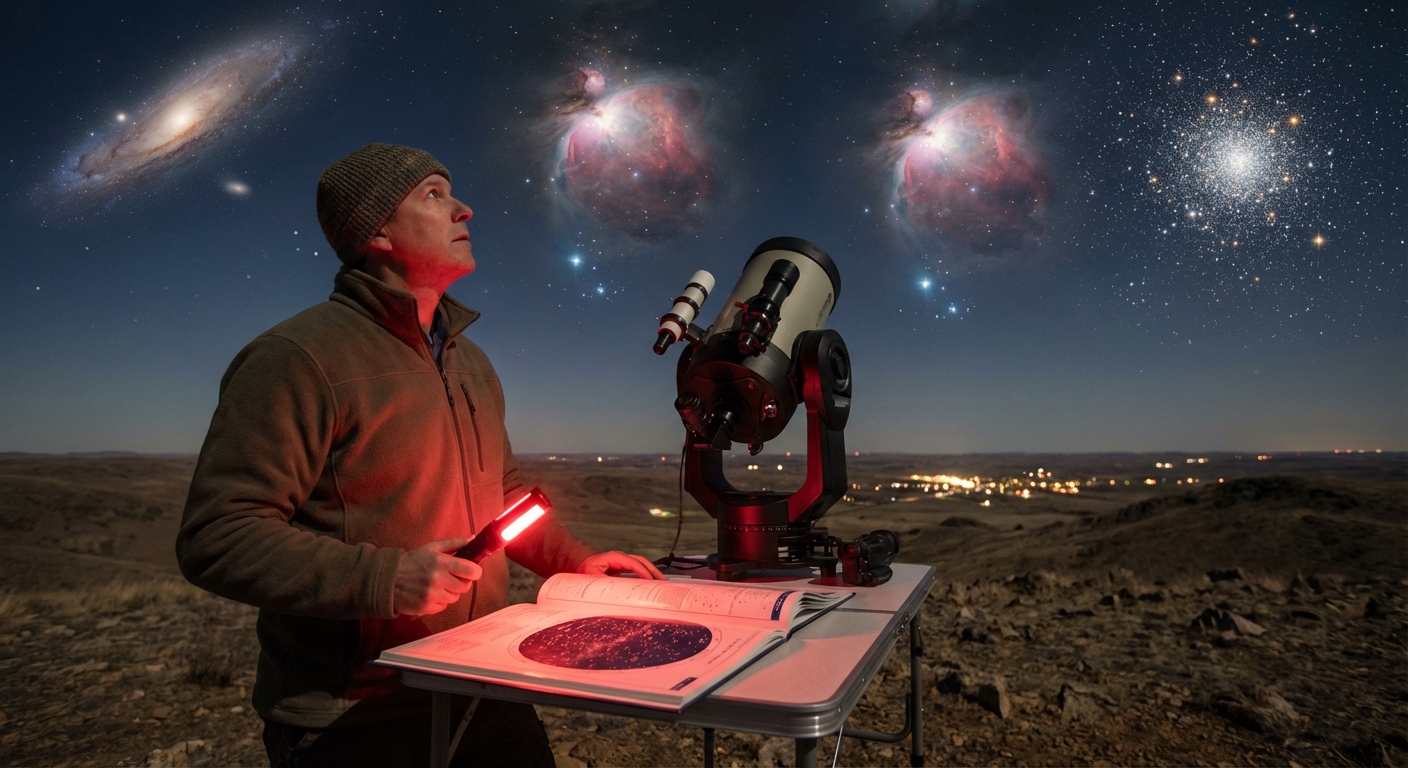
Scan a star atlas or astronomy app and you’ll see cryptic labels: M13, NGC 7000, IC 434, Sh2-155. Behind each designation is a profoundly different kind of object, shaped by gravity, radiation, and time on scales hard to fathom.
Why a Field Guide to the Deep Sky?
This guide is for space science enthusiasts who want to go beyond "pretty picture" status and understand what they’re looking at and why it looks that way.
We’ll move through the main families of deep-sky objects, blend historical context with current research, and keep the explanations rigorous yet accessible.
1. Galaxies: Islands in a Dark Ocean
1.1 Spiral Galaxies
Examples: Milky Way, Andromeda (M31), Whirlpool (M51), Triangulum (M33)
Spiral galaxies are rotating disks of stars and gas with spiral arms, a central bulge, and a surrounding dark matter halo.
Key physical features:
- Differential rotation: inner parts orbit faster than outer regions.
- Density waves: spiral arms aren’t solid structures but patterns where gas is compressed, triggering star formation.
- Metal-rich stars in the disk vs. older, metal-poor stars in the halo and bulge.
Recent insights:
- Gaia and radio surveys have refined our map of the Milky Way, revealing it as a barred spiral with multiple arms and ongoing interactions with dwarf companions.
- JWST images of distant spirals suggest disk structures formed earlier in cosmic history than expected.
Observing tip: In amateur scopes, spiral arms are subtle; look for brighter cores and elongated halos. Long-exposure imaging reveals structure.
1.2 Elliptical Galaxies
Examples: M87 in Virgo, NGC 5128 (Centaurus A, transitional), giant cluster ellipticals
Ellipticals range from nearly spherical (E0) to highly elongated (E7). They are star-rich, gas-poor systems dominated by older stellar populations.
Physical traits:
- Little cold gas → minimal ongoing star formation.
- Often reside in galaxy clusters, sometimes at their centers as massive cD galaxies.
- Host supermassive black holes (M87’s famously imaged by the Event Horizon Telescope).
Scientific role:
- Tracers of galaxy mergers and environmental effects in clusters.
- Their hot, X-ray emitting halos reveal the baryon budget and dark matter distribution.
1.3 Irregular and Dwarf Galaxies
Examples: Large and Small Magellanic Clouds, Leo I, Fornax Dwarf
Irregulars and dwarfs demonstrate that galaxies don’t need grand symmetry to matter.
- Dwarf spheroidals are dark-matter dominated fossils—excellent testbeds for dark matter models.
- Irregulars often show intense star formation, distorted by interactions with larger galaxies.
Current frontier: The Local Group and nearby volume host dozens of newly found ultra-faint dwarfs, discovered via deep surveys like DES and Pan-STARRS, crucial for understanding small-scale structure in cosmology.
2. Nebulae: The Breath of Stars
"Nebula" once meant almost anything fuzzy in the sky. Today, it denotes interstellar clouds of gas and dust. They’re the birthplaces and graveyards of stars.
2.1 Emission Nebulae
Examples: Orion Nebula (M42), Lagoon Nebula (M8), Eagle Nebula (M16)
These glow because high-energy ultraviolet photons from young, hot stars ionize surrounding hydrogen. When electrons recombine and transition to lower energy levels, the gas emits light, especially the H-alpha line at 656.3 nm.
Physical explanation:
- Regions are called H II regions (ionized hydrogen).
- Bright rims, pillars, and cavities are sculpted by stellar winds and radiation pressure.
Recent work:
- JWST has resolved protoplanetary disks (proplyds) in Orion and Carina, revealing how stars and planetary systems emerge from their natal cocoons.
Observing tip: From dark sites, emission nebulae respond dramatically to narrowband filters (UHC, OIII, H-beta), which suppress light pollution and boost contrast.
2.2 Reflection Nebulae
Examples: M45 (Pleiades reflection nebulosity), Witch Head Nebula (IC 2118)
These don’t emit their own light; instead, they scatter starlight, preferentially blue wavelengths (similar to Earth’s blue sky).
Why they’re blue:
- Small dust grains scatter shorter wavelengths more efficiently (Rayleigh scattering).
Reflection nebulae help astronomers map dust properties, grain sizes, and interstellar chemistry.
2.3 Planetary Nebulae
Examples: Ring Nebula (M57), Dumbbell (M27), Helix Nebula (NGC 7293)
Misnamed by early observers who saw them as disk-like "planets," these are actually shells of ionized gas ejected by dying Sun-like stars.
Life cycle:
- Red giant sheds its outer layers.
- Exposed hot core (future white dwarf) irradiates the gas.
- Nebula glows in characteristic emission lines (OIII, H-alpha, NII).
New findings:
- High-resolution imaging reveals complex, often bipolar structures, likely influenced by binary companions and magnetic fields.
- Chemical yields from planetary nebulae inform models of galactic chemical evolution.
2.4 Supernova Remnants
Examples: Crab Nebula (M1), Veil Nebula, Cassiopeia A
These are the expanding shock waves and debris from stellar explosions.
Scientific goldmine:
- Shock fronts accelerate particles → contributing to galactic cosmic rays.
- Spectroscopy reveals freshly minted heavy elements (oxygen, silicon, iron).
- Pulsar wind nebulae (like in the Crab) probe extreme magnetospheres and relativistic plasmas.
3. Star Clusters: Stellar Cities and Fossils
3.1 Open Clusters
Examples: Pleiades (M45), Hyades, Beehive (M44)
Loose groups of dozens to thousands of stars formed from the same molecular cloud.
They are astrophysical laboratories because:
- Member stars share age and composition, varying mainly by mass.
- Comparing their positions on the Hertzsprung–Russell diagram tests stellar evolution models.
Open clusters gradually dissolve under galactic tides, seeding the field star population.
3.2 Globular Clusters
Examples: Omega Centauri, M13, 47 Tucanae
Dense, roughly spherical clusters of up to millions of stars, orbiting the galactic halo.
Why they matter:
- Among the oldest known stellar systems (ages ~12–13 billion years).
- Provide lower bounds on the age of the universe.
- Reveal multiple stellar populations and complex formation histories.
Current tension: Detailed spectroscopy shows unexpected spreads in elements like helium and nitrogen, indicating that globular cluster formation is more intricate than a single burst.
4. Large-Scale Structures: Clusters, Filaments, and Voids
Zooming out, galaxies themselves become building blocks.
- Galaxy groups (like our Local Group) are small gravitationally bound associations.
- Galaxy clusters contain hundreds to thousands of galaxies, embedded in dark matter and hot X-ray gas.
- Filaments link groups and clusters into the cosmic web.
- Voids are relatively empty regions tens to hundreds of millions of light-years across.
Cosmological surveys measure how these structures grow over time, placing tight constraints on:
- Dark energy’s equation of state.
- Neutrino masses (which affect structure formation at small scales).
- Initial conditions set by cosmic inflation.
5. How to Read a Deep-Sky Image Like a Scientist
Next time you see a jaw-dropping deep-sky image, apply this checklist:
Identify the class: Galaxy? Nebula? Cluster? Mixed region?
2. Note the wavelengths: Optical? Infrared? X-ray? Multiwavelength composites reveal different physics. 3. Look for interaction signatures: Tidal tails, warped disks, shock fronts. 4. Consider the timescales: Star formation (millions of years), cluster evolution (billions), shock propagation (thousands). 5. Ask what’s invisible: Dark matter potential wells, magnetic fields, cosmic rays.
This habit transforms passive admiration into active interpretation—the mindset of an astronomer.
The Deep Sky as Ongoing Story, Not Static Catalog
From Messier’s comet-confusing "nebulosities" to modern all-sky surveys mapping billions of objects, our field guide to the deep sky is constantly being revised.
New instruments reveal new layers: cold gas traced by radio lines, hot gas shining in X-rays, primordial galaxies glimpsed in the infrared. Each class of object is a chapter in a larger narrative: how a nearly uniform early universe grew into the rich, structured cosmos we see today.
For the serious observer, the reward is twofold: the aesthetic impact of these distant forms, and the intellectual satisfaction of understanding the physics that sculpts them. The deep sky is not just background—it’s the main story.