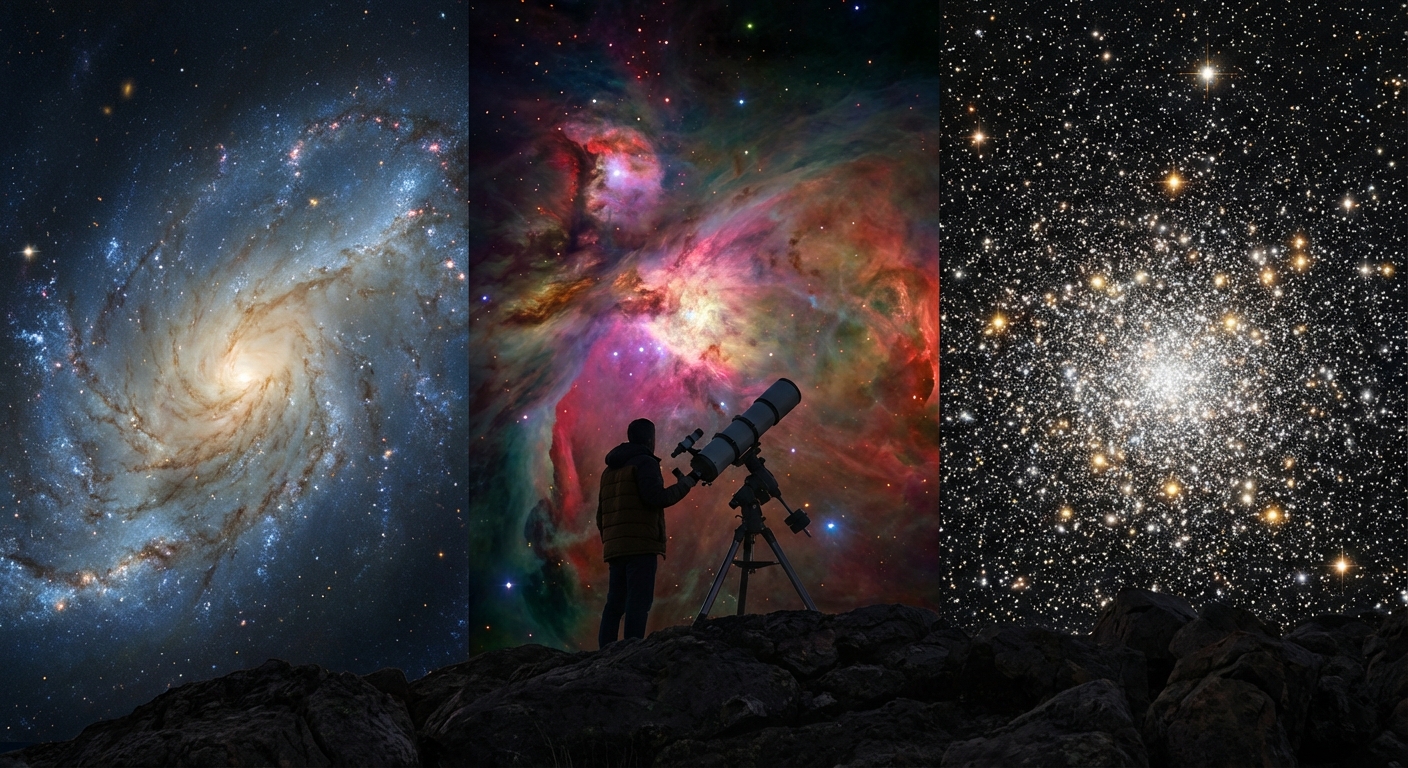
To the eye at the eyepiece, many deep-sky objects look like variations on a theme: faint, diffuse glows against a backdrop of stars. But the physical reality behind those glows could not be more different.
Same Sky, Very Different Beasts
A galaxy is a gravitationally bound ecosystem of billions of stars and dark matter. A nebula can be the afterglow of a dying sun or the cradle of newborn stars. A cluster is a stellar family, held together—or not—by their mutual pull.
Let’s put these three pillars of the deep sky side by side and see how they compare, from their scales and lifetimes to their role in cosmic evolution.
1. Scales: From Light-Years to Hundreds of Thousands
1.1 Galaxies: The Metropolises
- Typical size: 10,000–200,000 light-years across.
- Stars: from tens of millions (dwarfs) to trillions (giants).
- Mass (with dark matter): 10⁹–10¹³ solar masses.
Comparison: If the Solar System were a coffee bean, the Milky Way would be the size of a continent.
1.2 Nebulae: The Neighborhoods
"Nebula" covers several categories, but most span a few to a few hundred light-years.
- Orion Nebula: ~24 light-years across.
- Crab Nebula: ~11 light-years.
They’re huge compared to the Solar System, small next to a galaxy.
1.3 Star Clusters: The Apartment Blocks
- Open clusters: a few to ~30 light-years across.
- Globular clusters: ~50–200 light-years in diameter.
Star counts:
- Open clusters: tens to thousands of stars.
- Globular clusters: up to a million.
On cosmic scales, clusters are star-scale structures with galaxy-scale importance.
2. Origins: How Each Deep-Sky Class Is Born
2.1 Nebulae: Birth and Death Clouds
Nebulae are not a single evolutionary stage—they appear throughout stellar lifecycles.
- Molecular clouds: cold, dense gas (10–100 K) where stars begin to form.
- Emission nebulae: regions ionized by hot young stars (H II regions).
- Planetary nebulae: shells from dying sun-like stars.
- Supernova remnants: explosive debris from massive star deaths.
Recent results:
- ALMA and JWST have revealed complex filamentary structures inside molecular clouds, indicating star formation is hierarchical and turbulent, not smooth and uniform.
2.2 Star Clusters: Stellar Siblings
Clusters typically emerge from the collapse of a molecular cloud.
- Open clusters: the direct product of recent star formation.
- Globular clusters: likely relics of intense early starbursts, sometimes formed in merging protogalaxies.
Many field stars (including, likely, the Sun) were originally cluster members that later drifted away as the cluster dissolved.
2.3 Galaxies: Hierarchical Builders
In the standard cosmological model (ΛCDM), galaxies grow through:
- In-situ star formation from accreted gas.
- Mergers and accretion of smaller systems.
Dwarf galaxies are the building blocks; massive galaxies often show shells, streams, and tidal features—fossils of prior interactions.
JWST’s early results suggest that massive galaxies assembled faster than models predicted, igniting an active debate: are we misreading distances, or do we need to adjust our theories of early star formation and feedback?
3. Lifetimes and Timescales
3.1 Nebulae: Ephemeral on Cosmic Terms
- Star-forming regions (H II regions): a few million years.
- Planetary nebulae: ~10,000–50,000 years before fading.
- Supernova remnants: remain distinct for ~10,000–100,000 years.
These are snapshots in fast-changing phases of stellar evolution.
3.2 Star Clusters: From Short-Lived to Ancient
- Open clusters: often disperse over 100 million–1 billion years as galactic tides and encounters strip stars away.
- Globular clusters: can survive for the age of the universe, some 12–13 billion years old.
Globular clusters thus serve as chronometers for galactic halos and cosmic history.
3.3 Galaxies: Long-Lived Ecosystems
Galaxies evolve over billions of years:
- Star formation can last for 10+ billion years in spirals.
- Massive ellipticals often "quench" earlier, using or expelling gas more quickly.
- Mergers reshape structure over hundreds of millions of years.
Their evolution tracks the global cooling and structuring of the universe itself.
4. What They Tell Us About the Universe
4.1 Nebulae: The Chemistry Labs
Nebulae are prime sites to study:
- Nucleosynthesis: freshly produced elements from supernovae and AGB stars.
- Dust formation and destruction.
- Interstellar chemistry: complex molecules form on dust grains and in cold gas.
They answer questions like:
- How do we go from hydrogen and helium to the periodic table that builds planets and life?
- How do feedback processes (winds, radiation, supernovae) regulate star formation?
4.2 Star Clusters: The Stellar Theory Testbeds
In clusters, distance and age are nearly uniform, so differences between stars mainly reflect mass and binary status.
They are used to:
- Calibrate stellar evolution models by matching theoretical isochrones to observed color–magnitude diagrams.
- Test theories of dynamics and mass segregation (massive stars sinking to the center, low-mass stars being ejected).
- Probe dark remnants (black holes, neutron stars) through gravitational effects.
Recent work suggests some globular clusters may harbor intermediate-mass black holes, though the evidence is mixed and under active investigation.
4.3 Galaxies: The Cosmology Probes
Galaxies are central to:
- Measuring cosmic expansion through standard candles (Type Ia supernovae, Cepheids).
- Mapping dark matter via rotation curves and gravitational lensing.
- Tracing large-scale structure growth, constrained by galaxy clustering statistics.
With instruments like Euclid and Rubin Observatory, the spatial distribution and shapes of galaxies will sharpen our understanding of dark energy and possible deviations from general relativity at cosmological scales.
5. Observationally: How They Look in the Eyepiece and on Sensors
5.1 Galaxies
Visual impression (modest telescope, dark sky):
- Faint smudges with brighter cores.
- Edge-on galaxies: thin streaks, sometimes with darker dust lanes.
- Face-on spirals: hints of mottling, rarely clear arms visually except in very large amateur instruments.
Imaging:
- Long exposures reveal arms, bars, star-forming regions, and sometimes tidal streams.
5.2 Nebulae
Visual impression:
- Emission nebulae: ghostly clouds; filters dramatically enhance contrast.
- Planetary nebulae: small, bright disks; respond well to OIII filters.
- Reflection nebulae: faint, diffuse glow around bright stars.
Imaging:
- Narrowband imaging (Hα, OIII, SII) decouples physical components—ionization fronts, shock fronts, temperature variations.
5.3 Star Clusters
Visual impression:
- Open clusters: fields of sparkling stars, often striking even in binoculars.
- Globular clusters: fuzzy balls; larger apertures and higher magnifications "resolve" the outer regions into countless stars.
Imaging:
- Wide dynamic range captures both bright cores and faint outskirts; color separation reveals age and metallicity spreads.
6. Where to Find Each Type in the Sky
- Nebulae and young open clusters: hug the Milky Way band—you’re looking into our galaxy’s disk and spiral arms.
- Globular clusters: halo population; many cluster near the constellation Sagittarius, toward the galactic center direction.
- Galaxies: best seen away from the Milky Way band, where foreground dust and star density are lower; spring in the Northern Hemisphere is "galaxy season" in Virgo, Coma, and Leo.
This distribution itself is educational: it maps our location inside a spiral galaxy and our view outward into the cosmic neighborhood.
7. A Unified View: How They Interlock in Cosmic Ecology
A star forms in a nebula, often in a cluster, within a galaxy. It lives, evolves, and dies, sometimes creating new nebulae that seed the next generation of stars.
Clusters dissolve and their stars become the anonymous field populations of galactic disks and halos. Galaxies merge, reshaping or swallowing clusters and redistributing gas and dust.
In this sense:
- Nebulae are the recyclers, turning old stellar material into new stars.
- Clusters are the families, tracing star formation episodes and stellar physics.
- Galaxies are the cities, where this ongoing cycle of creation and destruction builds up the luminous content of the universe.
The deep sky is not a catalog of unrelated curiosities, but an interlocked system. By comparing galaxies, nebulae, and star clusters side by side, we see not a showdown, but three perspectives on the same grand process: the universe learning to make, unmake, and remake its own complexity over cosmic time.