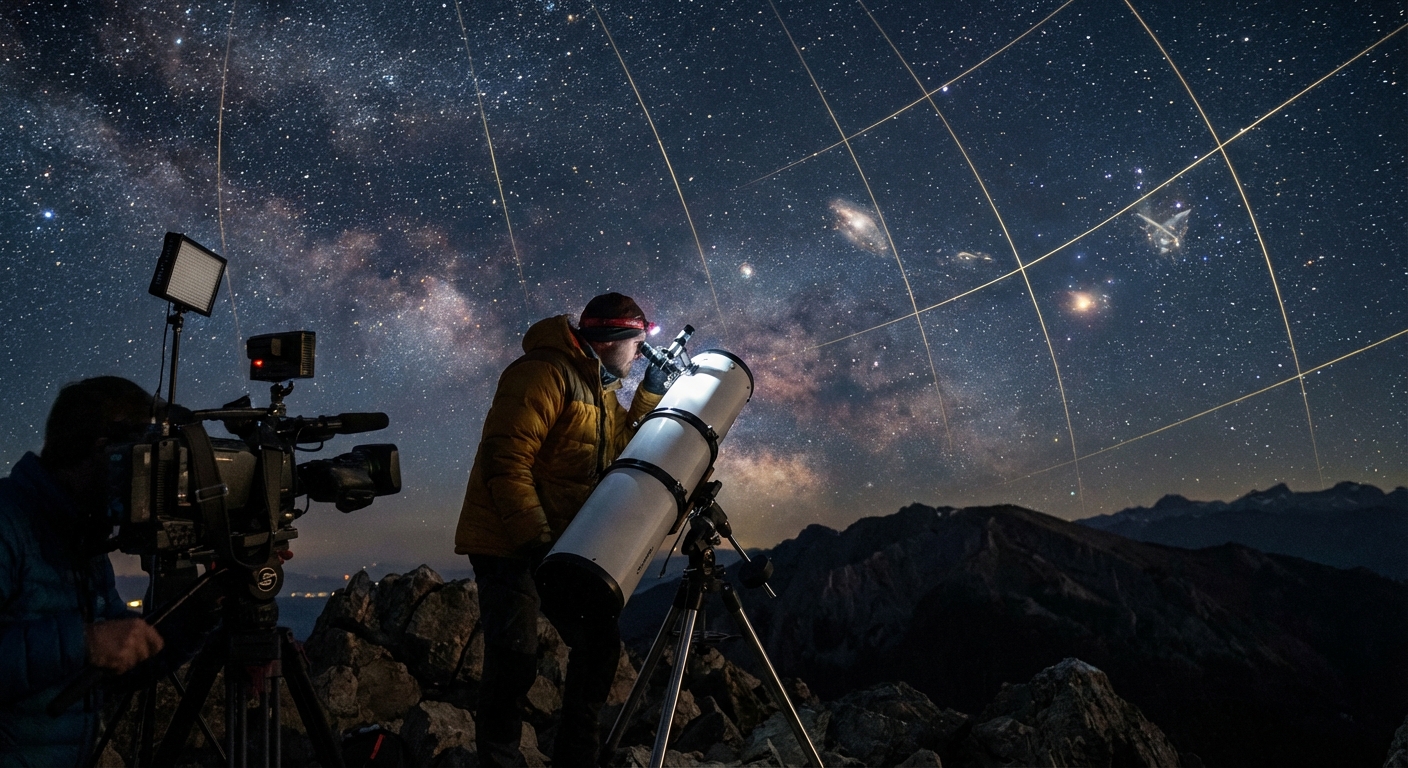
On a late winter night in 1924, a young Edwin Hubble stared at a photographic plate from the 100-inch Hooker Telescope on Mount Wilson and saw something almost unthinkable for the time: a Cepheid variable star in the Andromeda "nebula." In a stroke, Andromeda was no longer a faint cloud in our own galaxy—it was a separate island universe, now known as the Andromeda Galaxy (M31), over 2 million light-years away.
The Night We Discovered the Universe Was Bigger
That moment marks the birth of modern deep-sky astronomy: the study of celestial objects far beyond the Solar System—galaxies, nebulae, clusters, and the vast structures that web the cosmos together.
This is the story of how deep-sky observing not only expanded our sense of scale but forced us to rewrite physics itself.
What Counts as "Deep Sky"?
In observational astronomy, deep-sky objects (DSOs) typically fall into several broad categories:
- Galaxies – massive systems of stars, gas, dust, and dark matter (e.g., Andromeda, Sombrero Galaxy, M87)
- Nebulae – vast clouds of gas and dust, including star-forming regions (Orion Nebula), planetary nebulae (Ring Nebula), and supernova remnants (Crab Nebula)
- Star clusters – gravitationally bound populations of stars, either open clusters (Pleiades) or globular clusters (Omega Centauri)
- Large-scale structures – galaxy groups, clusters, filaments, and voids that make up the cosmic web
What makes them "deep" isn’t a strict distance threshold—it’s the regime of faint, extended objects whose light often takes millions or billions of years to reach us.
From Spiral Nebulae to Island Universes
Until the early 20th century, most astronomers believed the Milky Way was the entire universe and that mysterious "spiral nebulae" were just gas clouds within it. The debate climaxed in 1920 with the Great Debate between Harlow Shapley and Heber Curtis.
- Shapley argued the Milky Way was huge, and the spirals lay inside it.
- Curtis countered that spirals were "island universes"—independent galaxies like our own.
Hubble’s discovery of Cepheid variables in Andromeda settled it. Using Henrietta Leavitt’s period–luminosity relation for Cepheids, he derived distances far beyond the Milky Way’s boundaries.
Result: The universe became vastly larger overnight, and deep-sky objects were suddenly recognized as the building blocks of a much grander cosmos.
Deep Sky and the Expanding Universe
Once Hubble and others began systematically measuring both galaxy distances and their spectral redshifts, a startling pattern emerged: the farther away a galaxy is, the faster it appears to recede from us.
This is encapsulated in Hubble’s Law:
v = H₀ × d
Where:
- v is recessional velocity
- H₀ is the Hubble constant (current best estimates: ~67–74 km/s/Mpc, depending on method)
- d is distance
This relation was the first strong observational support for a dynamically evolving universe, as predicted by solutions to Einstein’s general relativity equations.
Today, measurements of deep-sky objects—especially distant galaxies and supernovae—remain crucial for determining cosmological parameters such as:
- The age of the universe
- The proportion of dark energy vs. dark matter
- The geometry (flatness) of spacetime
Recent Deep-Sky Discoveries That Changed Our Perspective
1. The Cosmic Dawn Through JWST
The James Webb Space Telescope (JWST) has pushed deep-sky astronomy into the infrared, where the light from the earliest galaxies—redshifted by cosmic expansion—can still be detected.
Highlights:
- Detection of galaxy candidates at redshifts z > 10, corresponding to less than 500 million years after the Big Bang.
- Evidence that massive, surprisingly mature galaxies existed earlier than standard models predicted, challenging our understanding of how quickly structure can form.
- Detailed spectroscopy of these objects reveals information about early star formation, metallicity, and ionizing radiation.
This work targets the Epoch of Reionization, when the first luminous objects ionized the neutral hydrogen fog that filled the young universe.
2. Mapping the Cosmic Web
Deep-sky surveys such as Sloan Digital Sky Survey (SDSS) and Dark Energy Survey (DES) have cataloged millions of galaxies, allowing 3D maps of the cosmic web—the large-scale structure formed by dark matter filaments and baryonic matter following their gravitational scaffolding.
Recent results show:
- Gigantic structures like the Sloan Great Wall and BOSS Great Wall, spanning over a billion light-years.
- Vast cosmic voids, relatively empty bubbles of space where few galaxies reside.
The statistical properties of these structures are sensitive probes of dark energy, dark matter, and the primordial fluctuations created during inflation.
3. Deep-Sky Gravitational Lenses
Massive galaxy clusters and galaxies act as gravitational lenses, magnifying and distorting background deep-sky objects.
JWST and Hubble observations of strong lenses have:
- Revealed highly magnified, ultra-distant galaxies, effectively turning nature into a cosmic telescope.
- Enabled precise mass maps of galaxy clusters, testing our models of dark matter and substructure.
Gravitational lensing of deep-sky galaxies is now a key cosmological tool.
Why Deep-Sky Objects Matter for Everyday Physics
Deep-sky observations aren’t just cataloging pretty pictures—they’re laboratories for fundamental physics:
- Dark Matter: Galaxy rotation curves, cluster dynamics, and lensing arcs all point to invisible mass shaping deep-sky structures.
- Dark Energy: Type Ia supernovae in distant galaxies revealed that cosmic expansion is accelerating, implying a repulsive component to spacetime.
- Nuclear physics: Supernova remnants and planetary nebulae show where heavy elements are forged and recycled, linking stellar nucleosynthesis to planetary formation and life.
In many ways, the deep sky is where theories go to be stress-tested under extreme conditions impossible to replicate on Earth.
Observing the Deep Sky from Your Backyard
Deep sky might sound like an elite domain of giant observatories, but amateur astronomers have always played a vital role.
With a modest telescope (even 6–8 inches of aperture) and dark skies, you can see:
- The Orion Nebula (M42) – a nearby star-forming region
- Andromeda Galaxy (M31) – visible even in binoculars
- Hercules Cluster (M13) – a dense globular cluster of hundreds of thousands of stars
- The Leo Triplet – a compact group of three interacting galaxies
Long-exposure astrophotography using consumer CMOS cameras now allows amateurs to capture faint nebulae and galaxies once reserved for professional equipment.
Amateur discoveries still make headlines: from new planetary nebulae to unusual supernovae in distant galaxies.
The Future: Deeper, Wider, Stranger
The coming decade will see deep-sky astronomy enter an even more data-rich era:
- Vera C. Rubin Observatory (LSST) will repeatedly image the entire southern sky, generating tens of terabytes of data per night and creating a dynamic deep-sky movie.
- Euclid (ESA) and Nancy Grace Roman Space Telescope (NASA) will map billions of galaxies to decode dark energy and cosmic structure growth.
- Next-generation 30–40 meter ground-based telescopes will resolve individual stars in galaxies far beyond our local group.
These instruments won’t just deepen our reaches—they’ll allow us to see how the deep sky changes over time, catching transient events like supernovae, tidal disruption events, and perhaps even rare signatures of exotic physics.
A Universe of Faint Glows
Step under a truly dark sky and most of the universe is invisible to your eyes—a handful of naked-eye galaxies, some clusters, a few smudges of nebulosity. Yet behind that seeming emptiness lies a lattice of trillions of galaxies and unfathomable distances.
Deep-sky astronomy is an act of inference and patience: gathering photons that have traveled for eons, decoding them into a story of how space, time, matter, and energy came to be arranged as they are.
We began by discovering that the universe is bigger than we imagined. The more deeply we look, the more it answers—and the more difficult, beautiful questions it leaves behind.