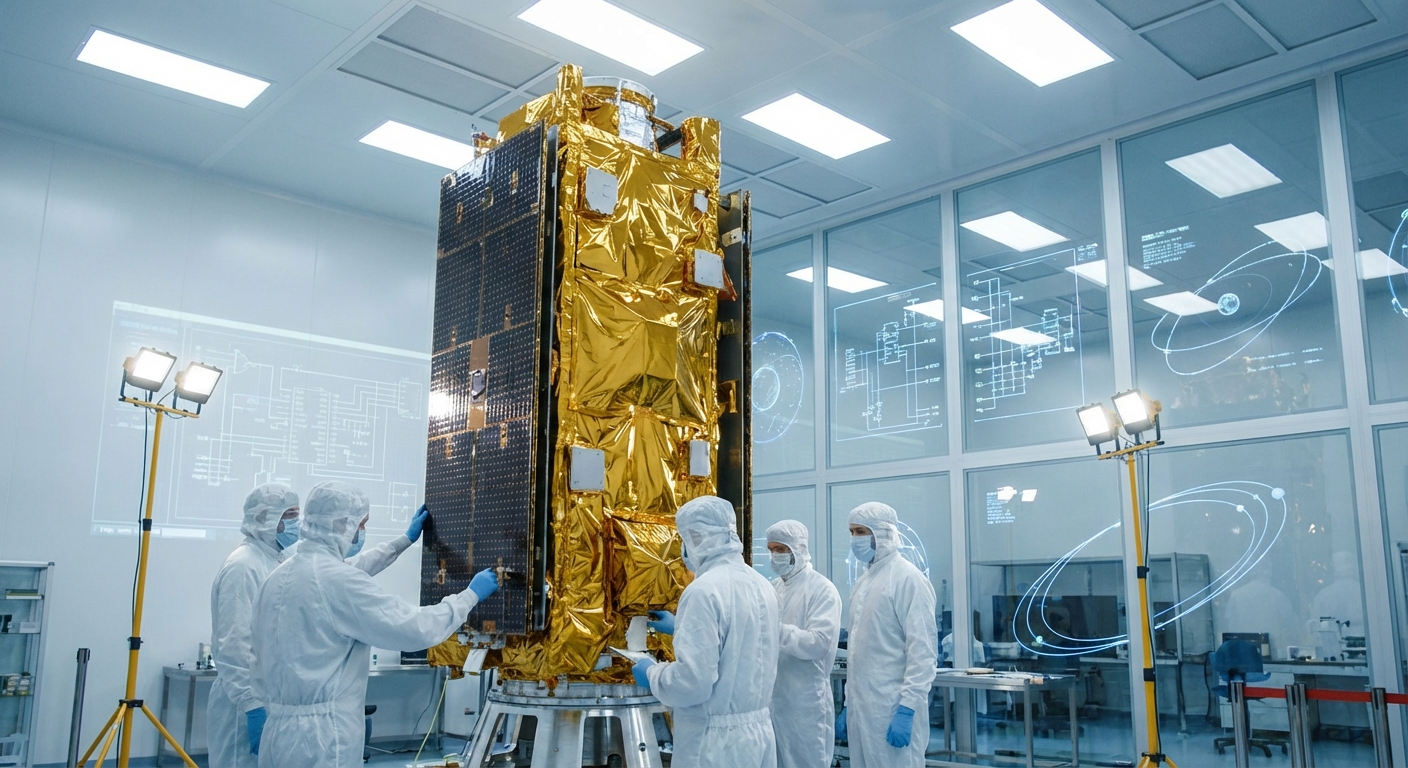
Not all space missions are created equal. Some are nimble pathfinders, built quickly to test new ideas. Others are workhorses, launched in series to monitor the Sun or Earth’s climate. And then there are flagships—the multi-billion-dollar, once-in-a-generation observatories and probes that redefine entire fields of science.
What Makes a Space Mission a "Flagship"?
Think of Voyager, Cassini–Huygens, Hubble, James Webb Space Telescope (JWST), and the upcoming Europa Clipper and Nancy Grace Roman Space Telescope. These missions resemble joint scientific cathedrals more than conventional engineering projects: intricate, expensive, and designed to last.
Understanding how they’re conceived and built is a window into how humanity chooses its biggest scientific bets.
It Starts With Questions, Not Hardware
The origin of a flagship mission is almost never a telescope design or a rocket concept. It begins with a deceptively simple query: What do we most need to know?
Every decade, the U.S. scientific community conducts Decadal Surveys in astronomy, planetary science, and heliophysics, coordinated by the National Academies. These surveys collect input from thousands of scientists worldwide and converge on a prioritized list of big questions.
Examples:
- How do galaxies, stars, and planets form and evolve?
- Are there habitable environments—or life—beyond Earth in our Solar System?
- What is the nature of dark energy and dark matter?
From those questions, the community proposes science traceability matrices—formal documents that connect:
- High-level goals → specific measurements → required instruments → mission concepts.
Only then does mission design begin in earnest.
Stakeholders in Space: Who’s at the Table?
Building a flagship is an international team sport:
- Space agencies: NASA, ESA, JAXA, CSA and others coordinate funding, management, and launch services.
- Science teams: Principal investigators and instrument leads define observing programs and data products.
- Industry: Large aerospace primes (e.g., Northrop Grumman, Airbus) and specialized firms build spacecraft, optics, and subsystems.
- Public and policy makers: Ultimately provide the political will and tax funding.
For example, JWST involved contributions from NASA, ESA, and CSA, with major components built across continents. This spreads cost and risk—but also layers in political and schedule complexity.
Mass, Power, and the Ruthless Mathematics of Design
Once science requirements are defined, they collide with physics and economics. Spacecraft designers live in a multi-dimensional trade space:
- Mass budget: Every kilogram has to be lifted out of Earth’s gravity well. Launch vehicles impose strict upper limits.
- Power budget: Instruments, computers, heaters, transmitters—all draw from finite solar panels or radioisotope generators.
- Volume and fairing size: Determines how large mirrors, antennas, or booms can be before they must fold or deploy.
- Thermal environment: Deep space can be brutally cold or, near the Sun, dangerously hot. Instruments demand narrow temperature ranges.
Flagships survive through systems engineering, which balances these competing demands via:
- Trades: For example, a larger telescope mirror improves resolution but increases mass and cost. How big is big enough to achieve the science?
- Margins: Extra capacity in mass and power as buffers against unforeseen growth.
- Redundancy: Critical systems often have backups, which again increase mass and complexity.
JWST’s iconic segmented mirror, for instance, was a compromise between scientific ambition (a 6.5-meter primary mirror) and launch constraints (Ariane 5’s fairing), necessitating an origami-like deployment sequence.
Orbit as an Instrument Choice
Where a mission goes is as crucial as what it carries.
Examples of orbit as strategy
- Hubble Space Telescope: Low Earth orbit for servicing by Space Shuttle; trade-off includes atmospheric drag and Earth occultations.
- JWST: Sun–Earth L2 point (~1.5 million km away) for a cold, stable thermal environment ideal for infrared observations.
- Europa Clipper (launching mid-2020s): Multiple flybys of Europa while orbiting Jupiter, avoiding intense radiation belts that would quickly fry electronics.
- Solar Orbiter: Highly elliptical orbit that gradually inclines, offering rare views of the Sun’s poles.
Orbit selection impacts:
- Communications latency and bandwidth.
- Required propulsion and fuel mass.
- Thermal design complexity.
- Radiation shielding needs.
Orbit is not just a destination; it’s an integral part of the “instrument.”
Sensing the Cosmos: Instrument Suites and Trade-offs
Flagship missions tend to carry complex instrument suites rather than single sensors.
Take Europa Clipper as an example:
- Ice-penetrating radar: To probe the thickness of Europa’s ice shell.
- Magnetometer and plasma instruments: To infer the depth and salinity of its subsurface ocean.
- Spectrometers (UV, IR, mass): To analyze surface composition and any plumes.
- High-resolution cameras: To map surface geology and potential landing sites.
Each instrument adds mass, power, data rate, and heat. Not every wish-list instrument makes the cut. Science teams must negotiate priorities: is it more important to get a slightly better mass spectrometer, or an additional narrow-band camera filter?
These decisions are recorded in requirements documents, against which every hardware and software choice is measured. This discipline prevents scope creep from turning missions into unlaunchable monsters.
Reliability by Design: Testing for the Unknown
Space is unforgiving, and flagships are usually designed for long lifetimes—decades, in Hubble’s case. Yet they are tested on Earth, in gravity, within finite time.
Environmental testing regimes include:
- Vibration and acoustic tests: Simulate the brutal launch environment.
- Thermal vacuum (TVAC): Bake and freeze the spacecraft in vacuum chambers cycling through expected temperature extremes.
- Radiation testing: For electronics, using proton and heavy-ion beams to simulate cosmic rays and solar storms.
- Deployment tests: For booms, mirrors, antennas, and sunshields; these are notoriously high-risk.
JWST’s five-layer sunshield had to unfold through hundreds of mechanisms and release devices. Engineers rehearsed this on Earth repeatedly, but never in actual zero-g and vacuum—a fundamental limitation that demanded meticulous modeling and redundancy.
Budget, Delay, and the Politics of Patience
Flagships routinely face budget overruns and schedule slips. JWST, originally slated for a much earlier and cheaper launch, ultimately flew in 2021 with a price tag around $10 billion.
Why it’s hard to stay on schedule:
- First-of-a-kind technology: No commercial off-the-shelf components for 6.5-meter cryogenic space mirrors.
- Reliability standards: Near-zero tolerance for failure in missions that cannot be repaired.
- Integration complexity: Components built by different contractors and nations must work together seamlessly.
Yet the payoff can be enormous. JWST has already:
- Discovered some of the most distant galaxies ever observed, less than 500 million years after the Big Bang.
- Detected complex organic molecules in exoplanet atmospheres.
- Imaged protoplanetary disks in unprecedented detail.
Scientific return often dwarfs initial promises, justifying the long waits.
Data Deluge: Turning Bits into Breakthroughs
A flagship’s mission truly begins once the instruments switch on.
The downstream infrastructure is vast:
- Deep Space Network (DSN): Global antenna arrays receiving weak signals from billions of kilometers away.
- Data pipelines: Calibration, compression, and archiving systems.
- Public archives: Hubble and JWST data become publicly accessible after proprietary periods, fostering open science.
Missions often exceed their designed lifetimes, creating long, homogeneous datasets invaluable for studying slow phenomena—stellar evolution, planetary climate cycles, or changes in Saturn’s rings.
Why Flagships Still Matter in an Era of Smallsats
The rise of cubesats and constellations might suggest that giant missions are outdated. In reality, they are complementary.
- Smallsats: Agile, cheap, great for targeted experiments, technology demos, or monitoring.
- Flagships: Deep sensitivity, long lifetimes, and complex instrument suites capable of addressing multi-faceted questions.
For example, swarms of smallsats might map magnetic fields or cosmic rays in three dimensions, while a flagship observatory provides the high-resolution spectral data needed to interpret those patterns.
The Next Wave of Flagships
On the horizon:
- Europa Clipper: Probing one of the most promising habitable environments in the Solar System.
- Nancy Grace Roman Space Telescope: Wide-field cosmology and exoplanet microlensing surveys, tackling dark energy and planet demographics.
- LISA (Laser Interferometer Space Antenna): A space-based gravitational wave observatory measuring spacetime ripples from massive black hole mergers.
Each of these missions took shape over decades, surviving political shifts and technical hurdles. They are monuments not just to engineering, but to a collective decision that some questions are worth answering slowly, expensively, and with unwavering care.
Flagship missions embody a quiet audacity: the belief that we can build machines that outlast their designers, travel farther than any engineer will, and still send back data that surprises the very scientists who conceived them.