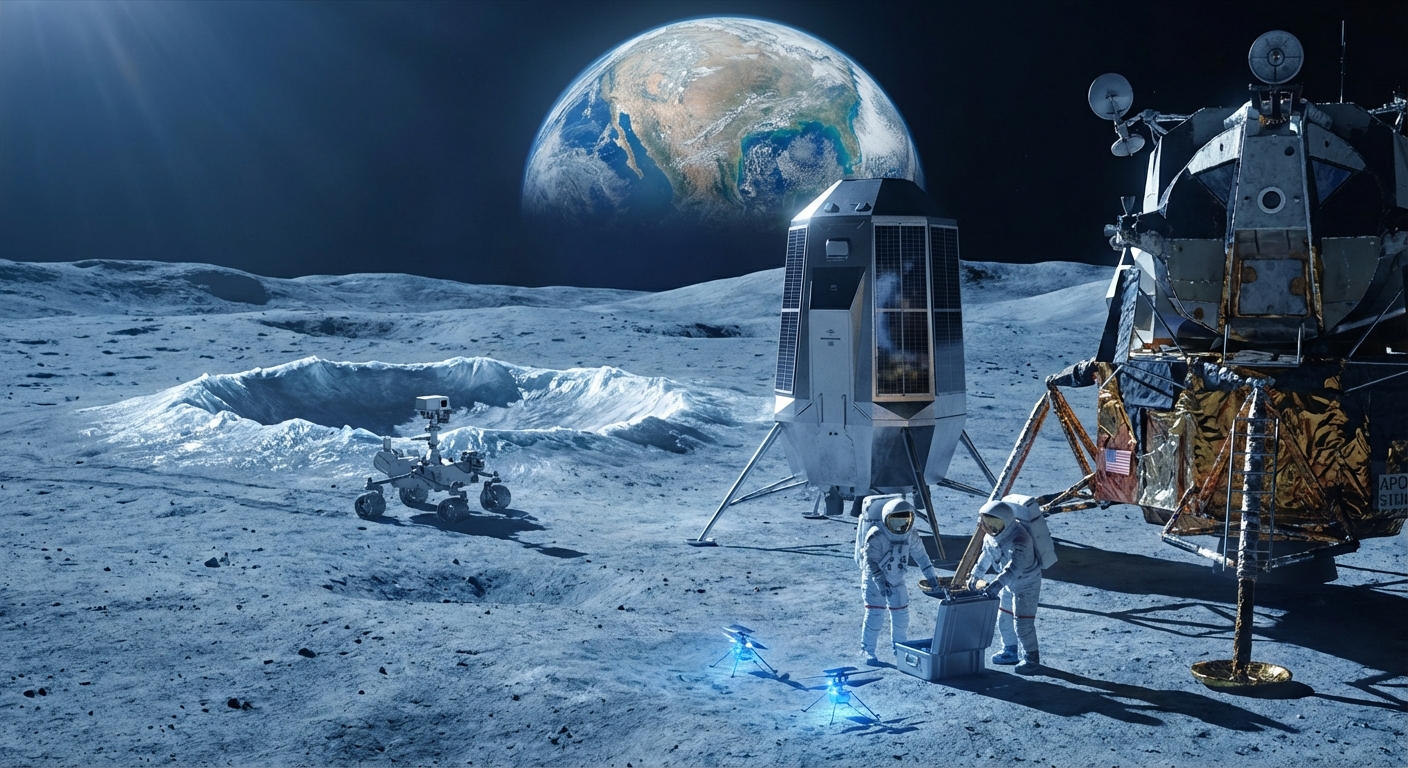
For decades, the Moon was treated like a finished chapter in space history: we went, we planted flags, we came home. Yet the 21st century has quietly turned our satellite into the hottest destination in the Solar System. From NASA’s Artemis program to India’s Chandrayaan-3 and China’s Chang’e series, a new generation of missions is transforming the Moon from a Cold War trophy into a working laboratory, fueling both science and a nascent cislunar economy.
A New Lunar Century
The modern lunar story is not about footprints. It’s about water, resources, long-term habitation, and a strategic high ground that bridges Earth orbit and deep space.
From Flags to Fieldwork
Apollo’s legacy—and its blind spots
Apollo delivered spectacular achievements: six successful landings, hundreds of kilograms of lunar rocks, and proof that humans could operate in deep space. But the missions were geographically limited: a handful of equatorial sites on the near side, visited for days at a time.
Key scientific questions were left hanging:
- How common is water ice at the poles?
- What is the full timeline of lunar volcanism?
- How uniform is the Moon’s crust and mantle composition?
- How does long-term dust exposure affect hardware and human health?
Today’s missions are designed less like heroic sprints and more like a coordinated field campaign.
The Polar Pivot: Chasing Lunar Water
One of the most consequential discoveries of the last two decades is that the Moon is not entirely dry.
- 1990s–2000s hints: Missions like Clementine and Lunar Prospector found indirect signatures of hydrogen near the poles.
- LCROSS (2009): NASA slammed a spent rocket stage into the Cabeus crater. Instruments detected water vapor and other volatiles in the ejecta.
- LRO & Chandrayaan-1: Neutron and spectral measurements confirmed widespread hydrogen enrichment, consistent with water ice in permanently shadowed regions (PSRs).
These PSRs act like cold traps; some areas haven’t seen sunlight for billions of years. Temperatures can plunge below -230°C, preserving a fossil record of volatile delivery to the inner Solar System.
Why lunar water matters
- Life support: Water for drinking and oxygen production.
- Propellant: Electrolyze water into hydrogen and oxygen—high-performance rocket propellants. A lunar refueling depot could radically reduce the cost of accessing deep space.
- Science: Isotopic fingerprints of lunar ice can reveal whether it came from comets, asteroids, or solar wind interactions.
This is why many modern missions—from NASA’s VIPER rover to upcoming landers—aim squarely at the poles.
Artemis: The Architecture of a Lunar Return
NASA’s Artemis program is often summarized as “Apollo 2.0,” but architecturally it’s closer to an evolving space infrastructure.
Key elements:
- Space Launch System (SLS): Heavy-lift rocket to send Orion and cargo beyond low Earth orbit.
- Orion spacecraft: Deep-space crew vehicle designed for multi-week missions.
- Human Landing System (HLS): Commercially built landers (e.g., SpaceX’s Starship variant and Blue Origin’s Blue Moon) to ferry astronauts from lunar orbit to the surface.
- Gateway: A small, modular space station in a near-rectilinear halo orbit (NRHO) around the Moon, serving as a staging node.
What’s different from Apollo
- International and commercial: ESA, JAXA, CSA, and private companies are core partners, not side participants.
- Sustained presence: Habitats, cargo landers, and surface infrastructure are part of the baseline plan.
- Science-first sites: Candidate Artemis landing regions focus on permanently shadowed craters and nearby illuminated ridges—ideal for both power and ice prospecting.
Artemis I (2022) has already performed an uncrewed lunar flyby and return, proving Orion’s systems. Artemis II (crewed flyby) and Artemis III (first crewed landing at the south polar region) will push human operations back into deep space.
The Global Lunar Rush: Not Just NASA
India’s precision touchdown
In 2023, Chandrayaan-3 made India the fourth nation to achieve a soft landing on the Moon—and the first to land near the south polar region.
The Vikram lander and Pragyan rover:
- Performed in-situ measurements of thermal properties of the regolith.
- Confirmed the presence of sulfur and other elements, refining models of lunar geology.
- Demonstrated low-cost, highly resilient engineering after Chandrayaan-2’s partial failure.
China’s sample-return feats
China’s Chang’e program has quietly built an end-to-end lunar capability:
- Chang’e 3 & 4: Landed and roved on the near and far side respectively—the first far-side landing in history.
- Chang’e 5 (2020): Returned ~1.7 kg of lunar samples from Oceanus Procellarum.
Analysis of Chang’e 5 samples revealed basaltic rocks as young as ~2 billion years, extending the timeline of lunar volcanism well beyond Apollo’s 3–4 billion-year-old samples. This single mission forced revisions to thermal evolution models of the Moon.
Future Chang’e iterations target the south pole and large-scale sample return, including from PSRs.
The Commercial Layer: CLPS and Beyond
NASA’s Commercial Lunar Payload Services (CLPS) initiative outsources many robotic deliveries to the private sector.
Companies such as Astrobotic, Intuitive Machines, Firefly, and others are building landers to:
- Deliver science instruments and technology demos.
- Test navigation, communication, and ISRU (in-situ resource utilization) hardware.
- Lower the cost per kilogram of reaching the lunar surface.
This iterative approach accepts higher risk on individual missions in exchange for faster learning cycles and a broader industrial base.
Technology Transformations: How We Land and Live Differently Now
Precision landing and hazard avoidance
Where Apollo relied on astronauts to visually avoid boulders, modern missions combine LIDAR, optical navigation, and terrain-relative navigation (TRN) to achieve meter-scale accuracy.
This is essential for:
- Targeting narrow PSRs.
- Landing near pre-deployed infrastructure.
- Avoiding slopes, rocks, and craters autonomously.
Surviving the lunar night
A lunar day lasts ~14 Earth days, followed by ~14 days of brutal darkness and cold. Many earlier landers were designed for a single lunar day. Emerging strategies include:
- Advanced batteries and radioisotope heaters to bridge the night.
- Sun-tracking habitats on peaks of near-eternal light.
- Thermal mass and regolith shielding to damp temperature swings and protect from radiation.
The Moon as a Science Platform
The Moon is not just a destination; it’s a vantage point.
- Lunar far side radio astronomy: Shielded from Earth’s radio noise, the far side is ideal for low-frequency radio observatories probing the Cosmic Dark Ages.
- Seismology 2.0: A new global seismometer network could refine models of the lunar core and crust, informing planetary formation theories.
- Fundamental physics: Long-baseline laser ranging and precision clocks on the lunar surface can test aspects of general relativity.
Ethical and Policy Frontiers
As multiple actors eye the same polar regions and resources, questions arise:
- How do we prevent interference between missions in delicate PSRs?
- What constitutes acceptable resource extraction under the Outer Space Treaty?
- Should some scientifically unique regions be set aside as protected zones?
The Artemis Accords attempt to establish norms around transparency, interoperability, and the concept of "safety zones"—non-ownership buffers to minimize operational conflict—but global consensus is far from settled.
The Moon as a Waypoint, Not a Wall
The true power of this new lunar era is that it turns cislunar space into a training ground for Mars and beyond.
- Dust mitigation techniques developed on the Moon will inform Mars surface ops.
- ISRU methods for water and oxygen will carry over to Martian ice deposits.
- Psychological and logistical lessons from months-long missions just three days from Earth will de-risk years-long journeys.
Far from being an already-solved problem, the Moon is revealing new layers of complexity with every mission. It is both our oldest cosmic companion and our newest frontier—a place where the echoes of Apollo meet the infrastructures of a multi-planetary future.