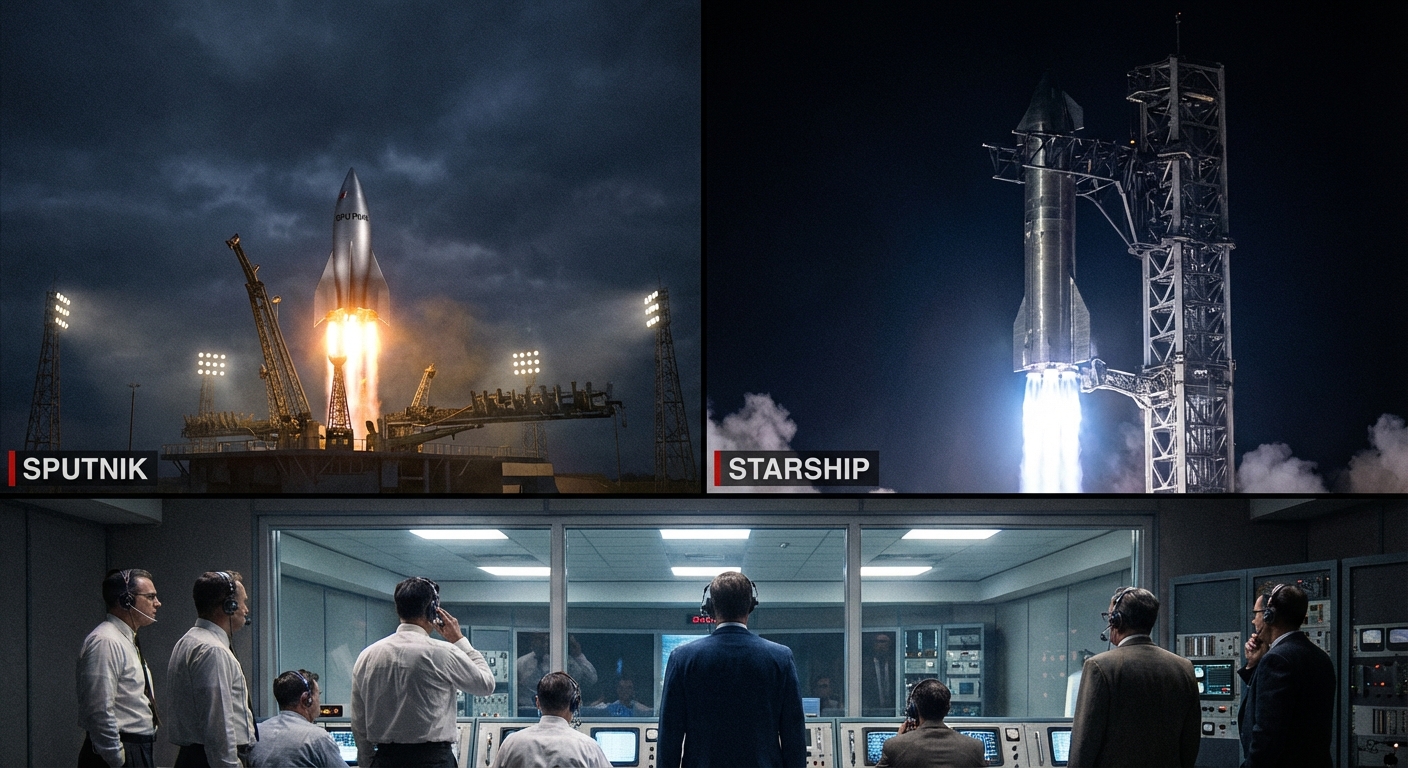
Every ambitious space mission—whether a cubesat or a flagship observatory—must first survive the same violent ordeal: launch. Rockets are more than just transportation; they are architectural constraints that shape what is scientifically and economically possible.
Why Launch Systems Still Dominate the Equation
Comparing modern launch systems reveals how we moved from the minimalist, expendable rockets of the Cold War to partially and soon fully reusable workhorses that are redefining the cadence and cost of reaching orbit and beyond.
A Brief Lineage: From Early Boosters to Heavy Lifters
The pioneering era
- Sputnik and Vostok (R-7 family): Derived from ICBMs, these Soviet rockets launched the first satellite and the first human. They established two key ideas: multi-stage configurations and clustered engines.
- Saturn V: NASA’s Moon rocket remains one of the most powerful launch vehicles ever flown, delivering ~140 metric tons to low Earth orbit (LEO). It set a benchmark for heavy-lift capability that stood unchallenged for half a century.
These early systems were entirely expendable: each launch meant discarding engines, tanks, and hardware into the ocean or atmosphere.
Expendable vs. Reusable: A Paradigm Shift
Expendable Launch Vehicles (ELVs)
Classic ELVs include:
- Ariane 5/6 (ESA)
- Atlas V, Delta IV (U.S.)
- Proton (Russia)
- H-IIA/B (Japan)
Advantages:
- Mature technology and predictable performance.
- Simpler structural and thermal requirements (no need to survive re-entry).
Disadvantages:
- Hardware thrown away after each mission.
- High per-launch cost limits mission frequency and scope.
Partially reusable systems
The last decade saw a major break:
- SpaceX Falcon 9 and Falcon Heavy: Designed to land and reuse first stages, sometimes multiple times.
Consequences for missions:
- Cost reduction: LEO launch prices have dropped from tens of thousands of dollars per kilogram to a few thousand, with further reductions likely.
- Higher cadence: Frequent launches enable more iterative mission design and risk-tolerant experiments.
- Secondary payload opportunities: More flights mean more chances for smaller missions to hitchhike.
Falcon 9 has become a de facto global workhorse for commercial, government, and scientific payloads.
Toward full reusability
- Starship (SpaceX): A fully reusable two-stage system under development, aiming for >100 tons to LEO with both stages recovered and reflown.
- New Glenn (Blue Origin): Planned partially reusable heavy-lift rocket with a reusable first stage.
If these systems mature, the economics and design of space missions could be transformed yet again.
Matching Missions to Rockets: A Practical Comparison
Factor 1: Destination and energy requirements
Sending a weather satellite to LEO is very different from injecting a probe toward Jupiter or Mars.
- LEO (~200–2000 km): Used for Earth observation (Sentinel, Landsat), crewed missions (ISS, soon commercial stations), and many smallsats.
- Rockets: Falcon 9, Soyuz-2, Long March 2/4/6, Vega, PSLV.
- GEO transfer and beyond Earth orbit: Telecom satellites, navigation constellations, and deep space missions.
- Rockets: Falcon Heavy, Ariane 5/6, Atlas V, Delta IV Heavy, Long March 3/5.
- Heavy interplanetary payloads or large observatories:
- Historically: Saturn V for Apollo.
- Now and upcoming: SLS (Space Launch System), Falcon Heavy, potentially Starship.
Delta-v (change in velocity) needs dictate stage count, propellant types, and fairing mass.
Factor 2: Fairing size and configuration
Sensitive platforms like space telescopes and planetary landers demand roomy, stable fairings.
- Ariane 5/6 and Falcon 9/Heavy: Have flown large communications satellites and probes (e.g., JWST on Ariane 5).
- SLS Block 1B: Will feature an enlarged fairing intended for massive, complex payloads tied to Artemis.
Fairing volume, not just mass-to-orbit, often limits instrument size and deployment concepts.
Factor 3: Reliability and heritage
Science missions often choose rockets with extensive flight records:
- Soyuz-2: Dozens of years of heritage, used for crewed and cargo flights.
- Atlas V: Exceptional reliability for flagship missions like Mars rovers and interplanetary probes.
- PSLV: India’s proven launcher for Earth observation and planetary missions.
Newer systems must earn trust before they carry billion-dollar payloads.
Case Studies: Rockets Shaping Missions
JWST and Ariane 5
- JWST’s mass, folded mirror, and massive sunshield required a high-performance, stable launcher.
- Ariane 5’s precise injection into its transfer trajectory to L2 minimized JWST’s fuel use, extending mission life.
Mars sample return architecture
- Perseverance rode an Atlas V to Mars, but upcoming stages of Mars Sample Return may involve multiple launches on different vehicles.
- ESA’s Ariane 6 is expected to launch the Earth Return Orbiter.
The need to coordinate trajectories, mass limits, and planetary protection protocols tightly couples mission and launcher.
Artemis and SLS vs. Commercial Options
- SLS (Space Launch System): Expendable heavy-lift rocket designed for deep-space crewed missions, capable of sending Orion and large payloads to lunar orbit in a single launch.
- Parallel commercial developments (Falcon Heavy, Starship) are being considered for cargo delivery, station modules, or even alternative architectures.
This evolving mix of government-developed and commercial heavy lift will influence how we structure future lunar and Martian missions.
Propulsion Choices: Chemical, Electric, and Beyond
Launch systems are overwhelmingly chemical rockets, optimized for high thrust to overcome gravity.
Once in space, many missions switch to different propulsion:
- Chemical upper stages: For rapid trans-lunar or interplanetary injection.
- Solar electric propulsion (SEP): High-efficiency, low-thrust ion or Hall effect thrusters (e.g., NASA’s DART, BepiColombo, upcoming Psyche), ideal for slow burns and fine maneuvers.
Future integration of nuclear thermal or even beamed propulsion would again alter how mission designers think about launch mass and staging.
How Reusability Changes Mission Design
Lower launch costs and higher cadence influence missions in nuanced ways:
- More risk-tolerant science: Cheaper, more frequent launches make it acceptable to fly bold technology demos and small science payloads that may fail.
- Modular architectures: Instead of one monolithic observatory, designers can consider constellations or segmented systems assembled in orbit.
- Rapid iteration: Lessons from one mission can be quickly folded into the next, akin to agile software development.
We’re already seeing:
- Swarms of Earth-observation smallsats (Planet, Spire).
- CubeSats hitching rides on planetary missions (e.g., MarCO on InSight, EQUULEUS on Artemis I).
Environmental and Safety Considerations
As launch cadence increases, so do concerns:
- Orbital debris: Upper stages and fairings can remain in orbit if not properly deorbited.
- Launch emissions: Black carbon and alumina particles from solid and kerosene-fueled rockets may impact the upper atmosphere.
- Downrange safety: Booster recovery zones and stage splashdowns must avoid populated areas and sensitive ecosystems.
Agencies and companies are responding with:
- Controlled deorbit and passivation of spent stages.
- Studies into alternative fuels (e.g., methane, "green" monopropellants).
- Stricter space traffic management and debris mitigation guidelines.
Looking Ahead: Toward Routine Access to Deep Space
The trend lines are clear:
- Growing reusability and mass-to-orbit.
- More international and commercial players, especially from Asia and emerging space nations.
- Increasing mission diversity—from lunar infrastructure to asteroid mining and interplanetary cubesats.
Launch systems are no longer bespoke, one-mission tools; they are becoming an industrial backbone. In the same way that reliable shipping and aviation networks unlocked global trade and scientific expeditions on Earth, routine, affordable lane access to orbit will unlock new classes of space missions that are still hard to imagine.
For now, every satellite, probe, and telescope still owes its existence to the violent grace of a rocket. Understanding these launch systems isn’t just an engineering curiosity—it’s a lens into what kinds of questions we can afford to ask the universe, and how often we get to ask them.