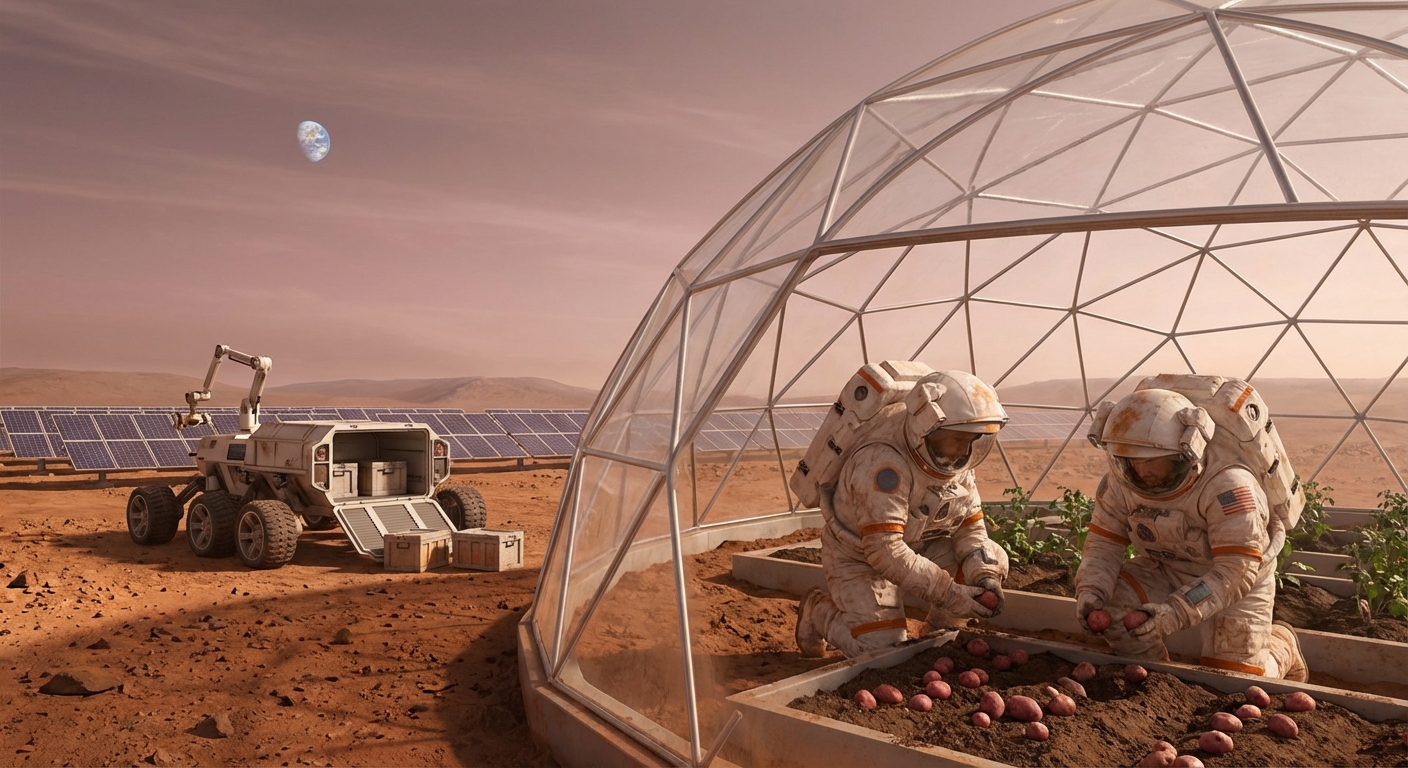
Every kilogram launched from Earth is staggeringly expensive. Even with reusable rockets driving costs down, sending water, air, and fuel across tens of millions of kilometers to Mars or the Moon is akin to supplying a remote outpost entirely by helicopter. Sustainable exploration demands a different philosophy: use what you find where you go.
From Cargo Runs to Cosmic Self-Sufficiency
That idea—in-situ resource utilization (ISRU)—is rapidly moving from science fiction to engineering reality. Recent and upcoming missions are actively testing how we can extract water from regolith, pull oxygen out of thin Martian air, and transform alien dirt into landing pads and habitats.
The Hidden Logistics Problem of Deep Space
Interplanetary missions have long been constrained by a brutal equation:
More payload → more fuel → more mass → more cost → fewer missions.
This “tyranny of the rocket equation” has shaped everything from Apollo’s brutally minimal lunar stays to the tight mass margins on Mars rovers.
Consider a crewed Mars mission:
- Transit time: ~6–9 months each way.
- Surface stay: ~500 days for favorable trajectories.
- Life support: Water, oxygen, food, spare parts, radiation shielding.
Trying to pack all of that onto launch vehicles at Earth would mean either colossal rockets or a prohibitive number of launches. ISRU offers a way out by turning Mars and the Moon into part of the logistics chain rather than passive destinations.
MOXIE: Breathing Mars Before We Arrive
One of the most consequential experiments in recent years flew quietly on NASA’s Perseverance rover: the Mars Oxygen In-Situ Resource Utilization Experiment (MOXIE).
How MOXIE works
Mars’ atmosphere is ~95% carbon dioxide (CO₂), very thin but omnipresent. MOXIE pulls in Martian air, filters it, compresses it, and then uses solid oxide electrolysis to split CO₂ into:
- O₂ (oxygen): useful for breathing and as rocket oxidizer.
- CO (carbon monoxide): vented for now, but potentially a feedstock for future chemistry.
Between 2021 and 2023, MOXIE ran multiple times under different conditions, ultimately producing about 122 grams of pure oxygen—enough for a small dog to breathe for 10 hours, or a human for a few hours at rest.
That sounds modest, but it validates the entire concept. Scaling MOXIE up by several orders of magnitude could enable a pre-deployed plant to manufacture tens of tons of oxygen for fuel and life support before humans ever arrive.
Why this matters for Mars missions
- Return fuel: A crewed lander might need ~30–40 tons of oxygen for ascent from Mars. Producing this locally could reduce Earth-launched mass by tens of tons.
- Habitat atmosphere: Oxygen for breathing can be tapped from the same process.
- Redundancy: Local production complements stored reserves and recycling systems, improving mission resilience.
MOXIE has effectively performed the first industrial process on another planet.
Mining the Regolith: Water, Metals, and More
Regolith—the fragmented, dusty surface material on the Moon, Mars, and asteroids—is both a hazard and a resource.
Water from lunar and Martian soil
- Lunar regolith: Especially in permanently shadowed regions, may contain up to several weight percent water ice mixed with soil. Missions like NASA’s VIPER rover (planned) aim to map and characterize these deposits in detail.
- Martian regolith: Contains hydrated minerals and, in some regions, near-surface ice. Past missions such as Phoenix (2008) actually saw subsurface ice sublimating after it was exposed.
Proposed extraction methods include:
- Excavation and heating: Dig regolith, heat it, capture and condense released water vapor.
- Microwave sintering: Use microwaves to heat regolith in place, liberating volatiles and forming solid construction materials.
Once extracted, water can be:
- Used directly for life support.
- Split via electrolysis into hydrogen and oxygen for fuel.
- Incorporated into radiation shielding around habitats.
Metals and construction materials
Lunar regolith is rich in oxides—iron, aluminum, silicon, titanium.
ISRU concepts include:
- Oxygen extraction from metal oxides, leaving behind usable metals.
- 3D printing with regolith simulants, already demonstrated on Earth, to build bricks, berms, and even structural components.
ESA, NASA, and private companies have run numerous lab and analog tests using regolith simulants heated with solar concentrators or microwaves to produce tiles, landing pads, and structural elements. The next step is taking these experiments off-world.
Building With Dust: Infrastructure from the Ground Up
Landing on loose regolith kicks up plumes of high-velocity dust, which can sandblast nearby hardware and habitats. Apollo footage already hinted at this; future sustained operations make it a critical design challenge.
ISRU turns a problem into a solution:
- Sintered landing pads: Using microwaves or laser energy to fuse the top layer of regolith into a solid pad, dramatically reducing dust.
- Regolith-filled bags or 3D-printed blocks: For radiation-shielded walls around habitats and tanks.
- Incorporating regolith into concrete-like materials using sulfur or polymer binders.
On the Moon, 10–20 cm of regolith can significantly reduce radiation exposure; burying habitats partially or fully can cut doses even further.
ISRU as a Mission Design Principle
ISRU is not a single gadget; it’s an architectural philosophy that reshapes how we design missions.
Pre-deployment and validation
Future Mars mission concepts often include:
- An automated ISRU plant landing one synodic period (26 months) before the crew.
- Remote operation from Earth to spin up oxygen and propellant production.
- A go/no-go decision for crewed launch based on verified propellant stockpiles on Mars.
This shifts risk from crewed to uncrewed phases and allows more ambitious surface operations.
Tying Earth orbit, Moon, and Mars together
A mature ISRU ecosystem might look like this:
- Moon: Water ice → propellant depots in cislunar space, supplying lunar landers and deep-space missions.
- Mars: Atmospheric CO₂ + water ice → methane and oxygen for ascent and surface vehicles.
- Asteroids: Volatiles and metals → radiation shielding, fuel, and raw materials manufactured in orbit.
This network of local resource nodes reduces dependence on Earth’s deep gravity well.
Technological and Scientific Hurdles
The physics is sound; the engineering and operations are non-trivial.
Challenges include:
- Dust intrusion: Regolith is abrasive, electrostatically clingy, and can foul seals and moving parts.
- Power: Heating regolith or running electrolysis at scale requires tens to hundreds of kilowatts of reliable power in harsh environments.
- Autonomy: ISRU systems must operate with minimal human intervention, often with long communication delays.
- Uncertain deposits: Orbital remote sensing can only estimate resource distribution; in-situ prospecting is essential.
Each ISRU test on missions—from MOXIE to planned lunar drills and reactors—is as much an experiment in remote industrial automation as it is in chemistry.
Ethics of Extraterrestrial Extraction
ISRU also raises foundational questions:
- Does extracting resources from the Moon or Mars constitute “appropriation” under the Outer Space Treaty?
- Should certain regions—like scientifically pristine ice deposits—be protected from large-scale industrial activity?
- How do we ensure that early ISRU efforts remain transparent and cooperative rather than triggering a resource scramble?
The Artemis Accords and national space resource laws (e.g., in the U.S. and Luxembourg) represent early attempts to reconcile economic activity with non-ownership principles, but a global consensus is still emerging.
Learning to Be Interplanetary
ISRU experiments on current missions are humble: grams of oxygen, lab-scale regolith processing, concept demonstrators. But they mark a turning point as significant, in logistical terms, as the first use of sails or steam on Earth’s oceans.
A civilization that can:
- Draw breath from Martian air,
- Drink water melted from lunar shadows,
- And build shelter from alien dust,
is no longer merely visiting the Solar System—it is beginning to live within it. Interplanetary supply lines won’t be measured solely in rockets and cargo manifests, but in how well we learn to treat other worlds as environments to be understood and partnered with, rather than warehouses to be emptied.