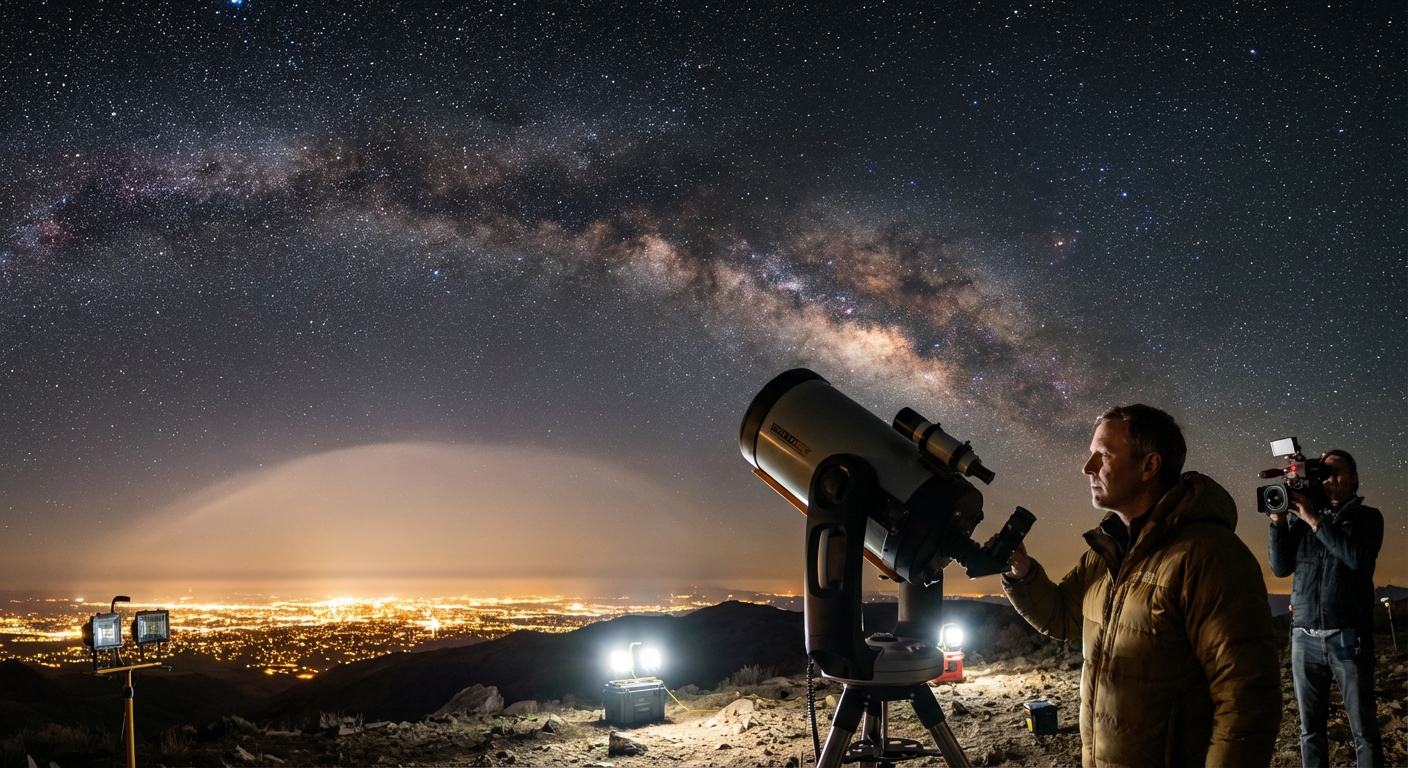
Space‑borne observatories like Hubble and JWST operate far beyond Earth’s weather and light pollution. Yet for ground-based stargazers and many professional surveys, where you observe remains decisive.
Why Location Still Matters in the Age of Space Telescopes
Light pollution is rising so fast that a 2023 analysis of Globe at Night data suggested the average sky brightened by ~10% per year in many regions. That corresponds to a child losing about half of the stars visible in their night sky by the time they’re an adult.
For space science enthusiasts, choosing your observing environment is not just about romance or aesthetics; it directly governs what phenomena you can study and how.
This guide compares dark-sky and urban observing in scientific terms—and shows you how to get the best out of each.
The Physics of a Bright Sky: Why Faint Objects Vanish
Skyglow as Noise
Astronomically, the night sky is a background signal. Faint objects become difficult to see when their light is drowned by skyglow—artificial light scattered by air molecules and aerosols.
Think in terms of signal-to-noise ratio (SNR):
- Signal: light from your target (a galaxy, nebula, comet, etc.)
- Noise: random fluctuations in the background, dominated by sky brightness
If sky brightness increases, noise goes up, and faint extended objects drop below your detection threshold—even when the telescope is capable enough.
Magnitude Limits: Naked Eye vs. Telescope
Under perfect dark skies:
- Typical naked-eye limit: magnitude +6 to +7
- With a 20 cm (8") telescope: galaxies and nebulae to mag ~13–14, sometimes fainter
Under bright city skies:
- Naked-eye limit often: mag +3 or worse (only a few hundred stars visible)
- Many galaxies with low surface brightness are nearly invisible even in moderate telescopes
Crucially, surface brightness matters as much as total brightness. A faint, diffuse nebula suffers more from light pollution than a compact star cluster of the same integrated magnitude.
Dark-Sky Sites: What Opens Up Scientifically
Deep-Sky Observing Becomes Transformative
At a true dark site (Bortle 1–2):
- The Milky Way is a luminous, structured band; dust lanes and star clouds are obvious.
- Dark nebulae—clouds of dust seen in silhouette—become visible, e.g., the Coalsack, the Pipe Nebula.
- Many galaxies in Virgo, Coma, and other clusters pop out as subtle glows instead of “nothing.”
Scientifically, you can:
- Practice galaxy morphology classification—distinguishing spirals, ellipticals, bars.
- Hunt low surface-brightness objects (Barnard’s catalog dark nebulae, dwarf galaxies).
- Observe the structure of the Milky Way and infer spiral arms by star clouds and dust lanes.
Subtle Phenomena: Airglow, Zodiacal Light, and Gegenschein
In pristine conditions, you may see:
- Airglow: faint greenish or reddish emission from atoms in the upper atmosphere.
- Zodiacal light: a soft cone of light along the ecliptic, caused by sunlight scattering off interplanetary dust.
- Gegenschein: a faint oval glow opposite the Sun, from backscattered light by the same dust.
These are not just curiosities; they’re direct visual evidence of:
- Atmospheric chemistry and upper-atmosphere processes.
- The existence and distribution of interplanetary dust.
Better Photometry and Astrometry
For serious imaging or measurement work, darker skies:
- Reduce the background in long exposures, improving SNR.
- Allow more accurate photometry (brightness measurements) of variable stars and exoplanet transits.
- Improve astrometric precision—positional measurements of asteroids and comets, crucial for orbit determination.
This is why major observatories cluster in dark places like Mauna Kea, La Palma, and the Atacama Desert.
City Skies: Limits—and Hidden Advantages
Urban environments are often written off as hopeless, but for some science targets, cities can be surprisingly productive.
What Survives the Glow
Even in Bortle 7–9 skies (severe light pollution), you can still observe:
- The Moon in exquisite detail
- Bright planets (Jupiter, Saturn, Venus, Mars)
- Double stars and many open clusters
- Bright planetary nebulae (e.g., M57 Ring Nebula, NGC 2392)
- Eclipses and lunar occultations
These objects have high surface brightness or angular contrast, making them relatively resistant to skyglow.
Science from the Sidewalk
From a city balcony, backyard, or rooftop you can:
- Conduct double-star measurements (position angle and separation) and compare with catalog values.
- Monitor lunar libration and occultations, probing the geometry of the Earth–Moon system.
- Track planetary atmospheric dynamics (Jupiter’s belts and zones, Saturn’s ring tilt, Mars dust storms).
Modern high-speed imaging and stacking techniques ("lucky imaging") allow urban observers to collect scientifically useful data, especially on planets.
Spectroscopy in the City
Even under bright skies, spectroscopy is relatively robust because you’re looking at relative intensity vs. wavelength, not faint extended structures.
With modest equipment you can:
- Record emission and absorption lines in bright stars.
- Capture low-resolution spectra of planets and bright nebulae.
- Study changes in nova and supernova spectra over time (with cooperative data or bright events).
This pushes your observing from “pictures” to physical diagnostics—temperature, composition, and motion along the line of sight.
How to Get Dark-Sky Performance in Less-Than-Dark Skies
While nothing fully substitutes for a truly dark site, you can partially compensate for light pollution with strategy and technology.
Choose Targets Wisely
Optimize for surface brightness and contrast:
- Focus on open clusters, globulars, double stars, and bright planetary nebulae.
- Avoid large, diffuse objects like the North America Nebula or the outer halos of galaxies.
Plan sessions when targets are highest in the sky (near the meridian) to minimize airmass and urban skyglow.
Filters and Their Limits
Certain optical filters can help:
- UHC (Ultra High Contrast) and O III filters enhance emission nebulae by isolating key wavelengths and suppressing some background light.
- Broadband LPR (Light Pollution Reduction) filters are less effective against modern LED-heavy spectra but can still offer modest gains.
However:
- Filters help nebulae, not galaxies (which emit broad-spectrum starlight).
- They cannot restore lost dynamic range; they only reshape it.
Shield Yourself from Direct Glare
Your local environment often matters as much as the city’s overall brightness:
- Use walls, screens, or portable panels to block direct streetlights.
- Observe from shaded courtyards or rooftops with minimal direct glare.
- Allow full dark adaptation (20–30 minutes) and avoid phones or white lights; use dim red light instead.
These steps won’t change skyglow, but they improve your eyes’ performance at the margin.
Hybrid Strategy: The Two‑Home Approach to Stargazing
For serious enthusiasts, the most effective solution is often dual-mode observing:
- City base for weeknight sessions: lunar, planetary, double stars, bright clusters, spectroscopy, practice with instrumentation and software.
- Dark-sky trips for deep-sky marathons: galaxies, nebulae, wide-field Milky Way projects, rigorous photometry.
Prepare in the city; execute under dark skies.
Planning Dark-Sky Expeditions
When you can travel to a darker site:
- Use light-pollution maps (e.g., VIIRS satellite data overlays, DarkSiteFinder) to identify Bortle 1–3 zones.
- Check altitude—higher is usually better: less atmosphere, drier air.
- Time around the new Moon for maximum darkness, unless you’re doing lunar work.
- Pre-plan target lists and star hops using desktop software or apps so you maximize your limited dark-sky hours.
Treat these trips like observing campaigns, not just escapes.
Dark Skies as a Scientific Resource Worth Defending
The accelerating loss of dark skies is not only an aesthetic concern; it constrains entire categories of research:
- Low surface-brightness galaxies and tidal streams test models of dark matter and galaxy formation.
- Faint variable stars and distant supernovae feed into distance scale and cosmology work.
- Meteor rates and faint meteor trails help probe small debris populations in the solar system.
All are harder or impossible to study as the background brightens.
Advocacy for full cutoff lighting, warmer color temperatures, and sensible illumination levels is effectively lobbying for continued access to these phenomena—for professionals and for you.
Choosing Your Sky, Choosing Your Science
Where you stargaze subtly chooses what kind of universe you’ll interact with:
- Under city lights, the sky is a laboratory for high-contrast physics: crater topography, planetary atmospheres, double stars, spectroscopy.
- Under dark skies, it becomes a canvas of structure formation and cosmic ecology: galaxies, nebulae, dust, and the Milky Way’s architecture.
Both regimes complement each other. The best stargazers learn to exploit each environment’s strengths, moving fluidly between worlds.
Space telescopes extend our reach, but they don’t replace the human experience of standing under a dark vault of stars—or even a compromised urban sky—and extracting physics from photons that have traveled for years, centuries, or eons.
The key is to be intentional: understand what your sky gives you, what it takes away, and how to work with it. The universe is still overhead, even if you have to work a little harder to see it.