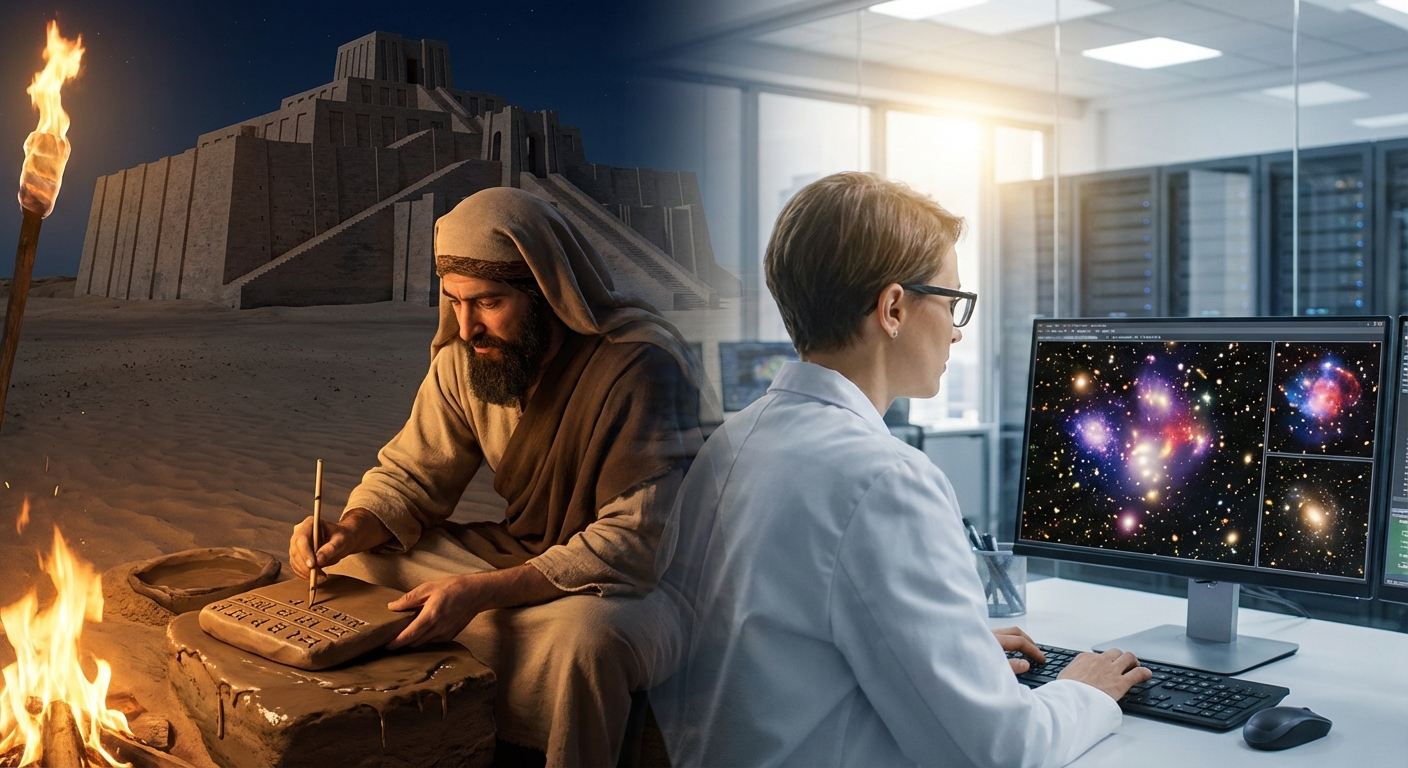
Long before “astronomy” had a name, humans watched the sky with an intensity that is hard to imagine today.
The First Science Began with Looking Up
Fixed stars, wandering planets, comets, and eclipses were not just curiosities—they were the framework for agriculture, religion, navigation, and power. Modern stargazing, with its apps and astrophotography, is the newest chapter in a story that has repeatedly transformed how we think about our place in the universe.
Tracing that history—from Babylonian omen texts to James Webb Space Telescope (JWST) deep fields—reveals something surprising: each major shift in how we look at the sky has forced a shift in how we think about reality itself.
Skywatchers of Antiquity: Patterns, Power, and Prediction
Babylon: Catalogs and Cosmic Bureaucracy
By ~1800 BCE, Babylonian astronomer-priests were recording planetary motions and eclipses on clay tablets. Their motivation was not “pure science” but divination: patterns in the sky were thought to foreshadow events on Earth.
Yet their systematic approach—meticulous, cumulative records—laid the foundation for predictive astronomy. They:
- Identified the Saros cycle of eclipses (~18 years)
- Compiled star lists and positions
- Recorded planetary retrograde loops
In trying to read the gods’ intentions, they inadvertently created one of humanity’s first large-scale data sets.
Greek Geometry Meets the Heavens
Greek thinkers reframed skywatching as a problem in geometry and philosophy. Hipparchus (~2nd century BCE) used Babylonian observations to refine models and discovered the precession of the equinoxes—Earth’s slow axial wobble over ~26,000 years.
By the time of Ptolemy (~2nd century CE), the geocentric cosmos had become a highly tuned mathematical machine: deferents, epicycles, and equants designed to reproduce observed motions.
Stargazing here was no longer chiefly divination; it was a test of how far human reason and geometry could explain the sky.
The Telescope Era: A Small Tube, a Big Upheaval
Galileo’s Glass and the Shattering of Certainties
In 1609, Galileo Galilei turned a crude telescope toward the heavens and saw:
- Mountains and craters on the Moon
- Four moons orbiting Jupiter (now called the Galilean moons)
- Phases of Venus
- Sunspots
Each observation undermined cherished assumptions:
- The Moon was not a perfect, polished sphere.
- Earth was not the only center of orbital motion.
- Venus orbited the Sun.
Stargazing had become experimentally dangerous to old worldviews. Instruments amplified not just light, but doubt.
Herschel, the Milky Way, and Cosmic Cartography
In the late 18th century, William and Caroline Herschel conducted “star gauging,” counting stars in thousands of telescopic fields to infer the shape of the Milky Way.
Their work suggested we lived in a disk-like system with the Sun near the center. The conclusion turned out to be only half-right, but the method—a statistical, survey-based approach—prefigured how astronomy would be done in the 20th and 21st centuries.
Stargazing was beginning to move from drawing single objects to mapping populations.
The Spectroscope: Turning Light into Physics
From Colors to Elements
In the mid-19th century, spectroscopy changed everything. When starlight is passed through a prism or grating, it splits into a rainbow with dark absorption lines. These lines correspond to the quantum energy levels of atoms.
By comparing stellar spectra to laboratory spectra, astronomers discovered:
- Stars and the Sun are made mostly of hydrogen and helium.
- Each star’s temperature, composition, and motion along the line of sight (via Doppler shifts) could be measured.
In other words, stargazing turned from geometry to astrophysics—the study of stars as physical objects obeying the same laws as Earthly matter.
The Cosmic Distance Ladder and an Expanding Universe
At the start of the 20th century, Henrietta Swan Leavitt found a relation between the period and luminosity of certain variable stars (Cepheids). This allowed distances to be measured far beyond parallax limits.
Armed with her discovery and huge photographic sky surveys, Edwin Hubble showed that:
- “Spiral nebulae” were actually external galaxies.
- The farther a galaxy, the faster it recedes—evidence for the expanding universe.
The night sky was no longer a static dome, but the visible edge of a dynamic, evolving cosmos.
Space Age Stargazing: Eyes Above the Atmosphere
From Sputnik to the Hubble Deep Field
The launch of Sputnik in 1957 opened a new era: telescopes no longer had to look through Earth’s blurring, absorbing atmosphere.
The Hubble Space Telescope (HST), launched in 1990, revolutionized visual stargazing with pinpoint images and the now-iconic Hubble Deep Field and Ultra Deep Field.
Those grainy, crowded images—where nearly every point of light is a galaxy—forced a reimagining of scale:
- Tens of thousands of galaxies in a patch of sky smaller than a grain of sand at arm’s length.
- Many seen as they were billions of years ago, due to light travel time.
Looking up became synonymous with looking back in time.
Multi-Wavelength Eyes
With telescopes across the spectrum—radio (VLA), infrared (Spitzer), X-ray (Chandra), gamma-ray (Fermi)—stargazing left the realm of human eyesight entirely.
We now map:
- Cold hydrogen clouds in radio
- Dust-shrouded star nurseries in infrared
- Supernova remnants and black hole jets in X-rays
Taken together, these wavelengths reveal a violent, feedback-rich universe where galaxies grow by cycles of star formation and explosive death.
JWST and the New Frontier: Ancient Light and Alien Worlds
A Time Machine for Galaxy Formation
Launched in late 2021, the James Webb Space Telescope (JWST) extends our view deeper into the infrared. Its early results include:
- Discovery of surprisingly bright, massive galaxies existing just a few hundred million years after the Big Bang, challenging models of early galaxy assembly.
- Detailed spectra of high‑redshift galaxies, revealing early chemical enrichment and dust content.
We are watching the first galaxies condense from primordial gas—a direct observational probe of cosmic dawn.
Peering Into Exoplanet Atmospheres
JWST is also turning stargazing into remote atmospheric chemistry:
- Transmission spectroscopy of exoplanets has already detected water vapor, carbon dioxide, methane, sulfur dioxide, and complex clouds.
- Targets include hot Jupiters, warm Neptunes, and super-Earths; upcoming surveys aim at smaller, potentially habitable worlds around red dwarfs.
For the first time, we are not only discovering planets but also characterizing their climates—a prelude to the search for biosignatures.
The Democratization of Deep Space: Amateurs at the Frontier
Backyard Observers and Space Missions
The gap between professional and amateur stargazing has narrowed:
- Amateur astronomers regularly discover comets and near‑Earth asteroids.
- High‑quality off‑the‑shelf cameras and small telescopes can detect supernovae in distant galaxies and perform precise exoplanet transit photometry.
- Citizen-science platforms (e.g., Zooniverse, AAVSO) rely on volunteers to classify galaxies, track variable stars, and vet exoplanet candidates.
While JWST studies the first galaxies, you can use a modest telescope to measure a star’s brightness dip as a known exoplanet transits—sampling the same physical phenomenon at a different scale.
Light Pollution: The Shrinking Sky
One sobering recent finding: a 2023 study using Globe at Night data showed that sky brightness has been increasing by ~10% per year in many places, causing a rapid loss of naked‑eye stars.
In historical terms, this is extraordinary. A human ability that shaped calendars, religions, and sciences may be vanishing from much of the world in a single century.
Stargazing’s next revolution may be political: preserving dark skies becomes a prerequisite for future generations to even see the universe their instruments will probe.
How Stargazing Keeps Rewiring Our Minds
Across 4,000+ years, stargazing has driven a series of intellectual upheavals:
- From omen to pattern – Babylonian records turned signs from the gods into repeatable cycles.
- From pattern to model – Greek geometry made the sky a mathematical object.
- From model to mechanism – Galileo and Newton connected celestial motion to universal laws.
- From mechanism to evolution – Spectroscopy and cosmology revealed stars and galaxies as evolving systems.
- From evolution to origins and life – Modern astronomy now tackles the origins of structure and the potential for biology elsewhere.
Every time we enhance our way of seeing—better records, optics, spectra, detectors—we’ve been forced to confront a more expansive, less human‑centered cosmos.
Looking Up, Then and Now
A Babylonian priest, a Polynesian navigator, Galileo at his backyard telescope, a Hubble mission planner, and a modern amateur with a sensitive CMOS camera all share a single act: they stand under the same sky and extract meaning from distant light.
What changes is what we can extract and what we dare conclude.
As JWST pushes toward the first stars and upcoming missions (like the Nancy Grace Roman Space Telescope and ground-based Extremely Large Telescopes) prepare to map dark energy and image Earth‑like exoplanets, stargazing continues its long, quiet revolution.
We still step outside, shield our eyes, and look up. But now, each point of light is a data-rich node in a cosmic network—galaxies assembling, black holes growing, planets orbiting, perhaps minds looking back.
The act is ancient. The implications are new every decade.