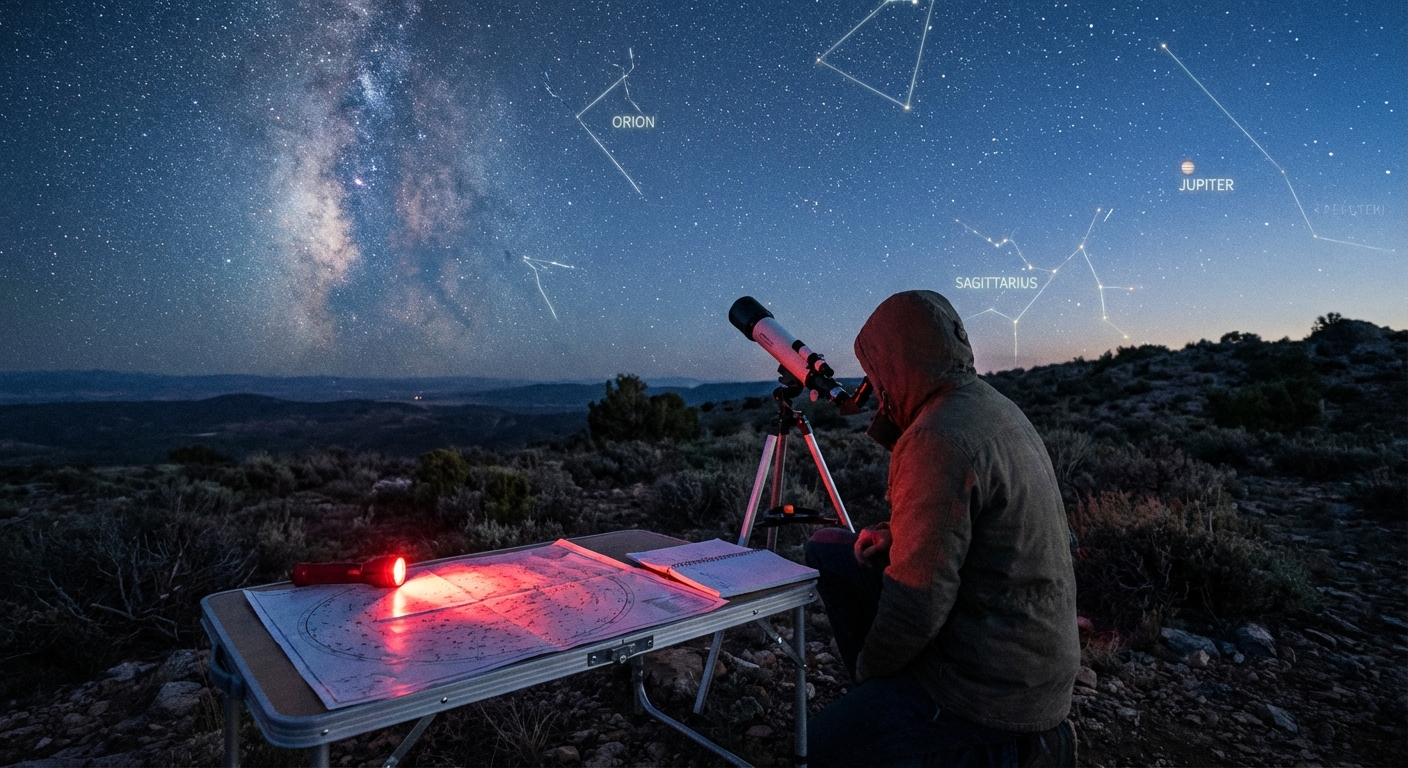
For most of human history, stargazing was navigation, myth, and calendar-keeping. Today, it has quietly become something else: a form of citizen science that can plug directly into cutting-edge astrophysics.
Why Stargazing Is More Powerful Than Ever
The same sky that guided Polynesian wayfinders now hosts exoplanets detected by TESS, gravitational-wave sources pinpointed by LIGO–Virgo–KAGRA, and fast radio bursts traced to distant galaxies. Yet the gateway to all of this is still profoundly simple: walk outside and look up.
This guide shows you how to read the sky the way professional astronomers do—using naked-eye observing, binoculars, and small telescopes as tools for understanding physical processes, not just collecting pretty views.
Step 1: Learn the Sky’s Framework — Constellations as Coordinates
Think of constellations not as pictures, but as an address system.
The Celestial Sphere in Plain Language
Astronomers imagine the sky as a giant sphere surrounding Earth:
- Right Ascension (RA): like longitude, measured in hours, minutes, seconds.
- Declination (Dec): like latitude, measured in degrees north or south of the celestial equator.
Star atlases and planetarium apps use this RA/Dec grid. When you learn constellations, you’re really learning landmarks inside that coordinate system.
A Practical Constellation Core
Instead of trying to memorize 88 constellations, focus on a few anchor patterns:
- Orion – winter Orion Nebula, belt stars as an RA reference.
- Ursa Major – year-round (in mid-northern latitudes); pointer stars to Polaris.
- Cygnus & Lyra – summer Milky Way, hosts the Cygnus X-1 black hole and the Lyra exoplanet fields observed by Kepler.
- Scorpius & Sagittarius – toward the Galactic Center and dense star fields.
Each pattern is tied to real astrophysics: black holes, star formation regions, and spiral-arm structure. When you recognize them, you’re not just “finding” stars; you’re situating yourself in the Milky Way.
Step 2: Upgrade Your Eyes — The Physics of Simple Gear
You can contribute to modern astronomy with nothing more than your eyes, but understanding your tools makes your observing more scientific.
Naked Eye: Your Built‑In Photometer
Under truly dark skies, human vision can reach magnitude +6 or slightly fainter. That sensitivity changes with:
- Light pollution (skyglow raises the background brightness)
- Airmass (objects low on the horizon are dimmed by more atmosphere)
- Adaptation time (your rods take ~20–30 minutes to fully adapt to darkness)
When you estimate star brightness or note whether you can see the Milky Way, you are effectively acting as a crude photometer, sampling sky quality. Projects like Globe at Night and Dark Sky Meter convert such human reports into global light-pollution maps.
Binoculars: The Most Underrated Scientific Instrument
A good 7×50 or 10×50 binocular acts like a mini-survey telescope:
- Light‑gathering power is proportional to aperture area. A 50 mm binocular objective gathers ~50× more light than your eye’s 7 mm dark-adapted pupil.
- Field of view (5–7°) makes it ideal for open clusters, Milky Way scanning, and comet hunting.
Many comets—like C/2020 F3 NEOWISE—are visually most impressive in binoculars, where you can see structure in the tail against the star field.
Small Telescopes: Resolution, Not Just Magnification
A 100 mm (4-inch) telescope can theoretically resolve features down to ~1.2 arcseconds (using the Rayleigh criterion: 138 / aperture in mm). In practice, Earth’s atmosphere ("seeing") limits you to ~1–2 arcseconds most nights.
That’s enough to:
- Split tight binary stars
- See shadow transits on Jupiter
- Resolve details in lunar craters only a few kilometers across
When you judge seeing and transparency during a session, you’re evaluating real atmospheric parameters that professionals also measure with dedicated instruments.
Step 3: Observe with a Scientist’s Notebook
Professional astronomers don’t just “look”; they record. You can adopt the same discipline.
What to Record Each Session
Use a paper notebook or observing app and capture:
- Date/time and location (UTC and coordinates, if possible)
- Sky conditions – transparency, seeing, estimated limiting magnitude
- Instrument details – telescope/binoculars, eyepiece, filters
- Object identifiers – common name, catalog number (e.g., M42, NGC 869)
- Quantitative notes – star colors, brightness comparisons, position angles, estimated size
This transforms casual viewing into data. Double-star observing, variable star brightness estimates, and asteroid positions all benefit from your careful descriptions.
Connecting to Pro-Level Catalogs
Instead of just “Andromeda Galaxy,” note:
- M31 / NGC 224 / RA 00h 42m / Dec +41° 16’
This lets you cross-reference databases like SIMBAD, NED, and mission archives (Hubble, JWST, Gaia) to see professional observations of the same object you just sketched in your notebook.
Step 4: Use the Sky as a Physics Laboratory
Every clear night offers live demonstrations of astrophysical principles.
Stellar Evolution in One Constellation
In Orion, you can see multiple stellar life stages at once:
- Betelgeuse – a red supergiant in a late evolutionary phase, shedding mass; its dramatic dimming in 2019–2020, likely caused by a dust cloud, was tracked by both professionals and amateurs.
- Rigel – a blue supergiant, hot and massive, representing a comparatively young evolutionary stage.
- M42 (Orion Nebula) – a stellar nursery, with newborn stars sculpting the gas.
By comparing colors, sizes, and brightness, you’re watching a continuous timescape of stellar life cycles.
Planetary Physics in Your Eyepiece
Planets are dynamic laboratories:
- Jupiter – Track the motion of the Galilean moons and their shadows transit the disk. You’re essentially redoing Galileo’s 17th-century experiment that challenged geocentrism.
- Saturn – Ring tilt changes over years due to orbital geometry. You’re seeing a 3D system evolve from our moving vantage point.
- Mars – During oppositions, albedo features (dark regions, polar caps) change with seasons, dust storms, and sublimation.
Each observation is an entry point into orbital mechanics, atmospheric physics, and radiative transfer.
Step 5: Plug into Cutting‑Edge Discoveries from Your Backyard
Stargazing is no longer just inspirational; it’s integrated with frontier research.
Exoplanets You Can’t See But Can Know
You won’t visually see an exoplanet, but with star charts you can point to:
- 51 Pegasi – first Sun-like star with a confirmed exoplanet (51 Peg b)
- TRAPPIST-1 – ultracool dwarf star with seven Earth-sized planets
- Kepler fields in Cygnus and Lyra – where thousands of planets were discovered by measuring tiny dips in starlight.
Some dedicated amateurs even perform exoplanet transit photometry using modest telescopes and CCDs, precisely measuring fractional-percent changes in brightness as planets pass in front of their stars.
Gravitational-Wave Hosts and Neutron Star Mergers
Since 2015, observatories have detected dozens of gravitational-wave events from black hole and neutron star mergers. When alerts go out, professional and amateur telescopes scour regions of sky for electromagnetic counterparts.
- The famous 2017 event GW170817, a neutron star merger, was localized to the galaxy NGC 4993. Amateurs with 30–40 cm telescopes contributed follow‑up monitoring.
When you point your scope at some ordinary-looking galaxy that once hosted such an event, you’re looking at the site of heavy-element creation—gold, platinum, and rare earth elements forged in that very collision.
Step 6: Join the Global Network of Skywatchers
Your observing can support actual research programs:
- Variable Star Observers (AAVSO) – Amateur observations extend long-term light curves over decades.
- Asteroid and Comet Hunters (MPC submissions) – Astrometry from small scopes refines orbits and assesses impact probabilities.
- Light Pollution Monitoring (Globe at Night, DarkSky) – Systematic naked-eye measurements influence policy.
In these collaborations, the distinction between “stargazer” and “scientist” blurs. Your backyard becomes an observing station in a worldwide network.
The Night Sky as a Living Textbook
To read the night sky like a scientist is to see beyond twinkling points of light into an active, evolving universe:
- Stars become thermonuclear reactors and time markers.
- Nebulae become fluorescent clouds lit by ultraviolet radiation.
- Galaxies become gravitationally bound ecosystems of dark matter, gas, and stars.
All of this is accessible from a dark hillside, a suburban backyard, or even a city rooftop with careful technique. With each sketch, brightness estimate, and logged observation, you’re not just watching the universe—you’re participating in how we come to understand it.
The sky hasn’t changed much since Babylonian astronomers scratched records onto clay tablets. What’s changed is our ability to decode what we see. Every time you step outside and look up with informed curiosity, you’re adding one more line to a story that now stretches from ancient star-priests to gravitational-wave observatories and beyond.