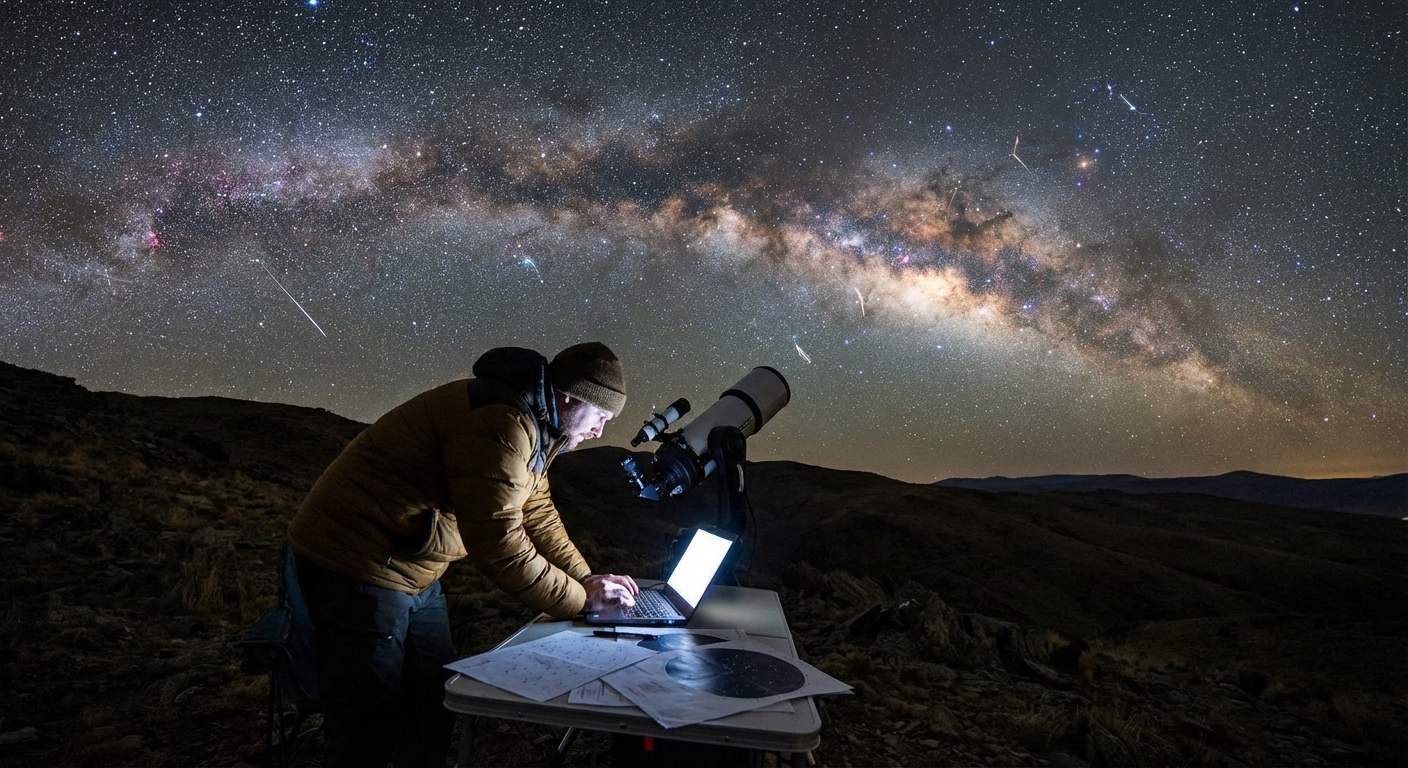
For many people, stargazing is about beauty: the Milky Way arching overhead, Saturn’s rings suspended in blackness, a meteor slicing across the sky. For space science enthusiasts, those same sights are also datasets in waiting.
Stargazing Beyond Aesthetics
Amateurs today can observe with a rigor and sophistication that would have impressed professionals a century ago. With careful technique and modest equipment, you can perform real measurements, contribute to research, and train your eye and mind to extract physics from every observing session.
These 12 advanced tips bridge the gap between casual observing and field science—without sacrificing the sense of awe.
1. Treat Your Eyes Like Instruments
Your eyes have specifications just like any sensor.
- Dark adaptation: Give yourself 20–30 minutes away from bright lights. Even a brief glance at a phone can reset this; use red-filtered displays or paper charts.
- Averted vision: Look slightly to the side of faint objects; you’ll bring them onto the more sensitive rod-rich region of the retina.
- Limiting magnitude tests: Use known star charts to see the faintest star you can detect. Record this each session as a measure of sky quality.
By tracking your own performance, you establish a baseline. Over time, you’ll detect subtle changes in transparency, light pollution, and your own observational skill.
2. Calibrate Your Sky: Bortle Class and SQM
Instead of vaguely noting “it seemed dark,” quantify your sky.
- Use the Bortle scale (1 = pristine, 9 = inner-city) as a qualitative descriptor.
- If possible, use a Sky Quality Meter (SQM) to measure sky brightness in magnitudes per square arcsecond.
Log entries like:
2026‑03‑14, 22:30 LT, Bortle 3, SQM 21.3, Milky Way obvious, zodiacal light visible.
Professional papers routinely report sky brightness; adopting similar habits makes your notes more interpretable and shareable.
3. Build an Observing Program, Not Just a Target List
Instead of random targets, think in terms of programs that address a theme or question:
- Variable star monitoring (e.g., eclipsing binaries, Cepheids)
- Monthly Mars log through an opposition, tracking albedo changes
- Jupiter feature tracking: Great Red Spot transit times, belt variations
- Double-star campaigns: measuring separation and position angles over time
Each program:
Has a clear observing strategy
Uses consistent methods
Produces comparable data sets over weeks or months
You’ll experience the sky as a dynamic system instead of a static curated gallery.
4. Learn to Estimate Brightness Scientifically
Visual photometry may seem old-fashioned, but it’s still valuable—especially for long-term monitoring.
- Use the AAVSO (American Association of Variable Star Observers) charts to find comparison stars with known magnitudes.
- Compare your target’s brightness to those stars using the fractional method (e.g., “target is halfway between mag 10.2 and 10.7 → estimate 10.45”).
- Record uncertainties: if your comparisons differ by 0.3 mag, say so.
Over time, you can train yourself to achieve ~0.1 mag precision in good conditions—impressive for eyeball measurements, and enough for many variable star projects.
5. Turn Your Smartphone into an Auxiliary Sensor
Smartphones are not ideal for deep astrophotography, but they’re powerful support instruments:
- Use GPS and time-sync apps for accurate UTC timestamps.
- Use gyroscope/compass data (via planetarium apps) for rough pointing and orientation.
- Log voice memos during sessions; transcribe later to avoid breaking dark adaptation.
Some phones, when attached to eyepieces with adapters, can capture:
- Lunar and planetary images for derotation and stacking
- Bright star fields to document meteor radiants or occultations
While your main data may come from visual estimates or dedicated cameras, the phone becomes a metadata and documentation hub.
6. Master Star Hopping as Cognitive Cartography
Relying only on GoTo mounts can limit your sky literacy. Star hopping—navigating from bright stars to faint targets using patterns—is both satisfying and scientifically useful.
Benefits:
- You’ll internalize angular distances (degrees, arcminutes) intuitively.
- You’ll recognize asterisms and use them as reference frames, like professional astronomers use coordinate grids.
- You’re less dependent on electronics and more resilient at the eyepiece.
Practice by navigating to moderately challenging objects (like M57, M13, or NGC 2392) from bright stars using printed charts with scales marked.
7. Use Sketching as a Measurement Tool
Astro-imaging is powerful, but sketching forces you to notice details and relative positions.
- Sketch fields at moderate magnification using simple circles and dots.
- Note star brightness with symbol size; indicate nebulosity with shading.
- Annotate cardinal directions (N, E, etc.) and field of view.
Later, you can:
- Compare sketches with star charts to identify objects.
- See if features (e.g., nebula brightness, jet structures in galaxies) change over time.
Many historical discoveries—like changes in Jupiter’s storms—started as careful drawings.
8. Embrace High-Speed Imaging for Planets
For lunar and planetary work, the atmosphere is your main enemy. Lucky imaging turns turbulence into an advantage.
Workflow:
- Record video at high frame rates (50–200 fps) using a planetary camera or even a capable DSLR/mirrorless in crop video mode.
- Use software (e.g., AutoStakkert!, RegiStax) to select the sharpest frames and align/stack them.
- Apply gentle wavelet sharpening to reveal fine details.
Results:
- Resolution approaching or exceeding what you see visually.
- Real features: festoons in Jupiter’s belts, Saturn’s Cassini Division, subtle lunar rilles.
With timestamps, such sequences become time-resolved data on atmospheric dynamics and rotation.
9. Use Filters to Ask Specific Physical Questions
Filters are more than contrast boosters; they’re selective samplers of physical processes.
- O III filters isolate doubly ionized oxygen lines at 495.9 and 500.7 nm—strong in planetary and supernova remnants. You’re literally mapping regions of shock-heated, high-energy gas.
- H‑beta filters highlight hydrogen emission at 486.1 nm; useful for certain faint nebulae like the Horsehead.
- Neutral density (ND) and polarizing filters on the Moon let you study subtle albedo contrasts without being blinded.
Ask: What physical component or process does this filter emphasize? Then plan observations to compare filtered and unfiltered views as experiments.
10. Synchronize with Space Missions and Pro Surveys
Your backyard sky is the same sky seen by major observatories.
- Use mission websites (e.g., JWST, Hubble, TESS, Gaia) to see what they’re observing.
- Point at the same targets when possible: clusters, galaxies, exoplanet host stars.
Example:
- When TESS monitors a particular sector for exoplanet transits, you can image or visually estimate the brightness of some of its brighter target stars—experiencing directly the patch of sky feeding planet discoveries.
Consult surveys like Pan-STARRS or SDSS image cutouts for your targets. Comparing your view to multi-band, deep professional images trains your understanding of what you’re seeing visually.
11. Join Data-Sharing Networks and Citizen Science Projects
To convert personal observations into communal science:
- Submit variable star, nova, or exoplanet transit measurements to AAVSO.
- Log meteor observations with IMO (International Meteor Organization).
- Use platforms like Zooniverse to classify images from large surveys when weather keeps you indoors.
In several domains, especially transient events, the combined coverage of amateurs outperforms what professional telescopes can provide alone.
Your methodical logs may become part of long time-series datasets used in peer‑reviewed research.
12. Preserve the Sense of Wonder—On Purpose
It’s easy, in the midst of calibrations and measurements, to lose the emotional impact that drew you to the sky.
Make space in each session for:
- Unstructured looking: gaze at the Milky Way without an agenda.
- Contextual imagination: when you observe Andromeda (M31), recall that its light left when multicellular life was just emerging on Earth.
- Scale reflections: note that every faint galaxy in your field contains billions of stars, each a potential system.
Psychologically, this matters. The sense of awe is not an optional add‑on; it’s a powerful motivator that sustains the patience required for good science.
Turning the Sky into a Laboratory
With these practices—calibration, structured programs, careful measurement, and community engagement—you recast stargazing as fieldwork in cosmic physics.
You’ll begin to see consistent themes:
- Change over time: variable stars, planets, comets, and human impacts like growing light pollution.
- Structure across scales: from lunar craters to spiral arms of galaxies.
- Universality of laws: the same gravity, thermodynamics, and quantum transitions governing both lab experiments and distant nebulae.
Yet none of this diminishes the romance of a clear night. It deepens it, because now when you step outside and look up, you’re not just admiring the sky—you’re in quiet dialogue with it, turning photons into understanding, one observation at a time.