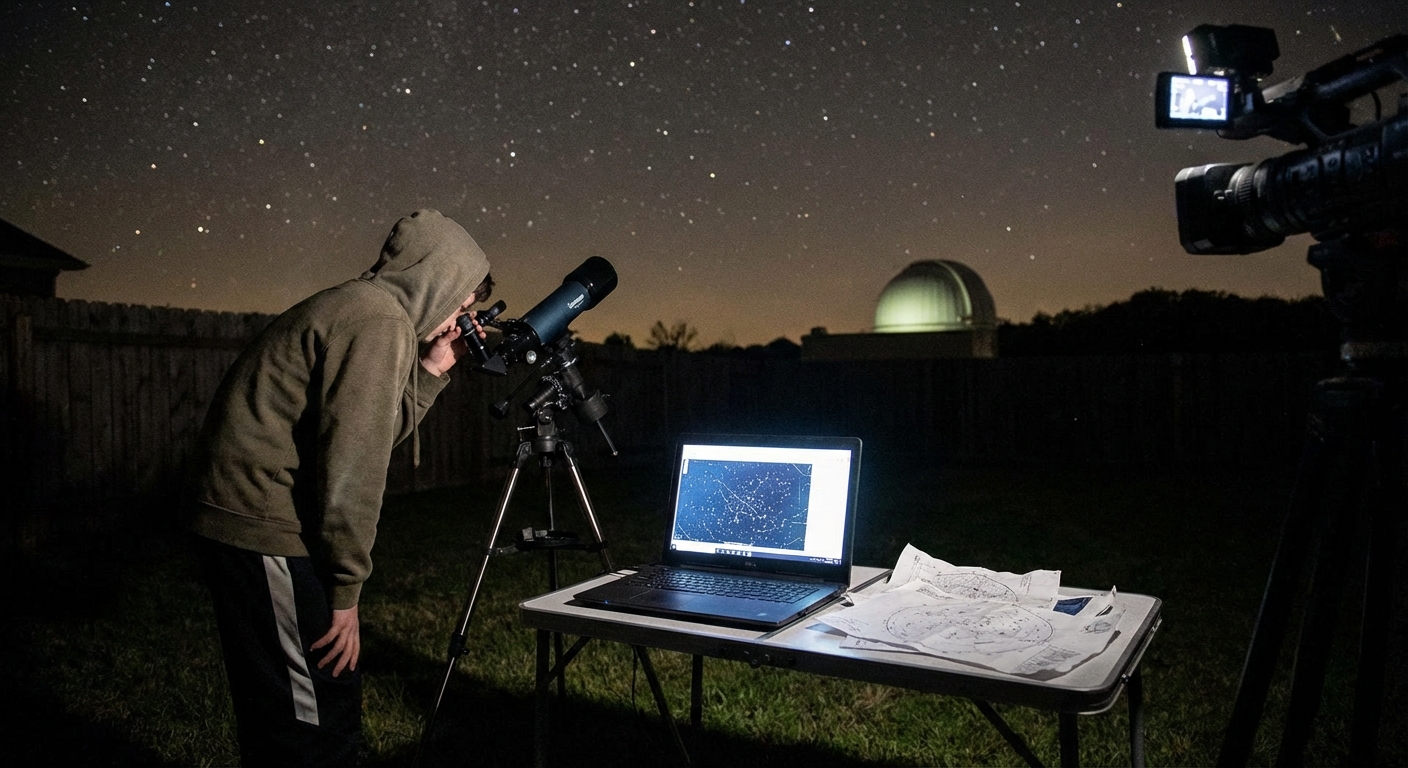
It’s easy to assume that meaningful astronomical discoveries now belong exclusively to billion-dollar observatories and sprawling data centers. Yet amateurs continue to make genuine contributions—from discovering comets to monitoring exoplanet transits and supernovae.
Amateur Astronomy in the Age of Big Science
The key is not owning the largest telescope, but working strategically: choosing projects where your equipment and persistence match real scientific needs.
Here are 12 expert-level, but accessible, ways to turn your hobby into data that professionals can use.
1. Specialize Instead of Sampling Everything
Professionals rarely dabble; they focus. You can benefit from the same mindset.
Choose a niche that matches your equipment, location, and interests, such as:
- Variable star photometry
- Exoplanet transit timing
- Near-Earth asteroid astrometry
- Lunar and planetary imaging
- Supernova hunting and follow-up
Focusing allows you to:
- Learn relevant software and calibration techniques in depth.
- Build a long-term dataset, which is often more valuable than a few isolated, pretty images.
2. Learn Photometry and Astrometry Basics
Two of the most scientifically useful measurements amateurs can provide are:
- Photometry: measuring how bright an object is (and how it changes over time).
- Astrometry: measuring an object’s precise position on the sky.
To get started:
- Use software like AstroImageJ, MaxIm DL, or Tycho Tracker.
- Calibrate your images with bias, dark, and flat-field frames.
- Learn to use comparison stars from standard catalogs (e.g., AAVSO sequences) for photometry.
Good photometry can refine exoplanet transit parameters; good astrometry helps track asteroids and comets.
3. Join Established Networks and Databases
Your data becomes far more valuable when plugged into organized efforts. Consider:
- AAVSO (American Association of Variable Star Observers): contribute light curves of variable stars, novae, and exoplanets.
- Minor Planet Center (MPC): submit asteroid and comet astrometry.
- Exoplanet Transit Databases like ETD: upload transit timing measurements.
These organizations provide standards, software recommendations, and feedback on data quality. Many professional papers acknowledge and use these contributions.
4. Exploit the Power of Time and Persistence
Big observatories are oversubscribed; they can’t stare at the same object night after night for months. You can.
Ideal amateur projects leverage this advantage:
- Long-term monitoring of variable stars to detect period changes or unexpected behavior.
- Transit timing variations (TTVs) in exoplanet systems—small shifts in transit times that can hint at additional planets.
- Supernova light curves following a discovery, tracing how brightness evolves.
In time-domain astronomy, a modest telescope used consistently can outperform a giant instrument used sporadically.
5. Calibrate Like a Professional
Astronomical images are data, not just pictures. To make them scientifically useful:
- Always capture bias frames (zero-second exposures), dark frames (same exposure as lights, with the shutter closed), and flat fields (uniformly illuminated frames).
- Maintain a consistent calibration library and document your procedures.
- Keep detailed logs of exposure times, filters, equipment, and conditions.
This discipline reduces systematic errors and makes your data comparable across nights—and with others’ work.
6. Use Standard Filters When Possible
Professional photometry relies on standard passbands (e.g., Johnson–Cousins BVRI, Sloan ugriz). If your budget allows:
- Invest in at least one or two standard filters, often starting with V or Rc.
- Calibrate against known standard stars in the field when possible.
Standardized filters make your measurements compatible with professional datasets, enabling them to be folded into long-term studies.
7. Coordinate in Real Time for Transients
Transient events—supernovae, novae, gamma-ray burst afterglows—often require rapid follow-up, especially in the first hours to days.
Tap into alert networks:
- Astronomer’s Telegram and Gamma-ray Coordinates Network (GCN) for rapid notices.
- Social media and dedicated Discord/Slack channels for amateur–professional coordination.
Be ready with:
- A prioritized target list.
- Scripts or sequences in your capture software for rapid deployment.
- A clear reporting format for photometric or astrometric results.
Even a few well-timed data points can fill critical gaps in early light curves.
8. Turn Planetary Images into Science
Planetary imaging is often seen as purely aesthetic, but high-resolution images of Mars, Jupiter, and Saturn can be scientifically useful.
Tips:
- Use lucky imaging: record high-frame-rate video and stack the best frames to overcome atmospheric turbulence.
- Align with standardized coordinate systems (e.g., System II longitudes for Jupiter).
- Submit notable features (storms, impacts, dust activity) to networks like the Planetary Virtual Observatory & Laboratory or professional-aligned campaigns.
Amateur images have, for example, captured impact flashes on Jupiter and tracked evolving storms that professionals later analyzed in detail.
9. Mine Public Survey Data
You don’t always need to collect photons yourself. Professional surveys like Pan-STARRS, ZTF, and soon Rubin LSST release enormous datasets.
With basic coding or database skills, you can:
- Search for overlooked transient events.
- Conduct statistical studies of asteroid light curves.
- Identify unusual variable stars or galaxy morphologies.
Pairing your own follow-up observations with survey data is particularly powerful.
10. Embrace Modern Tools: Python, Jupyter, and APIs
Professional astronomers increasingly rely on Python, Jupyter notebooks, and virtual observatories.
As an advanced amateur, you can:
- Use Astropy, Photutils, and other libraries for data reduction.
- Access online catalogs (Gaia, SDSS, Pan-STARRS) via APIs.
- Cross-match your targets with professional datasets.
The learning curve is real, but the payoff is immense: you gain the same analytic toolkit used in cutting-edge research.
11. Collaborate and Communicate Clearly
Science advances when results are shared clearly and reproducibly.
- Join local astronomy clubs or online communities focused on scientific observing.
- Participate in campaigns organized by professionals—for eclipsing binaries, exoplanets, or specific variable stars.
- When contributing data, provide full metadata: equipment details, calibration methods, and uncertainties.
Well-documented amateur data often finds its way into professional publications, with amateurs listed as co-authors or acknowledged contributors.
12. Stay Aligned with Current Science Questions
Finally, keep your efforts aligned with what professionals actually care about right now.
Stay updated by:
- Following preprint servers like arXiv (especially astro-ph section) for accessible abstracts.
- Reading observatory press releases with an eye for ongoing monitoring needs.
- Attending online colloquia and outreach talks where scientists outline open problems.
For instance:
- The discovery of unusual exoplanet atmospheres motivates better transit timing to refine system parameters.
- The debate over the Hubble constant tension benefits from more precise distance indicators and supernova light curves.
By tuning your projects to these live questions, you maximize the scientific value of your nights under the stars.
Your Backyard as an Outpost of the Global Observatory
Modern astronomy is a layered enterprise: flagship telescopes, survey projects, theoretical modeling, and—quietly but importantly—amateur observers filling crucial gaps in coverage, time sampling, and sky area.
With a modest telescope, disciplined technique, and a willingness to learn modern tools, you can transform backyard astronomy into genuine participation in the science of the universe.
The cosmos is too vast, variable, and intricate for professionals to monitor alone. There is room—and need—for dedicated enthusiasts who are ready to treat their telescopes not just as windows to beauty, but as instruments of discovery.