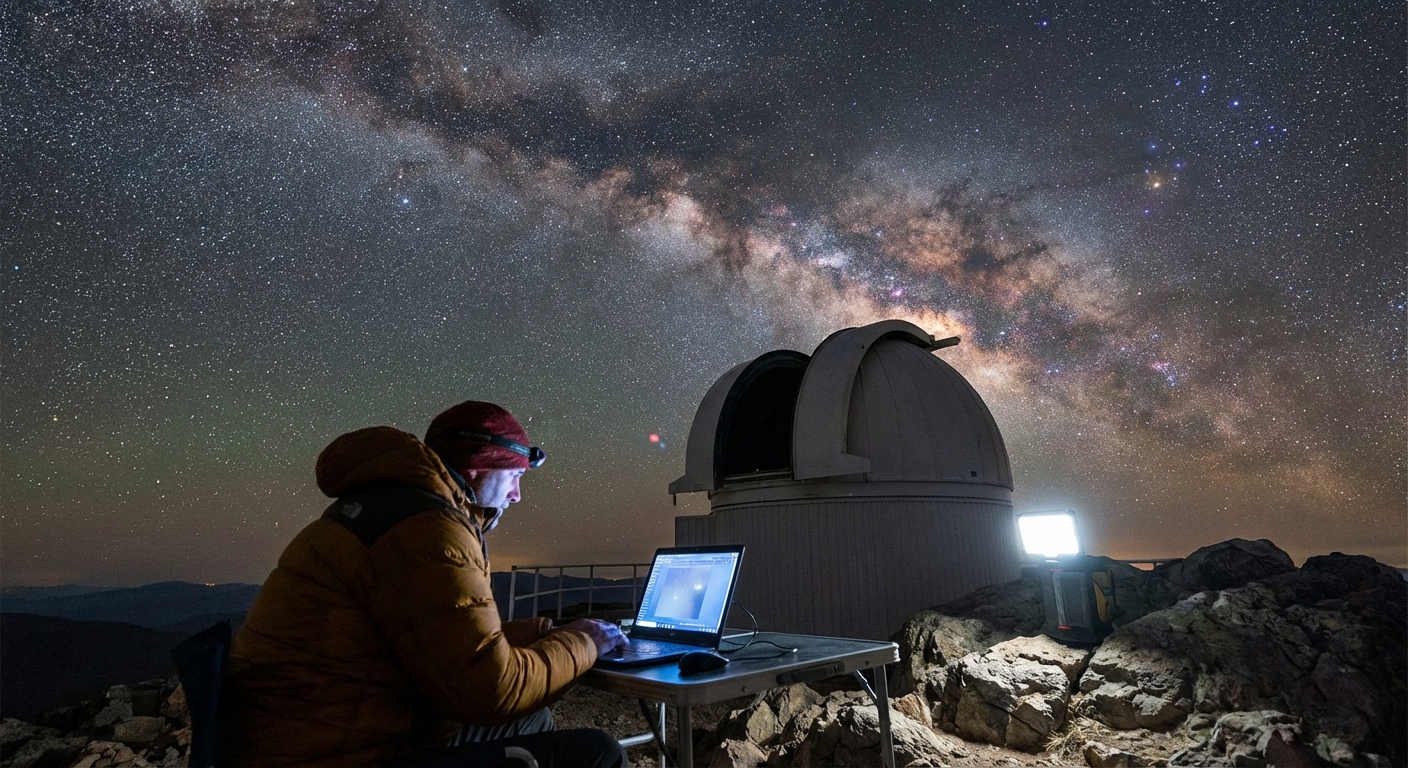
Some astronomical breakthroughs arrive with fanfare—first black hole image, first exoplanet. Others happen quietly in the background, embedded in spectra, sky surveys, and patient measurements of faint smudges. Many of those quieter revolutions come from deep-sky astronomy.
The Silent Revolutions Above Our Heads
Here are ten deep-sky discoveries that reshaped our understanding of the cosmos, often without the headline credit they deserved.
1. Cepheid Variables in Andromeda: The Universe Gets Bigger
When: 1920s
Key object: Cepheid variable stars in the Andromeda Galaxy (M31)
What happened:
- Edwin Hubble used Henrietta Leavitt’s period–luminosity relation for Cepheids to measure Andromeda’s distance.
- He found it lay far beyond the Milky Way.
Why it matters:
- Turned spiral "nebulae" into galaxies.
- Expanded the universe from a single-system view to a cosmos of island universes.
Ever since, Cepheids and other standard candles in deep-sky galaxies have underpinned our cosmic distance ladder.
2. Galaxy Redshifts: The Expanding Universe Emerges
When: Late 1920s
Key objects: Receding galaxies across the deep sky
What happened:
- Vesto Slipher and others measured redshifts in galaxy spectra—systematic shifts of absorption and emission lines to longer wavelengths.
- Hubble correlated those redshifts with his distance measurements.
Why it matters:
- Revealed that space itself is expanding.
- Laid the observational foundation for the Big Bang model.
Deep-sky galaxies thus became the markers of cosmic expansion, defining the scale factor of the universe.
3. The Virgo Cluster: Dark Matter Steps into the Light
When: 1930s–1970s
Key objects: Galaxies in the Virgo Cluster and other clusters
What happened:
- Fritz Zwicky studied galaxy velocities in the Coma Cluster and found they moved too fast to be bound by the visible mass.
- Decades later, Vera Rubin measured galaxy rotation curves, confirming similar discrepancies in individual galaxies.
Why it matters:
- Introduced the concept of dark matter—non-luminous mass dominating gravitational dynamics.
- Deep-sky structures like clusters and spiral galaxies became gravitational laboratories for this unseen component.
Today, galaxy clusters and their gravitational lensing patterns remain among the best probes of dark matter distribution.
4. H II Regions and the Birth of Stars
When: Mid-20th century onward
Key objects: Emission nebulae such as Orion (M42), Carina, and NGC 3603
What happened:
- Spectroscopic studies of bright emission nebulae revealed they are ionized hydrogen regions, lit by newly formed massive stars.
- Radio observations of molecular lines (like CO) mapped cold gas feeding these regions.
Why it matters:
- Established that stars form in giant molecular clouds, not in isolation.
- Framed nebulae as part of a galactic ecosystem—sites of ongoing stellar birth shaping galaxy evolution.
With modern instruments, deep-sky star-forming regions now reveal protoplanetary disks, jets, and early stellar clusters in stunning detail.
5. Planetary Nebulae: The Fate of Sun-Like Stars
When: 19th–20th centuries; physical understanding solidified in mid-1900s
Key objects: Ring Nebula (M57), Dumbbell Nebula (M27), Helix Nebula
What happened:
- These small, bright nebulae were recognized as shells of gas ejected by dying intermediate-mass stars.
- The central stars were identified as white dwarfs, the compact remnants of Sun-like stars.
Why it matters:
- Completed a missing chapter in stellar evolution: the endgame for stars that don’t explode as supernovae.
- Showed how such stars enrich the interstellar medium with carbon, nitrogen, and other life-related elements.
Deep-sky planetary nebulae thus trace the chemical recycling that makes rocky planets and biology possible.
6. Supernova Remnants: Cosmic-Ray Forges
When: 20th century onward
Key objects: Crab Nebula (M1), Tycho’s SNR, Cassiopeia A, the Veil Nebula
What happened:
- X-ray and radio observations of supernova remnants revealed shock fronts and non-thermal emission.
- The Crab Nebula showed a pulsar driving a relativistic wind.
Why it matters:
- Identified supernova remnants as major accelerators of galactic cosmic rays.
- Connected core-collapse supernovae to neutron stars and pulsars.
These deep-sky remnants turned from historical curiosities into laboratories for high-energy astrophysics and particle acceleration.
7. Quasars and Active Galactic Nuclei: Black Holes Go Mainstream
When: 1960s–1980s
Key objects: Quasars (e.g., 3C 273), Seyfert galaxies, radio galaxies like M87
What happened:
- Extremely luminous, distant point-like sources (quasars) were identified with galactic nuclei hosting supermassive black holes.
- Spectra showed enormous redshifts and high-velocity gas near the cores.
Why it matters:
- Demonstrated that supermassive black holes are not exotic rarities but common engine rooms of galaxies.
- Linked deep-sky active galactic nuclei (AGN) to feedback processes that regulate star formation and galaxy growth.
The Event Horizon Telescope’s image of M87* is the recent, iconic culmination of decades of deep-sky AGN work.
8. Gravitational Lensing: Nature’s Cosmic Telescope
When: 1979 onward
Key objects: Gravitationally lensed quasars and galaxies (e.g., "Einstein Cross," cluster lenses like Abell 1689)
What happened:
- Observations of multiple quasar images and distorted galaxy arcs around massive clusters confirmed gravitational lensing predicted by general relativity.
Why it matters:
- Turned galaxy clusters into tools for mapping dark matter.
- Enabled the detection and magnification of extremely distant galaxies, extending our reach into the early universe.
JWST’s deep imaging of lensing clusters now reveals lensed galaxies at redshifts >10, probing the first few hundred million years after the Big Bang.
9. Type Ia Supernovae in Distant Galaxies: Dark Energy Revealed
When: Late 1990s
Key objects: Type Ia supernovae in remote galaxies
What happened:
- Two independent teams (Supernova Cosmology Project, High-Z Supernova Search Team) used Type Ia supernovae as standardizable candles.
- They found that distant supernovae were dimmer than expected, implying that cosmic expansion is accelerating.
Why it matters:
- Introduced dark energy, a dominant, mysterious component driving cosmic acceleration.
- Reshaped cosmology into the current ΛCDM framework.
These supernovae, tiny points in deep-sky galaxies, provided one of the most profound surprises in modern science.
10. Ultra-Deep Fields: The Universe in a Grain of Sky
When: 1990s–2020s
Key surveys: Hubble Deep Field, Hubble Ultra Deep Field, Hubble eXtreme Deep Field, JWST Deep Fields
What happened:
- Telescopes stared for hundreds of hours at seemingly empty patches of sky.
- The resulting images revealed thousands of galaxies in a speck of sky smaller than a grain of sand held at arm’s length.
Why it matters:
- Showed that the deep sky is crowded with galaxies in all directions.
- Allowed statistical studies of galaxy evolution across cosmic time.
- Recently, JWST’s deep fields have challenged assumptions by revealing surprisingly massive early galaxies.
These ultra-deep surveys are time machines in image form, letting us watch the emergence of structure across billions of years.
The Quiet Power of the Faint and Far
Not all scientific revolutions arrive with fireworks. Many come as updated plots, discrepant data points, or an unexpected feature in a spectrum. Deep-sky astronomy has been a consistent source of such quiet upheavals.
From dark matter to dark energy, from stellar life cycles to cosmic reionization, the faint galaxies and nebulous glows beyond our Solar System have guided us toward a far stranger and richer universe than our ancestors imagined.
The next quiet revolution may already be buried in a deep survey catalog, waiting for someone—maybe an early-career researcher, maybe a dedicated amateur collaborating in a citizen science project—to notice that something in the deep sky doesn’t quite fit the script.